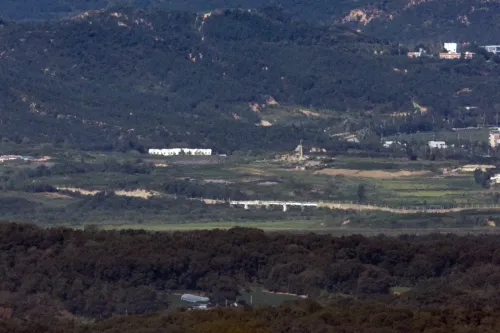
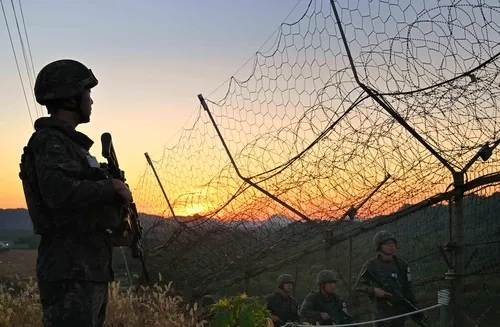
North Korea buried DMZ land mine, South Korean defence chief confirms

Synopsis
South Korea's defence minister has confirmed what Seoul long suspected: the North Korean mine found near the DMZ blast site was deliberately buried, not flood-swept. With at least four mines now believed planted, two soldiers severely wounded, and the armistice openly violated, this is the most serious border incident on the Korean Peninsula in nearly a decade.
Key Takeaways
Defence Minister Kang Shin-chul confirmed on 29 September that the North Korean mine near the DMZ blast site was deliberately buried , not washed away.
The original explosion occurred on 21 September , south of the Military Demarcation Line , injuring three South Korean soldiers , two severely.
At least four mines are believed to have been placed at or near the blast site, positioned 1-2 metres apart .
The Joint Chiefs of Staff assessed North Korean land mines were 'highly likely' the cause, following a joint inspection with the United Nations Command .
Minister Kang called the incident a clear violation of the armistice agreement and pledged 'corresponding measures' in coordination with the UNC and international community.
South Korean Defence Minister Kang Shin-chul confirmed on Tuesday, 29 September that a North Korean resin antipersonnel mine recovered near the site of last week's explosion inside the Demilitarised Zone (DMZ) was deliberately buried by North Korean forces — not one that had been washed away by flooding. The disclosure significantly escalates tensions on the Korean Peninsula and points to a calculated breach of the 1950-53 Korean War armistice.
What the Mine Discovery Revealed
South Korean military personnel recovered the North Korean resin antipersonnel mine on Tuesday, located near the site of the 21 September blast that occurred south of the Military Demarcation Line (MDL) dividing the two Koreas. The explosion left three South Korean soldiers injured, two of them with severe wounds.
Minister Kang stated that the mine was buried, responding directly to a query by Representative Yu Yong-weon of the main opposition party, who had asked whether the device was planted or flood-displaced. Kang's one-word answer — 'Buried' — left little ambiguity about Pyongyang's role.
Scale of the Threat: At Least Four Mines Placed
Earlier on Tuesday, Kang told lawmakers that at least four mines were believed to have been placed at or near the DMZ explosion site. He noted that multiple mines had been spotted positioned 1-2 metres apart from each other, making the possibility that they were swept in by water 'very low,' according to his assessment.
The military had previously stated that three mines in total were believed to have been buried at the blast site — including the two that detonated — based on accounts from soldiers who reported spotting an unexploded device as they retreated from the area.
Joint Inspection and Armistice Violation
The explosion itself occurred during an operation to clear a path for a joint inspection between South Korea's military and the United Nations Command (UNC). The inspection was intended to verify Seoul's suspicions that Pyongyang had illegally buried mines across the border in violation of the armistice agreement. Following a joint site inspection on Monday, the Joint Chiefs of Staff (JCS) assessed that North Korean land mines were 'highly likely' the cause of the blast.
When asked directly whether he was certain that last week's explosion was caused by North Korea-planted mines, Kang replied: 'Yes.' He also agreed with a lawmaker's characterisation that the incident constituted a violation of the armistice, adding: 'It is clearly a violation of the armistice agreement, and the responsibility lies with North Korea, so we will take corresponding measures.'
Seoul's Response and Next Steps
Kang pledged to work with the UNC and the international community to hold those responsible to account, though he did not elaborate on the specific 'corresponding measures' Seoul intends to pursue. His remarks are tied to what he described as Pyongyang's border reinforcement work — a pattern of activity that analysts say has intensified along the DMZ in recent months.
This is not the first time North Korea has been accused of placing mines near the MDL; a 2015 incident in which South Korean soldiers lost limbs to a landmine blast in the DMZ triggered a major diplomatic standoff. The latest episode, with confirmed soldier casualties and a defence minister's direct attribution, is likely to draw a sharper international response. How Seoul and the UNC calibrate their next move will set the tone for inter-Korean relations in the months ahead.
Point of View
A joint UNC-South Korean inspection and physical mine recovery have closed that exit. What is striking is the operational logic: mines placed 1-2 metres apart, during an active joint inspection to verify exactly this kind of activity, suggest either deliberate provocation or a stunning miscalculation of detection risk. Seoul's pledge of 'corresponding measures' is carefully vague — but with the UNC now co-invested in the findings, the response will carry multilateral weight that 2015's bilateral standoff did not.
NationPress
29 Sept 2026
Frequently Asked Questions
What happened at the DMZ explosion site on 21 September?
A blast inside the Demilitarised Zone on 21 September injured three South Korean soldiers, two of them severely. The explosion occurred during an operation to clear a path for a joint military inspection aimed at verifying whether North Korea had buried mines near the border.
Did North Korea deliberately plant the mines near the DMZ?
South Korean Defence Minister Kang Shin-chul confirmed on 29 September that the mine recovered near the blast site was buried — not washed away by flooding. He said the mine is presumed to be linked to North Korea's border reinforcement work, and stated 'yes' when asked if he was certain the explosion was caused by North Korea-planted mines.
How many mines are believed to have been placed at the DMZ site?
At least four mines are believed to have been placed at or near the explosion site, according to Minister Kang. The military previously assessed that three mines were buried at the blast site itself, including the two that detonated.
Does this incident violate the Korean War armistice?
Yes, according to Minister Kang, who explicitly agreed with a lawmaker's characterisation that the incident constitutes a violation of the 1950-53 Korean War armistice agreement. He stated that responsibility lies with North Korea and pledged corresponding measures.
What action is South Korea planning in response?
Minister Kang pledged to cooperate with the United Nations Command and the international community to hold those responsible to account. He did not specify the exact nature of the 'corresponding measures' Seoul intends to take, saying only that they would be pursued once the mine cause is fully confirmed.