Panmunjom axe murder at 50: South Korea, UNC honour 1976 US soldier killings
Synopsis
Fifty years after North Korean soldiers bludgeoned two US officers to death over a poplar tree in the DMZ, South Korea and the UNC gathered at the very site to honour their memory — a ceremony that underscores how a single act of violence in 1976 hardened one of Asia's most consequential military alliances and nearly triggered a second Korean War.
Key Takeaways
South Korea and the UNC held a memorial on 18 August 2025 marking the 50th anniversary of the Panmunjom axe murder incident .
Arthur Bonifas and 1st Lt.
Mark Barrett were killed by North Korean soldiers on 18 August 1976 inside the Joint Security Area (JSA) .
Some 130 military personnel and family members of the two slain officers attended the ceremony.
The attack was ordered by Senior Lt.
Pak Chol after Bonifas refused to halt the trimming of a poplar tree claimed to have been planted by Kim Il-sung .
Operation Paul Bunyan , a major US-South Korea show of force, felled the tree three days after the killings.
The incident prompted a rare statement of regret from North Korea and pushed the US to the brink of war with the North.
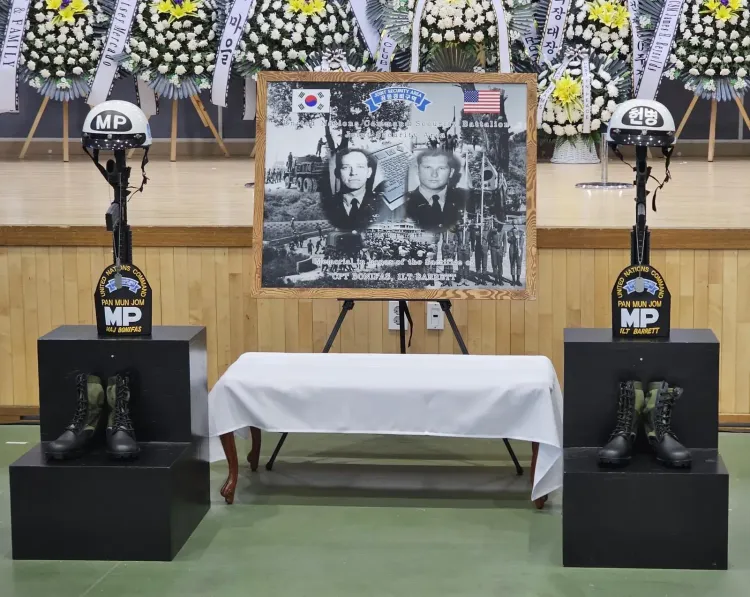
South Korea and the US-led United Nations Command (UNC) on Tuesday, 18 August 2025, marked the 50th anniversary of the Panmunjom axe murder incident, reaffirming the durability of the South Korea-US alliance at a memorial ceremony attended by family members of the two slain American officers — Major Arthur Bonifas and First Lieutenant Mark Barrett.
A Ceremony Five Decades in the Making
Some 130 military personnel from South Korea, US forces, and the UNC gathered at the memorial site inside the Joint Security Area (JSA) of the Demilitarised Zone (DMZ). Family members, including Barrett's niece Stacey Adams and Bonifas's two daughters — who were eight and six years old when their father was killed — joined the proceedings.
UNC Deputy Commander Lt. Gen. Scott Winter delivered a tribute on behalf of UNC Commander Gen. Xavier Brunson, who was unable to attend due to scheduling matters. 'We know that half a century does not erase the pain of a profound loss,' Winter said. 'But please know that this command and this alliance hold your families in the highest reverence.'
What Happened on 18 August 1976
On 18 August 1976, five South Korean civilian service workers entered the JSA to trim a poplar tree that had obstructed the sightlines of UNC soldiers. Bonifas and Barrett accompanied the crew, along with South Korean military personnel.
A contingent of North Korean soldiers, led by Senior Lt. Pak Chol, arrived and demanded the trimming stop, claiming that North Korean leader Kim Il-sung had planted the tree. When Bonifas disregarded the demand and allowed work to continue, the North Koreans returned in greater numbers armed with clubs and crowbars. Pak ordered his men to kill the Americans.
Both officers were bludgeoned to death using axes and knives left behind by the fleeing tree-trimming crew. Four other US soldiers and four South Korean soldiers were injured in the attack.
Aftermath and Operation Paul Bunyan
The incident pushed the United States to the brink of war with North Korea — barely two decades after the 1950–53 Korean War armistice. It prompted then-North Korean leader Kim Il-sung to issue a rare statement of regret.
Three days later, the United States and South Korea launched Operation Paul Bunyan, a massive display of combined military force, during which the contested poplar tree was finally felled. A memorial marker was subsequently placed at the site. Bonifas was posthumously promoted to major.
What the Alliance Said
Describing the killings as an 'unprovoked, brutal and deliberate act of violence,' Winter stressed that peace is not a 'natural state' but a 'fragile condition that must be guarded and fought for.' He added: 'Their sacrifice galvanised an unshakable resolve between the Republic of Korea and the United States.'
Beth Bonifas, the major's younger daughter, spoke of her father as 'a man of quiet strength, extraordinary patience, unwavering devotion to his family and a deep sense of duty to something greater than himself.'
At the Memorial Site
After the formal ceremony, participants moved to the spot where the poplar tree once stood — now marked by a historic stone — and laid flowers in tribute. JSA service members stood in formation beside the tree stump as guards bearing the flags of the UNC, JSA, South Korea, and the United States flanked the memorial stone. The site sits adjacent to the Bridge of No Return, a Cold War landmark inside the JSA and an enduring symbol of the divided Korean Peninsula.
Point of View
Yet it rarely receives the analytical weight it deserves. The incident reveals a pattern that persists today: North Korea tests alliance resolve through calibrated violence, then retreats with a minimal gesture — Kim Il-sung's 'regret' statement being a textbook example. Operation Paul Bunyan was not merely tree-felling; it was a demonstration that the US would mobilise B-52s and an aircraft carrier over a poplar. Five decades on, as the Korean Peninsula remains technically at war, the ceremony is a reminder that the alliance's emotional foundation is built as much on blood as on treaty text — and that Pyongyang has never fully forgotten what that show of force signalled.
NationPress
18 Aug 2026
Frequently Asked Questions
What was the Panmunjom axe murder incident of 1976?
On 18 August 1976, North Korean soldiers attacked and killed two US Army officers — Maj. Arthur Bonifas and 1st Lt. Mark Barrett — inside the Joint Security Area of the DMZ, using axes and knives left behind by a tree-trimming crew. The attack was ordered after the Americans refused to halt the pruning of a poplar tree that North Korea claimed had been planted by Kim Il-sung.
Why is the 2025 memorial significant?
The ceremony marks the 50th anniversary of the killings and was attended by family members of both slain officers, along with 130 military personnel from South Korea, the US, and the UNC. It reaffirms the South Korea-US alliance at a time of continued tensions on the Korean Peninsula.
What was Operation Paul Bunyan?
Operation Paul Bunyan was a large-scale US and South Korean military operation launched three days after the axe murders, on 21 August 1976, to fell the disputed poplar tree. It involved a massive show of force, including B-52 bombers and an aircraft carrier, and is seen as one of the most significant military demonstrations in the DMZ's history.
How did North Korea respond to the 1976 axe attack?
North Korean leader Kim Il-sung issued a rare statement of regret following the incident — an unusual step for Pyongyang. The attack had pushed the United States to the brink of war with North Korea, just over two decades after the 1950–53 Korean War armistice.
Who attended the 50th anniversary memorial ceremony?
The ceremony was attended by approximately 130 military personnel from South Korea, US forces, and the UNC, as well as family members of the two fallen soldiers, including Barrett's niece Stacey Adams and Bonifas's two daughters. UNC Deputy Commander Lt. Gen. Scott Winter delivered the tribute address on behalf of UNC Commander Gen. Xavier Brunson.