CM Conrad Sangma condemns killing of six Naga civilians
Synopsis
Meghalaya Chief Minister and NPP national president Conrad Sangma strongly condemned the killing of six Naga civilians on June 10, 2026, calling it a senseless act that undermined the United Naga Council's goodwill peace efforts. He urged restraint and justice for the victims.
Key Takeaways
Six Naga civilians were killed in an incident that Meghalaya CM Conrad Sangma described as brutal and wholly unacceptable.
The killings occurred despite active goodwill efforts by the United Naga Council (UNC) to foster dialogue and reconciliation.
Sangma, also national president of the National People's Party , extended condolences to bereaved families and stood in solidarity with affected communities.
He called on all parties to exercise restraint and ensure the perpetrators are brought to justice .
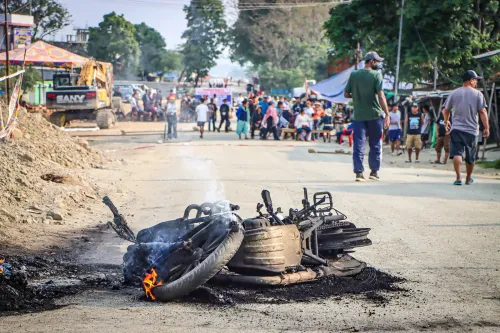
The incident deepens concerns about civilian safety amid ongoing ethnic tensions in Manipur that have persisted since May 2023 .
Attention now turns to a potential formal inquiry by Manipur authorities or the Ministry of Home Affairs and possible UNC-government talks.
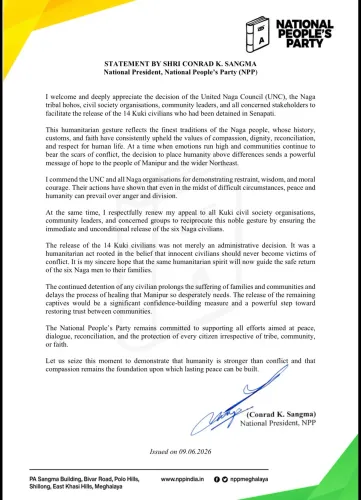
Meghalaya Chief Minister Conrad Sangma on Wednesday, June 10, 2026, issued a strong condemnation of the killing of six Naga civilians, calling the act 'brutal' and 'wholly unacceptable' while extending condolences to the bereaved families and urging all parties to exercise restraint.
Context
Sangma, who also serves as national president of the National People's Party (NPP), said the tragedy was made 'even more heartbreaking' because it occurred despite goodwill and sincere efforts by the United Naga Council (UNC) to create an atmosphere conducive to dialogue and reconciliation. The UNC is the apex body of Naga tribes in Manipur and has been a key channel for community-mediated peace efforts in the region.
In his post, Sangma wrote: 'A gesture intended to build trust and foster understanding has instead been met with violence, resulting in the loss of innocent lives and immense suffering for their families and communities.'
Policy Backdrop
The killing comes against the backdrop of prolonged ethnic conflict in Manipur, where tensions among Meitei, Kuki-Zo, and Naga communities have produced repeated civilian casualties since May 2023. The UNC has previously organised district-level peace initiatives and bandhs to shield Naga-inhabited areas from the spillover of these clashes.
At the broader level, the 2015 Framework Agreement between the Government of India and the NSCN-IM established a formal track for a negotiated settlement of the Naga political issue, though a final accord has remained elusive. Civilian casualties during UNC-facilitated peace windows undermine confidence in these negotiated channels and risk hardening positions on all sides.
Stakeholders and Impact
The six victims' families and the wider Naga community in Manipur bear the immediate human cost of the incident. The UNC's credibility as a peace facilitator is also at stake: its outreach was explicitly cited by Sangma as a goodwill gesture that preceded the attack, raising questions about the security environment in which community-led dialogue is expected to operate.
Regional chief ministers from non-Congress, non-BJP parties in the Northeast have consistently issued parallel calls for restraint whenever civilian deaths occur in Manipur's ongoing conflict, reflecting both the limits of existing security arrangements and the continued relevance of community dialogue channels. Sangma's statement fits within this pattern while also carrying weight given his national party leadership role.
What's Next
Sangma called on 'all concerned to exercise restraint and ensure that those responsible are brought to justice,' emphasising that 'lasting peace can only be built through mutual respect, dialogue, and a commitment to resolving differences through peaceful means rather than violence.' Attention will now turn to whether Manipur state authorities or the Ministry of Home Affairs order a formal inquiry into the incident, and whether UNC-government talks on confidence-building measures are convened in the aftermath. The episode underscores that civilian protection must be a non-negotiable condition for any credible peace process in the region.
Point of View
He frames the violence as a deliberate assault on the dialogue process itself, raising the diplomatic stakes beyond a routine condemnation. As NPP national president, his voice carries weight across the Northeast's multi-party landscape, and his call for justice implicitly pressures both Manipur's state government and the Centre to act visibly. The statement also reflects a broader pattern among non-Congress, non-BJP northeastern leaders of positioning themselves as credible peace brokers when Delhi's security architecture is seen to have failed. If no formal accountability follows, the episode risks further eroding community trust in negotiated frameworks such as the 2015 NSCN-IM accord.
NationPress
16 Sept 2026
Frequently Asked Questions
Who are the six Naga civilians killed that Conrad Sangma condemned?
The six victims are Naga civilians whose killing was condemned by Meghalaya Chief Minister Conrad Sangma on June 10, 2026. The specific identities and exact circumstances of the incident have not been officially confirmed at the time of his statement.
What is the United Naga Council (UNC)?
The United Naga Council is the apex body of Naga tribes in Manipur. It coordinates political and peace-related positions across Naga-inhabited areas and has led district-level peace initiatives to shield Naga communities from the spillover of Manipur's ethnic conflict.
Why is Conrad Sangma speaking about Manipur when he is Meghalaya's Chief Minister?
Conrad Sangma is not only Meghalaya's Chief Minister but also the national president of the National People's Party, a regional party with influence across Northeast India. Leaders from the region routinely speak on Manipur's ethnic conflict given its cross-border humanitarian and political implications.
What is the 2015 Framework Agreement related to the Naga issue?
The 2015 Framework Agreement was signed between the Government of India and the NSCN-IM to establish a formal negotiated track for resolving the longstanding Naga political issue, which involves demands for autonomy and territorial recognition across Nagaland, Manipur, and other northeastern states.
What action has Conrad Sangma demanded after the Naga civilian killings?
Sangma urged all concerned parties to exercise restraint and ensure that those responsible for the killings are brought to justice. He also called for lasting peace to be pursued through mutual respect and dialogue rather than violence.