Is South Korea's Ruling Party Igniting Controversy with a New Broadcasting Bill?

Synopsis
In a bold move, South Korea's ruling Democratic Party has proposed a controversial broadcasting bill to diminish governmental influence over public broadcasters. In response, the opposition People Power Party has initiated a filibuster, setting the stage for a dramatic parliamentary showdown. How will this political battle unfold and impact media governance?
Key Takeaways
Democratic Party of South Korea proposes a controversial broadcasting bill.
People Power Party responds with a filibuster.
The amendment aims to reduce government control over public broadcasters.
Only one bill may realistically pass before the session ends.
Filibuster can be stopped with a majority agreement.
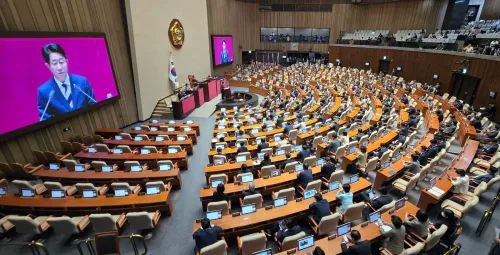
Seoul, Aug 4 (NationPress) The ruling Democratic Party (DP) of South Korea introduced a highly debated broadcasting bill on Monday, aiming to lessen the government's control over public broadcasters. This move ignited a filibuster by the main opposition, the People Power Party (PPP), in response.
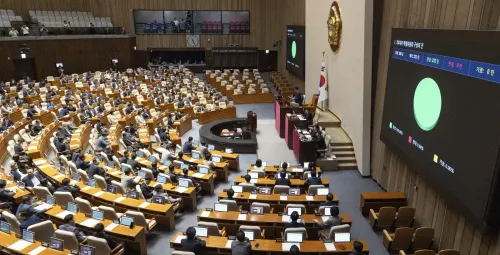
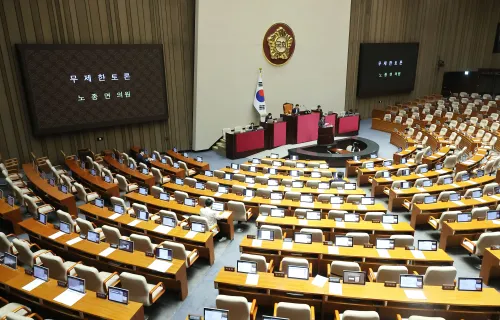
The proposed amendment to the Broadcasting Act is part of three significant broadcasting bills that seek to reform the governance of public broadcast media by minimizing the influence of the government and the National Assembly in appointing board directors. It was presented during a parliamentary plenary session just before the extraordinary session of the Assembly concludes at midnight on Tuesday.
At 4:01 p.m., in opposition, PPP lawmakers initiated a filibuster to obstruct the bill's passage, as reported by Yonhap news agency.
Earlier, DP leader Jung Chung-rae stated that the ruling party, which possesses a majority in the National Assembly, aims to enact the broadcasting bills during this session.
Jung also mentioned that the DP intends to push through other contentious bills opposed by the PPP, including the yellow envelope law designed to expand labor protections and limit companies from seeking damages related to legitimate union activities, as well as proposed revisions to the Commercial Act that aim to enhance protections for minority shareholders.
Earlier in the session, lawmakers voted to prioritize the order of bills, moving the Broadcasting Act ahead of both the Commercial Act and the yellow envelope bill.
A filibuster is a tactic where lawmakers speak for extended periods to delay or prevent a parliamentary vote. According to the National Assembly Act, a filibuster can be terminated after 24 hours if at least three-fifths of parliament members, or 180 lawmakers, agree to it.
Only one bill can realistically be passed before the Assembly's extraordinary session concludes.
Point of View
We remain committed to providing an unbiased perspective on the developments surrounding South Korea's media governance. The ongoing conflict between the ruling party and the opposition reflects larger issues within the political landscape, emphasizing the need for balance in governance and media independence.
NationPress
14 Oct 2026
Frequently Asked Questions
What is the purpose of the proposed broadcasting bill?
The broadcasting bill aims to reduce governmental influence over public broadcasters, facilitating a more independent media landscape.
What is a filibuster?
A filibuster is a parliamentary tactic where lawmakers speak for extended periods to delay or prevent a vote on a bill.
Who leads the ruling Democratic Party?
The ruling Democratic Party is led by Jung Chung-rae.
What other bills are the Democratic Party pushing?
They are also advocating for the 'yellow envelope law' and revisions to the Commercial Act.
How can a filibuster be stopped?
A filibuster can be halted if three-fifths of parliament members, or 180 lawmakers, consent to end it.