Market Decline and Oil Price Surge Following Trump's Iran Address
Synopsis
In a significant market reaction, global stocks dropped while oil prices surged after President Trump's remarks on the ongoing Iran conflict. Concerns about supply disruptions and economic impacts loom large, raising questions about future market stability.
Key Takeaways
Global markets fell after Trump’s remarks about Iran.
Oil prices surged, exceeding $105 per barrel .
Concerns over prolonged conflict are raising inflation worries.
Supply chain disruptions could lead to widespread rationing .
Economists predict a potential economic slowdown.
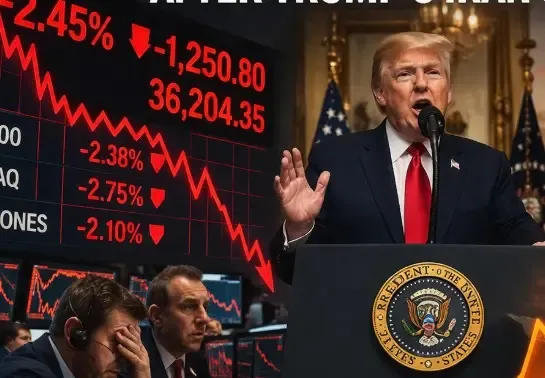
Washington, April 2 (NationPress) Global financial markets experienced a downturn, while oil prices surged following US President Donald Trump's indication that the conflict with Iran will persist for several weeks. This has sparked worries regarding potential supply interruptions and lasting economic repercussions, as reported by various American media outlets.
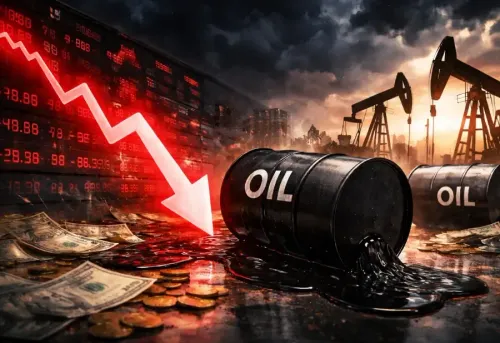
Following Trump's address, US stock futures fell, with S&P 500 futures dipping approximately 0.8 percent, Nasdaq futures declining around 1 percent, and Dow futures plummeting by roughly 350 points, according to reports from The Wall Street Journal, The New York Times, and CNBC.
Asian markets also saw a decline in early trading, with South Korea’s Kospi dropping over 2 percent, and Japan’s Nikkei also falling, reflecting investor apprehension about the future of energy supplies.
In response to Trump's warning that the United States would respond “extremely hard over the next two to three weeks” if no agreement is reached, oil prices skyrocketed.
The global benchmark price increased by more than 3 percent during and following the speech, with Brent crude surpassing $105 per barrel during Asian trading hours.
According to The Wall Street Journal and other sources, investors were seeking indications of de-escalation or a defined exit strategy. Instead, while Trump maintained that the war was nearing its conclusion, he also implied further military action, which added to the uncertainty surrounding the timeline.
Market participants continue to monitor the Strait of Hormuz, a vital corridor for global oil shipments that has faced disruptions amid the ongoing conflict.
Experts have warned that ongoing disturbances in this waterway could tighten global oil supply and maintain elevated price levels.
A report from Oxford Economics highlighted by The New York Times estimated that the war has already caused a 10 percent shortfall between global oil supply and demand, increasing the risk of “widespread rationing” and supply chain interruptions in emerging markets.
Furthermore, rising energy prices are exacerbating inflation concerns, as US gasoline prices have exceeded $4 per gallon, exerting additional pressure on households and businesses.
While Trump acknowledged the increasing fuel costs, he characterized them as temporary, asserting that markets would stabilize once the conflict concludes.
Nevertheless, economists have warned that the repercussions could be more enduring, with some adjusting growth forecasts downward and raising concerns of a slowdown if the conflict continues.
Point of View
The market's immediate response to Trump's speech underscores the intertwining of geopolitical tensions and economic stability. Investors are rightfully anxious as uncertainty looms over supply chains and energy costs, signaling a need for vigilance and strategic planning.
NationPress
24 Sept 2026
Frequently Asked Questions
What triggered the recent market decline?
The market decline was triggered by President Trump's indication that the Iran conflict will continue, raising concerns about supply disruptions and economic fallout.
How did oil prices react to Trump's speech?
Oil prices surged sharply, with the global benchmark rising more than 3 percent, reaching over $105 per barrel during Asian trading.
What are the potential economic implications of the Iran conflict?
The ongoing conflict may lead to supply chain disruptions, heightened inflation due to rising energy costs, and a potential slowdown in economic growth.
What should investors be aware of in light of these developments?
Investors should stay informed about geopolitical tensions and market reactions, as volatility may continue in response to the situation in Iran.
Is there a chance for market stabilization soon?
While Trump suggested that market stabilization could occur once the conflict ends, economists warn that the impact may last longer than anticipated.