Did the US Supreme Court Just Strike Down Trump's Global Tariffs?
Synopsis
In a landmark decision, the US Supreme Court has overturned the majority of President Trump’s tariffs, stating he lacked the necessary authority under a 1977 emergency law. This ruling signifies a substantial restriction on presidential power and could impact global trade relations significantly. Discover the implications of this historic judgment.
Key Takeaways
The US Supreme Court invalidated most of Trump's tariffs.
Trump lacked authority under the 1977 emergency law.
This ruling limits presidential power in economic matters.
Companies may seek refunds for tariffs already paid.
Congress still holds the power to impose tariffs.
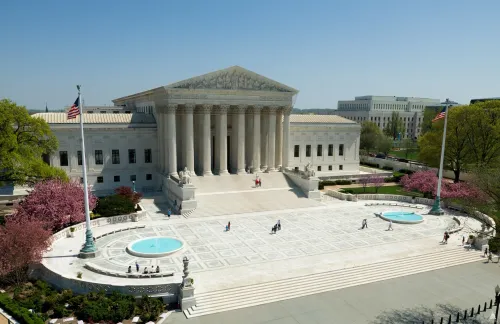
Washington, Feb 20 (NationPress) In a significant blow to President Donald Trump’s economic strategy, the US Supreme Court on Friday invalidated the majority of his extensive tariffs, determining that he did not possess the authority under a 1977 emergency law to impose widespread import duties on America’s global trading partners, including India.
This ruling represents an unusual instance of the conservative-dominated court limiting Trump’s executive power. As reported by Politico, the court delivered a 6-3 verdict against the tariffs, describing it as “a major repudiation of a core piece of Trump’s economic programme.”
Chief Justice John Roberts, who penned the majority opinion, stated: “The President claims the extraordinary ability to unilaterally impose tariffs of unlimited amount, duration, and scope. Given the extensive historical and constitutional context of that claimed authority, he is required to provide clear congressional authorization to exercise it.”
Roberts further noted that the 1977 statute relied upon by Trump “falls short” of the necessary Congressional endorsement.
The Washington Post indicated that the justices ruled the President lacked the authority under the 1977 emergency economic powers law to levy a broad spectrum of import duties on nearly all of the nation’s trading allies.
The Hill remarked that the court “discarded the majority of President Trump’s sweeping tariffs on Friday, dismantling a cornerstone of his economic strategy by ruling that his usage of an emergency statute to reshape global trade was unlawful.”
The justices dismissed Trump’s expanded application of the International Emergency Economic Powers Act (IEEPA), a statute from the 1970s that permits the president to “regulate” imports when necessary to respond to national emergencies posing an “unusual and extraordinary” threat.
“We claim no special expertise in economic or foreign affairs,” Roberts wrote. “We assert only, as we must, the limited role assigned to us by Article III of the Constitution. In fulfilling that role, we conclude that IEEPA does not empower the President to impose tariffs.”
Trump had proclaimed emergencies regarding fentanyl and trade imbalances to justify tariffs on nations like Canada, China, and Mexico, along with imposing what he termed reciprocal tariffs on numerous trading partners worldwide. With respect to India, Trump has enacted an 18 percent tariff.
The Hill highlighted that Trump is the first president in nearly 50 years to attempt to invoke IEEPA for tariff imposition.
Sector-specific tariffs based on different legal authorities, including those on steel, aluminum, and copper, were not challenged and remain intact.
This ruling is anticipated to prompt companies to reclaim billions of dollars in tariffs already disbursed. In anticipation of the ruling, Costco, parts of the Toyota Group, Revlon, and hundreds of other companies had initiated lawsuits to safeguard their claims, according to The Hill.
Despite this ruling being a considerable defeat, options remain for the administration. Congress holds constitutional power to impose tariffs, and the President may seek to justify duties under other existing legislation.
The International Emergency Economic Powers Act was enacted in 1977 to grant presidents the authority to tackle extraordinary foreign threats during national emergencies. Over the years, it has primarily been utilized for sanctions rather than broad tariffs, making this case a crucial test of executive power in trade policy.
Point of View
I believe this Supreme Court ruling is a pivotal moment in the balance of powers within our government. It sends a clear message about the limits of executive authority in economic matters. This decision not only affects the Trump administration but also sets a precedent for future administrations. The implications for international trade and economic policy will be significant and warrant close observation.
NationPress
30 Sept 2026
Frequently Asked Questions
What was the ruling of the Supreme Court regarding Trump's tariffs?
The Supreme Court struck down most of Trump's tariffs, ruling that he lacked the authority under a 1977 emergency law to impose such broad import levies.
What law did Trump use to justify the tariffs?
Trump relied on the International Emergency Economic Powers Act (IEEPA) from 1977 to justify the imposition of tariffs on various countries.
What are the potential consequences of this ruling?
The ruling could lead to companies recovering billions in tariffs already paid and may affect the future authority of the President in trade matters.
Does Congress have the authority to impose tariffs?
Yes, Congress retains the constitutional authority to impose tariffs, which could be a pathway for future tariff actions.
Why is this ruling significant?
This ruling represents a significant limitation on executive power, setting a precedent for how future administrations may approach trade policy.