Thailand, Myanmar agree joint Kok, Sai river water tests
Synopsis
Thailand and Myanmar have agreed their first joint sampling of the Kok and Sai rivers, where Thai tests have found arsenic above safety limits. A one-year plan sets six sampling points in each country, with the first exercise between December 2026 and January 2027 and data to be shared at least twice a year.
Key Takeaways
Thailand and Myanmar agreed in Bangkok to their first joint water-quality sampling of the Kok and Sai rivers.
A one-year plan sets four Kok and two Sai sampling points inside each country; first joint tests are slated for December 2026–January 2027 .
Both sides will exchange monitoring data at least twice a year through designated agencies.
Thailand's Pollution Control Department recorded a Kok River arsenic peak of 0.026 mg per litre in March 2025 — 2.6 times the limit — near the Myanmar border.
Tests from 26–30 October found arsenic above 0.01 mg per litre at one of 10 Kok sites and at all three Sai sites.
Both rivers originate in Myanmar, flow into northern Thailand and join the Mekong system.
Thailand and Myanmar on Wednesday agreed to conduct their first joint water-quality sampling of the Kok and Sai rivers as early as next month, stepping up cooperation on transboundary waterways where Thai authorities have detected arsenic above surface-water safety standards. The understanding was reached at the inaugural meeting of the bilateral Joint Working Group (JWG) on water quality management in boundary and transboundary rivers, held in Bangkok.
Key Developments
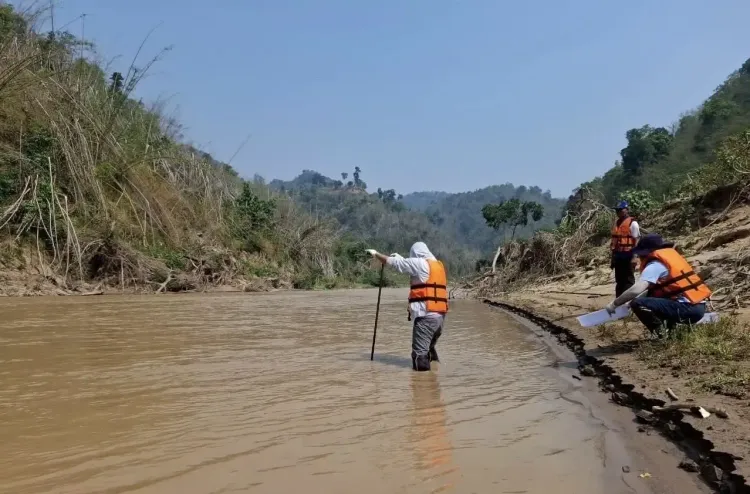
A joint media release said both nations agreed in principle on a one-year work plan creating four sampling points along the Kok River and two along the Sai River within each country's territory. The initial joint sampling exercise is scheduled between December 2026 and January 2027, subject to logistical readiness and bilateral coordination.
Both sides committed to exchange monitoring data through designated agencies at least twice annually. During the talks, delegates also discussed broadening future assessments to river sediments, contaminant accumulation in aquatic organisms, agricultural soils and local vegetables, alongside evaluating potential public-health implications.
The joint release stated that “Both countries attach great importance to the water quality situation in the boundary rivers,” underscoring concerns over possible impacts on community health and well-being.
Arsenic Levels Recorded by Thai Authorities
Thailand's Pollution Control Department first recorded arsenic concentrations surpassing national surface-water quality thresholds in the Kok River in March 2025, logging a peak reading of 0.026 mg per litre, or 2.6 times the permissible limit, near the Myanmar border.
In its latest monthly tests, conducted between 26 and 30 October, the department detected arsenic levels exceeding the 0.01 mg per litre standard at one of 10 monitored sites along the Kok River near the border. Readings in the Sai River remained slightly above the threshold across all three monitoring points.
Notably, the October round shows that exceedances have not been confined to a single snapshot in 2025. While only one Kok site was above the limit in the latest round, the Sai River registered readings above the standard at every station sampled.
Why the Kok and Sai Rivers Matter
Both the Kok and Sai rivers originate in Myanmar and flow through the border region into northern Thailand before merging with the Mekong River system. That geography makes water quality a shared, not purely domestic, problem: contaminants detected downstream in Thailand may have sources upstream, which is why joint sampling points on both sides of the boundary sit at the centre of the new work plan.
This comes amid repeated Thai findings that arsenic in these waterways has at times exceeded the 0.01 mg per litre surface-water benchmark used by the Pollution Control Department. Communities along the two rivers rely on them for agriculture, fisheries and daily use, which is why officials have flagged possible effects on health and well-being even as they have not published a completed public-health assessment.
This is the first joint sampling arrangement of its kind for these two rivers. The JWG meeting in Bangkok marks a shift from unilateral Thai monitoring to a structured, if still limited, bilateral protocol.
What Happens Next
The operational test of the agreement will be the December 2026–January 2027 sampling window and the twice-yearly data exchange that is meant to follow. Any expansion to sediments, aquatic organisms, soils and vegetables remains a topic of discussion rather than a dated commitment.
Officials on both sides will need to confirm logistical readiness before crews can take the first paired samples. Until those results are shared, the public picture of contamination will continue to rest largely on Thailand's monthly tests, which have already shown arsenic above the national standard on the Kok in March 2025 and again, at least at one site, in late October, with the Sai remaining slightly above the limit at all three of its stations.
Point of View
Published and tied to enforcement — not filed and forgotten.
NationPress
25 Nov 2026
Frequently Asked Questions
What did Thailand and Myanmar agree on for the Kok and Sai rivers?
They agreed to conduct their first joint water-quality sampling of the Kok and Sai rivers under a one-year work plan, with four sampling points on the Kok and two on the Sai inside each country. The pact was reached at the inaugural Joint Working Group meeting in Bangkok.
When will the first joint water sampling take place?
The initial joint sampling is scheduled between December 2026 and January 2027, subject to logistical readiness and bilateral coordination. Both sides also said the exercise could begin as early as the month after the Bangkok meeting.
Why are arsenic levels in the Kok and Sai rivers a concern?
Thai authorities have recorded arsenic above the 0.01 mg per litre surface-water standard, including a Kok River peak of 0.026 mg per litre in March 2025 — 2.6 times the limit — near the Myanmar border. Tests between 26 and 30 October found one of 10 Kok sites and all three Sai sites still above the threshold.
Where do the Kok and Sai rivers flow?
Both rivers originate in Myanmar and flow through the border region into northern Thailand before merging with the Mekong River system. Joint sampling points are to be set on each country's territory along both rivers.
How often will Thailand and Myanmar share water-quality data?
Both sides committed to exchange monitoring data through designated agencies at least twice a year. They also discussed, but did not date, a possible widening of tests to sediments, aquatic organisms, soils, vegetables and public-health effects.