India-Bangladesh trade talks: Trivedi meets Commerce Minister Muktadir in Dhaka
Synopsis
With bilateral trade at $13 billion but stalled by 18 months of friction, India's High Commissioner Trivedi and Bangladesh's Commerce Minister Muktadir sat down in Dhaka to clear the logjam — flagging border haats, land ports, yarn import curbs, and a proposed joint business task force as the immediate fixes. The meeting signals both sides want economic pragmatism to outlast political turbulence.
Key Takeaways
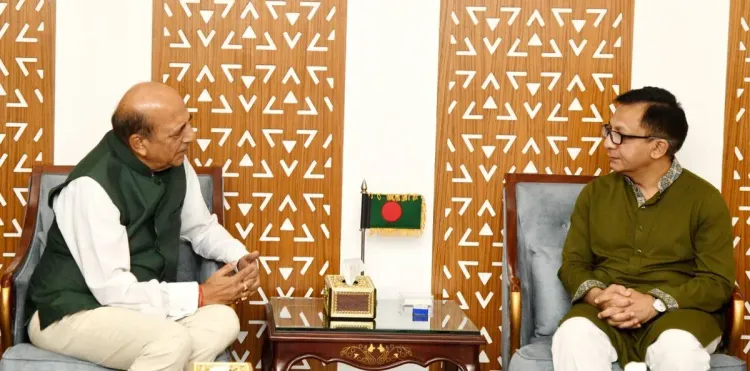
Indian High Commissioner Dinesh Trivedi met Bangladesh Commerce Minister Khandakar Abdul Muktadir in Dhaka on 25 August .
Bilateral trade stands at around $13 billion but has faced significant hurdles over the past one and a half years .
India is Bangladesh's second-largest trading partner after China.
Talks covered reopening of border haats , full functioning of land ports , and easing curbs on yarn imports through land routes.
A joint business task force between the two countries was proposed to strengthen commercial ties.
Improving digital infrastructure was identified as a key step to accelerate bilateral trade and investment.
Indian High Commissioner to Bangladesh Dinesh Trivedi met Bangladesh Commerce Minister Khandakar Abdul Muktadir in Dhaka on 25 August to discuss bilateral economic and commercial cooperation, with both sides exploring concrete steps to deepen trade and investment ties. The meeting comes amid reports that bilateral trade — currently valued at around $13 billion — has faced significant headwinds over the past year and a half.
Key Developments from the Meeting
The Indian High Commission in Dhaka posted on X that High Commissioner Trivedi 'emphasised the important role of businesses and the private sector in steering the economic partnership for mutually beneficial trade and investment.' The post added that 'a broad gamut of issues of mutual interest and mutual benefit was also discussed.'
The High Commission further noted that discussions 'highlighted the importance of strong people-to-people ties as an enduring foundation of India-Bangladesh relations, and the need to further deepen connections between the business communities, professionals and people of the two countries.'
Trade Hurdles on the Agenda
Talks specifically addressed measures to ease cross-border commerce, including the reopening of border haats, ensuring the full functioning of land ports, and easing restrictions on yarn imports through land routes, according to local media reports. Minister Muktadir acknowledged after the meeting that 'several hurdles have slowed trade over the past one and a half years,' adding: 'We discussed the problems and how trade relations between the two countries can be made easier and more effective in the future.'
Muktadir confirmed that India remains Bangladesh's second-largest trading partner after China, underscoring the strategic weight of the bilateral relationship despite current friction.
Joint Task Force and Digital Infrastructure Proposed
A notable outcome of the talks was a proposal to establish a joint task force involving businesses from both countries to strengthen commercial cooperation. Improving digital infrastructure was also identified as a key enabler for new investment opportunities and faster bilateral trade, according to Muktadir.
Muktadir expressed optimism that Trivedi's initiative would inject fresh momentum into economic cooperation between the two neighbours.
Trivedi's Message: Equality and Shared Future
High Commissioner Trivedi stressed that Bangladesh and India are both independent and sovereign nations, with bilateral cooperation needing to be grounded in equality. 'Both countries need to work together, particularly for the future of the younger generation,' he said. Despite political and economic differences, he noted that people on both sides seek development and progress, and that a stronger economic partnership could open doors for broader bilateral collaboration.
What to Watch Next
The proposed joint business task force and specific trade facilitation measures — particularly around land ports and yarn imports — will be closely tracked as indicators of whether this diplomatic engagement translates into tangible trade relief. With Bangladesh navigating a complex geopolitical and economic landscape, the trajectory of India-Bangladesh commerce in the coming months will be a key barometer of the bilateral relationship's health.
Point of View
But the fact that both sides felt compelled to meet specifically to address 18 months of slowdown reveals how fragile the economic relationship has become. The proposal for a joint business task force is sensible on paper, but India-Bangladesh commerce has historically been hampered less by the absence of frameworks than by their non-implementation — border haats and land ports have been recurring talking points for years. The real test is whether this meeting produces binding timelines, not just goodwill statements. With Bangladesh's political landscape in flux and China deepening its own economic footprint there, India cannot afford another cycle of announced-but-unexecuted trade facilitation measures.
NationPress
9 Oct 2026
Frequently Asked Questions
Why did India's High Commissioner meet Bangladesh's Commerce Minister?
Indian High Commissioner Dinesh Trivedi met Bangladesh Commerce Minister Khandakar Abdul Muktadir in Dhaka on 25 August to discuss ways to revive and deepen bilateral trade, which has faced significant hurdles over the past one and a half years despite being valued at around $13 billion.
What specific trade issues were discussed at the Dhaka meeting?
The talks focused on reopening border haats, ensuring the full functioning of land ports, and easing restrictions on yarn imports through land routes. A joint business task force and improvements to digital infrastructure were also proposed as steps to accelerate bilateral commerce.
What is the current state of India-Bangladesh bilateral trade?
Bilateral trade between India and Bangladesh amounts to around $13 billion, according to Minister Muktadir. India is Bangladesh's second-largest trading partner after China, though trade has slowed considerably over the past 18 months due to various hurdles.
What is the proposed India-Bangladesh joint task force?
Commerce Minister Muktadir put forward a proposal to establish a joint task force involving businesses from both India and Bangladesh, aimed at strengthening commercial cooperation and facilitating trade between the two countries. No formal timeline for its creation was announced.
What was High Commissioner Trivedi's broader message at the meeting?
Trivedi stressed that bilateral cooperation must be grounded in equality between two sovereign nations, and that a stronger economic partnership could pave the way for greater collaboration in other areas. He emphasised the importance of working together for the future of the younger generation on both sides.