Giriraj Singh chairs Raipur meet to boost weavers, khadi sector
Synopsis
Union Textiles Minister Giriraj Singh has outlined a plan to revitalise India's silk, khadi and handloom sectors after a review meeting in Raipur, targeting modern design training for weavers and an annual income of up to ₹5 lakh for cottage entrepreneurs, with export agencies to help take local products global.
Key Takeaways
Union Textiles Minister Giriraj Singh held a review meeting in Raipur, Chhattisgarh on 15 June 2026 focused on silk, khadi and handloom sectors.
The government aims to connect weavers with modern design training and innovation to raise their incomes.
A roadmap is being prepared to ensure cottage entrepreneurs earn up to ₹5 lakh annually .
Export agencies will be leveraged to take local handloom and khadi products to global markets .
The initiative is framed within the Atmanirbhar Bharat and Viksit Bharat 2047 policy frameworks.
The Khadi and Village Industries Commission (KVIC) and the National Handloom Development Programme (2015) form the institutional backbone of this push.
Union Textiles Minister Giriraj Singh on Monday, 15 June 2026 outlined a multi-pronged plan to revitalise India's silk, khadi and handloom sectors, anchoring his remarks around a review meeting held in Raipur, Chhattisgarh. The minister said the government's foremost commitment is to economically empower weavers, artisans and cottage entrepreneurs through modern training, innovation and global market access.
Context
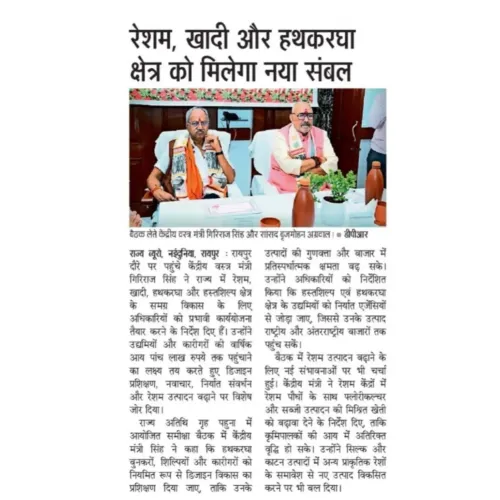
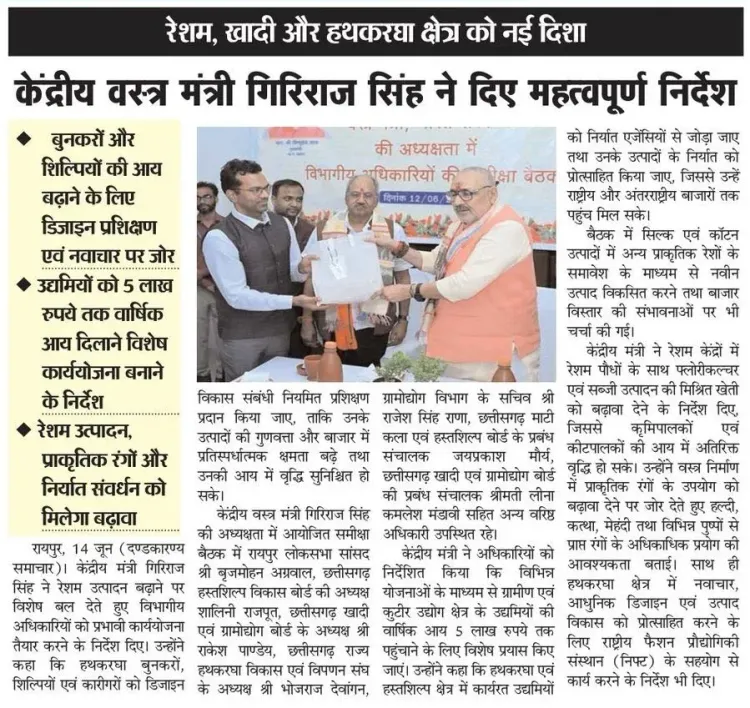
Posting in Hindi on X, Singh described the Raipur meeting as 'ek bada kadam' — 'a big step' — towards translating the government's resolve into ground-level action. He stated: 'Revitalising the silk, khadi and handloom sectors and economically empowering our weavers, artisans and cottage entrepreneurs is our highest commitment.' The post was accompanied by an image from the meeting.
The review meeting in Raipur follows a recurring pattern of the Union Textiles Ministry convening state-capital-level consultations to convert central policy into state-level action plans. Chhattisgarh has a notable presence of handloom and tribal textile clusters, making it a significant node in this exercise.
Policy Backdrop
Singh flagged two specific priorities: connecting weavers with modern design training and innovation to increase their incomes, and preparing a roadmap to ensure artisans and cottage entrepreneurs earn up to ₹5 lakh annually. He also cited collaboration with export agencies to take local products to global markets.
These objectives align with the broader Atmanirbhar Bharat Abhiyan, launched in 2020, which included dedicated provisions for the handloom and MSME sectors. The National Handloom Development Programme, introduced in 2015, similarly provided financial assistance, design support and market linkages to weavers — forming the policy lineage on which the current push builds.
The Khadi and Village Industries Commission (KVIC), the statutory body overseeing khadi promotion and village industries, remains a key institutional vehicle for implementing such programmes across states.
Stakeholders and Impact
The sectors in focus — silk, khadi and handloom — collectively employ millions of rural artisans and weavers, many of them women in economically marginalised clusters. Design modernisation and export linkages are seen as critical levers to raise per-unit value and income without displacing traditional craft identities.
Textile exporters and export promotion councils are among the stakeholders Singh invoked, signalling that the government intends to use institutional export infrastructure to bridge local production with international buyers. The #VocalForLocal and #ViksitBharat2047 hashtags in the post situate the initiative within the government's long-term vision of a developed India by 2047.
What's Next
Attention will now turn to whether state-level monitoring committees in Chhattisgarh and other states formalise the design training modules and income-target roadmaps discussed at the Raipur meeting. Progress on the ₹5 lakh annual income benchmark for cottage entrepreneurs will be a key metric to track in subsequent quarters.
If the Raipur template is replicated across major handloom states — including Andhra Pradesh, Telangana, Uttar Pradesh and West Bengal — it could mark a systematic shift in how central textile policy is operationalised at the state level, with measurable income targets replacing broader aspirational goals.
Point of View
Trackable commitment that will be difficult to walk back. Framing the initiative under both Atmanirbhar Bharat and Viksit Bharat 2047 allows the ministry to connect a granular state-level exercise to the government's flagship long-term narrative. The export-linkage emphasis suggests the ministry is moving beyond domestic market promotion toward positioning Indian handloom as a globally competitive product category. Whether the Raipur template generates binding state action plans or remains a consultative exercise will determine its real policy weight.
NationPress
14 Sept 2026
Frequently Asked Questions
What did Giriraj Singh announce for handloom weavers in June 2026?
Giriraj Singh announced plans to provide modern design training and innovation support to weavers to raise their incomes, and outlined a roadmap to ensure cottage entrepreneurs earn up to ₹5 lakh annually, following a review meeting in Raipur.
What is the ₹5 lakh income target for artisans about?
The ₹5 lakh annual income target refers to a planned roadmap being developed by the Union Textiles Ministry to ensure cottage entrepreneurs and artisans in the silk, khadi and handloom sectors achieve a minimum annual income of ₹5 lakh.
Why was the textiles review meeting held in Raipur?
Raipur, the capital of Chhattisgarh, hosted the review meeting as part of the Textiles Ministry's practice of convening state-level consultations to translate central policy into on-ground action plans; Chhattisgarh has significant handloom and tribal textile clusters.
What is the role of KVIC in India's khadi sector?
The Khadi and Village Industries Commission (KVIC) is a statutory body responsible for promoting khadi production and village industries across India, and serves as a key institutional vehicle for implementing government schemes for artisans and cottage entrepreneurs.
How does the handloom initiative connect to Atmanirbhar Bharat?
The Atmanirbhar Bharat Abhiyan, launched in 2020, included dedicated provisions for the handloom and MSME sectors to boost local production and reduce import dependence; the current push by Giriraj Singh builds on that framework while adding export-orientation and income-target goals.