Trump and Merz Address Iran Conflict and Trade Issues
Synopsis
In a pivotal meeting, US President Donald Trump and German Chancellor Friedrich Merz discussed the Iran conflict and trade tensions. Both leaders highlighted the need for coordination during challenging global circumstances, focusing on military actions and economic impacts.
Key Takeaways
Trump and Merz emphasized collaboration to address the Iran conflict.
Military actions have weakened Iran's capabilities , according to Trump.
The leaders discussed the economic impacts of the ongoing conflict.
Trade agreements were highlighted as a priority for both nations.
Trump defended his administration's tariff strategies.
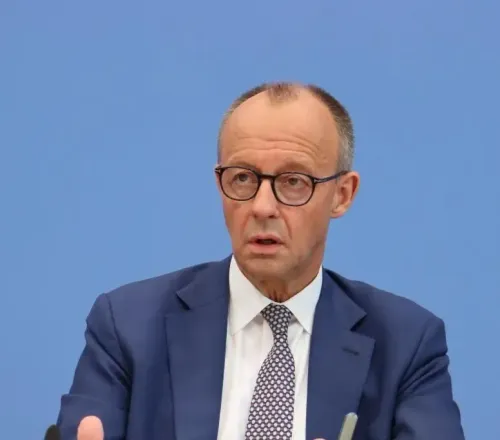
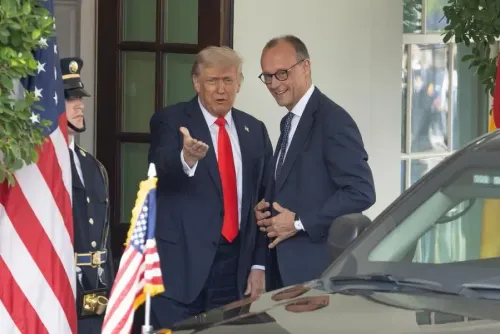
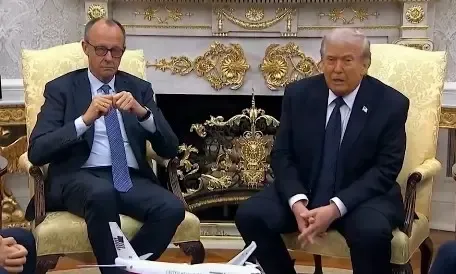
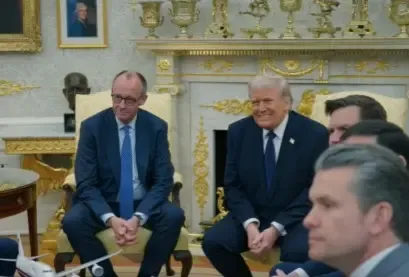
Washington, March 4 (NationPress) US President Donald Trump and German Chancellor Friedrich Merz engaged in discussions at the White House, concentrating on the Iran conflict, transatlantic trade matters, and the ongoing war in Ukraine. The two leaders emphasized the importance of close collaboration during what Merz termed as “difficult times.”
As Merz was welcomed to the Oval Office, Trump highlighted the robust relationship between the two nations, indicating that they would address both security and economic concerns. This meeting marked Trump's first engagement with a foreign leader following the recent attack on Iran.
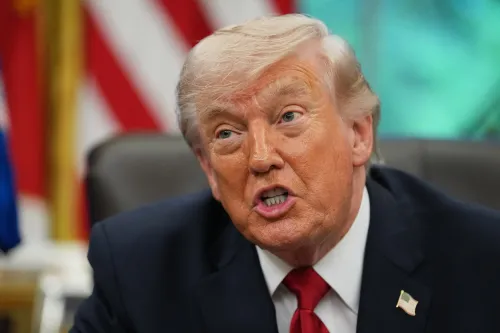
“Thank you very much, everyone. We are meeting with a man who has become a friend,” Trump remarked. “The relationship we share in trade and other areas has been exceptionally strong.”
The US President stated that the situation concerning Iran would be a key focus of their dialogue and asserted that recent military interventions have significantly compromised Tehran’s capabilities.
“They lack a navy; it has been dismantled. Their air force is gone; it has been eliminated. They have no air detection systems; their radar has been destroyed,” Trump declared.
“Almost everything has been neutralized. We will see how things unfold. However, we are performing very well.”
Merz pointed out that Germany and the US share a common goal regarding Iran and are already contemplating potential scenarios following the downfall of the current regime.
“We are aligned in our efforts to remove this dreadful regime in Tehran and will discuss the aftermath if they are ousted,” Merz stated.
He also stressed the urgency of finalizing a trade agreement and coordinating efforts regarding the war in Ukraine.
“We need to deliberate on our trade agreement, which I hope can be established promptly,” he mentioned. “Additionally, we must address the situation in Ukraine. There are numerous adversities in the world today.”
When asked if Israel had influenced Washington's current stance toward Iran, Trump dismissed the notion.
“No, I may have pushed their hand,” he contended, explaining that the US acted based on its belief that Iran was poised to initiate attacks.
“We were engaged in negotiations with these irrational individuals, and I was convinced they would strike first,” Trump added. “If anything, I might have pressured Israel's decision-making, but they were prepared, and we were prepared.”
Trump further noted that Iranian military capabilities were consistently being diminished.
“They are still launching some missiles; eventually, they won’t even manage that because we are targeting all of their carriers and missile supplies,” he stated.
The president expressed concern that the ongoing conflict might result in another hardline regime in Tehran.
“The worst-case scenario would be if we intervene and then someone equally as bad as the previous leader takes charge,” he cautioned.
Regarding economic repercussions, Merz acknowledged that the conflict is driving up energy costs and impacting global economies.
“This is undoubtedly detrimental to our economies, affecting both oil and gas prices,” he affirmed.
Trump maintained that the military action has garnered widespread international support and mentioned that many nations are collaborating with Washington against Iran.
“Some European countries have been cooperative, while others have not,” Trump noted, adding that “Germany has been exceptional.”
In the dialogue with reporters, Trump also defended his administration’s tariff strategies, stating that the US has applied a baseline tariff on imports.
“We have implemented a 15 percent tariff across the board,” he explained. “We have generated hundreds of billions of dollars in revenue for our country through these tariffs.”
The leaders also deliberated on the war in Ukraine, with Trump asserting that resolving the conflict remains a priority for his administration.
“Very high,” he responded when asked about the conflict's importance on his agenda. “I would love to see it conclude.”
This meeting occurred as the United States spearheads a growing military initiative against Iran following strikes that Washington claims targeted the country’s nuclear and missile infrastructure.
Middle Eastern tensions have sharply escalated in recent weeks, raising alarms about global energy markets and regional stability.
Point of View
The discussions between Trump and Merz highlight the urgency of international collaboration in addressing the Iran conflict and trade tensions. Their commitment to a unified approach reflects a proactive stance in navigating these complex geopolitical challenges.
NationPress
19 Sept 2026
Frequently Asked Questions
What was the main focus of the Trump-Merz meeting?
The primary focus was on the Iran conflict, transatlantic trade issues, and the ongoing war in Ukraine.
How did Trump describe Iran's military capabilities?
Trump claimed that Iran's military capabilities have been severely weakened, stating they no longer possess a functional navy or air force.
What economic issues did Merz highlight?
Merz noted that the conflict was causing rising energy prices, which are damaging both US and German economies.
Did Trump believe Israel influenced US actions against Iran?
Trump dismissed the idea that Israel pushed the US into conflict, suggesting that the US acted independently based on its assessment of threats from Iran.
What tariff policies did Trump discuss?
Trump mentioned that his administration instituted a 15 percent tariff on imports, generating substantial revenue for the US.