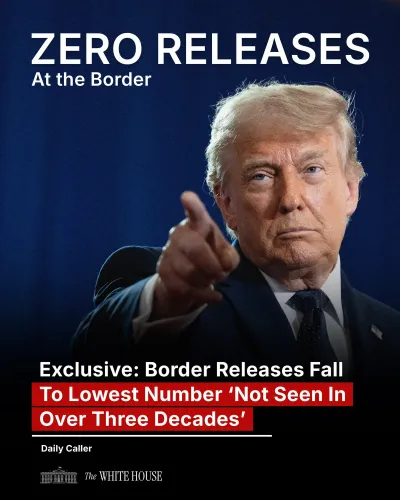
Trump Claims 100+ Hostages Freed in One Year, Zero Ransom Paid

Synopsis
The White House announced that President Donald J. Trump has secured the release of over 100 American hostages from foreign captivity in just over one year, with no ransom paid to captors — framing the milestone as a signature second-term foreign-policy achievement.
Key Takeaways
The White House claims President Trump has freed over 100 American hostages from abroad in just over one year of his second term.
The administration states zero dollars were paid to any captor in exchange for the releases.
Long-standing US policy prohibits ransom payments to hostage-takers to avoid incentivising further detentions.
During Trump's first term, high-profile releases included Americans held in North Korea (2018) and Turkey (2019) via diplomatic pressure.
The State Department and the Office of the Special Presidential Envoy for Hostage Affairs are the primary operational bodies for such cases.
Further congressional scrutiny and State Department disclosures on remaining US detainees are expected.
More than 100 Americans have been brought home from captivity abroad in just over a year — and not a single dollar paid to their captors, The White House declared on Thursday, August 13, 2026. The announcement frames the milestone as a signature foreign-policy win for President Donald J. Trump's second term, invoking his trademark 'Promises Made, Promises Kept' refrain.
The 100-Hostage Benchmark and What It Signals
The White House post states the administration has secured the release of over 100 American hostages from captivity in foreign countries since Trump returned to office — without paying ransom to any of their captors. The no-ransom framing is deliberate: US policy across administrations has long prohibited paying money to hostage-takers or terrorist groups, on the grounds that payments create incentives for further detentions. Trump is claiming not just results, but results achieved on those terms.
During his first term (2017–2021), Trump made hostage returns a high-visibility priority, securing releases of Americans held in North Korea in 2018 and in Turkey in 2019 through direct diplomacy and pressure rather than ransom. The current claim extends that record into a second-term context, though the specific figure of over 100 in one year represents a significantly larger scale than any publicly documented single-year total from prior administrations.
Diplomacy Over Dollars: The Mechanics Behind the Releases
Successive US administrations — Republican and Democrat alike — have relied on diplomatic pressure, economic sanctions, and third-party intermediaries to negotiate the freedom of detained Americans. The explicit refusal to pay captors is both a legal constraint and a strategic signal: rewarding hostage-taking invites more of it. Trump's team is presenting the 100-plus figure as proof that pressure-based diplomacy, rather than financial concession, can deliver results at scale.
The State Department and the Office of the Special Presidential Envoy for Hostage Affairs — the unit created specifically to coordinate such cases — would be the operational engines behind any such releases. Families of American detainees abroad have long pressed for faster, more aggressive government action, making this milestone politically resonant beyond just foreign-policy circles.
'Promises Made, Promises Kept' — The Political Calculus
The slogan is not incidental. 'Promises Made, Promises Kept' has been a core Trump campaign and governing refrain since his first term, used to benchmark commitments against outcomes. Deploying it here ties hostage recovery directly to his broader narrative of executive competence and America-first results. The post carries a video — likely testimonial or documentary footage — amplifying the human dimension of the claim.
Congressional scrutiny of hostage-recovery policy has been a recurring feature of Washington politics, with lawmakers from both parties pressing administrations on transparency, timelines, and methods. Further State Department announcements on remaining US detainees, and any forthcoming congressional hearings on hostage policy, will test whether the momentum the White House is claiming holds under examination.
One hundred families. One year. No ransom. If the numbers stand, it is a foreign-policy ledger entry that no successor will find easy to ignore.
Point of View
If verified, would represent an extraordinary acceleration of US hostage-recovery outcomes and a meaningful political asset for Trump heading into any domestic debate on foreign policy competence. The deliberate 'no ransom' emphasis is as much a message to adversaries — that detaining Americans yields no financial reward — as it is a domestic talking point. However, the aggregate figure invites scrutiny: the mechanics, the countries involved, and the diplomatic concessions (if any) made in lieu of money will determine whether this is a durable legacy or a contested statistic. For India, which watches US-Iran, US-Russia, and US-China dynamics closely, the hostage diplomacy posture signals how Washington intends to project leverage in the coming years.
NationPress
13 Aug 2026
Frequently Asked Questions
How many American hostages has Trump freed since taking office in his second term?
The White House claims President Trump has secured the release of over 100 American hostages from foreign captivity in just over one year of his second term, as announced on August 13, 2026.
Did the US pay ransom for the hostages Trump freed?
According to the White House, no ransom was paid to any captor. Long-standing US policy prohibits ransom payments to hostage-takers or terrorist groups to avoid incentivising further detentions.
What is the US government's official policy on paying ransom for hostages?
The United States has a longstanding policy against paying ransom to hostage-takers or terrorist organisations. Instead, the government uses diplomatic pressure, economic sanctions, and third-party intermediaries to negotiate releases.
Which US agency handles American hostage cases abroad?
The State Department and the Office of the Special Presidential Envoy for Hostage Affairs are the primary bodies responsible for coordinating the recovery of Americans detained in foreign countries.
What hostage releases did Trump secure during his first term?
During his first term (2017-2021), Trump secured the release of Americans held in North Korea in 2018 and in Turkey in 2019, primarily through direct diplomatic pressure rather than ransom payments.