Trump Delivers Remarks on American Shipbuilding Push
Synopsis
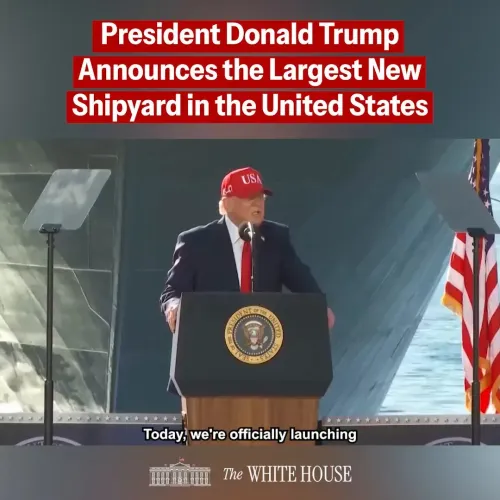
President Trump addressed the nation on American shipbuilding on October 6, 2026, spotlighting a sector central to US industrial revival and naval readiness. The White House broadcast the remarks live, underlining the administration's intent to accelerate domestic maritime manufacturing capacity.
Key Takeaways
President Trump delivered live remarks on American shipbuilding on October 6, 2026 .
The White House announced the address in real time on X, signalling high intended visibility.
US commercial shipbuilding has lost ground to South Korea , China , and Japan over recent decades.
Reviving domestic yards is framed as both an economic and a national security priority by the Trump administration.
The Jones Act and US Navy fleet-maintenance demands remain key policy levers in any shipbuilding push.
The move carries strategic implications for allied nations, including India , deepening its defence-industrial ties with Washington.
With an American flag emoji and the word 'NOW,' The White House signalled on Tuesday, October 6, 2026 that President Donald Trump had stepped to the podium to deliver remarks specifically focused on American shipbuilding — a sector that sits at the crossroads of industrial revival, maritime trade, and national defence.
Why shipbuilding is back at the centre of US industrial policy
Shipbuilding has long been a flashpoint in debates over American manufacturing competitiveness. The United States once dominated global commercial shipbuilding but ceded ground over decades to South Korea, China, and Japan, which together now account for the overwhelming majority of the world's new vessel orders. Reviving domestic capacity has been framed by successive administrations as both an economic imperative — supporting high-wage, skilled blue-collar jobs — and a strategic one, ensuring the country can sustain its own naval and logistics fleet.
For the Trump administration, shipbuilding fits squarely within a broader 'America First' manufacturing doctrine that has targeted industries deemed critical to national security. Executive action and federal procurement rules have previously been used to steer government contracts toward domestic yards, and any fresh remarks from the President on this theme are likely to build on — or accelerate — those existing levers.
Defence, trade, and the yards at stake
The strategic stakes are considerable. US Navy shipyards are already stretched meeting fleet-maintenance demands, and Pentagon planners have flagged the shipbuilding industrial base as a vulnerability in any prolonged great-power competition scenario. On the commercial side, provisions like the Jones Act — which requires goods shipped between US ports to travel on American-built, American-flagged vessels — remain a live policy tool that any serious shipbuilding initiative must reckon with.
Remarks of this nature typically accompany executive orders, funding announcements, or workforce partnership agreements with port cities and private yards. Until the full text of President Trump's address is released, the precise policy measures remain to be detailed — but the fact that the White House flagged the speech in real time signals its intended visibility.
A revitalised American shipyard sector would carry direct implications for allied nations, including India, which has deepened maritime and defence-industrial ties with Washington in recent years — making any shift in US naval production strategy one that New Delhi will watch closely.
Point of View
The administration signals both an electoral and a strategic calculation. For allies like India, any acceleration of US naval-industrial investment reshapes the terms of joint maritime initiatives under frameworks such as the Quad. The speech, flagged live by the White House, is less a standalone announcement than a chapter in a longer effort to redefine what American economic sovereignty looks like on the water.
NationPress
7 Oct 2026
Frequently Asked Questions
What did Trump say about American shipbuilding on October 6 2026?
President Trump delivered live remarks on American shipbuilding on October 6, 2026, as announced by the White House on X. The full text of the address was not immediately available, but the White House flagged the speech in real time, indicating its significance to the administration's manufacturing agenda.
Why is American shipbuilding important for US national security?
The US shipbuilding industrial base is considered a national security vulnerability because American yards have lost significant ground to Asian competitors. The US Navy relies on domestic yards for fleet maintenance, and a depleted industrial base limits the country's ability to sustain naval operations in a prolonged conflict scenario.
What is the Jones Act and how does it relate to US shipbuilding?
The Jones Act requires that goods transported between US ports be carried on vessels that are American-built, American-flagged, and American-crewed. It is a central policy tool in protecting and incentivising domestic shipbuilding, and any major shipbuilding initiative must address its provisions.
How does the US shipbuilding push affect India?
India and the United States have deepened maritime and defence-industrial ties in recent years, including under the Quad framework. Any shift in US naval production strategy or shipbuilding investment could reshape the terms of joint maritime initiatives between the two countries.
Which countries dominate global shipbuilding today?
South Korea, China, and Japan collectively dominate global commercial shipbuilding, accounting for the vast majority of new vessel orders worldwide. The United States, which once held a leading position, has seen its commercial shipbuilding share decline sharply over recent decades.