Trump: Europe agrees to release large diesel reserves immediately
Synopsis
President Trump announced on October 2, 2026, that Europe has agreed to release a 'massive amount' of heavily stocked diesel oil immediately, signalling a transatlantic energy coordination move with potential implications for global fuel markets and goods inflation.
Key Takeaways
President Trump announced on October 2, 2026 that Europe has agreed to release a 'massive amount' of its heavily stocked diesel oil.
The White House stated the release process will begin 'immediately,' indicating an already-concluded agreement rather than an ongoing negotiation.
No volume, specific European counterpart, or release mechanism was named in the announcement.
Diesel is a critical fuel for freight, agriculture, and industry, meaning a large supply release could put downward pressure on goods-sector inflation.
The move signals the Trump administration is using allied energy reserves as an active tool of economic policy.
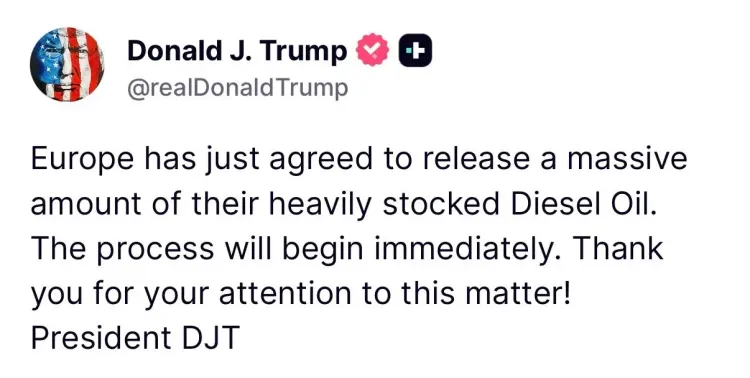
A transatlantic energy deal took shape on Friday, October 2, 2026, as President Donald J. Trump announced that Europe had agreed to release a 'massive amount' of its heavily stocked diesel oil — with the process set to begin 'immediately.' The announcement, relayed through the official White House account, carries the hallmarks of a rapid, executive-level energy agreement between Washington and European partners.
What Trump announced and what it means for fuel markets
The post quoted President Trump directly: 'Europe has just agreed to release a massive amount of their heavily stocked Diesel Oil. The process will begin immediately.' The language is unambiguous — this is not a pledge or a negotiation update, but a concluded agreement with an immediate start date. Diesel, the workhorse fuel of global freight, agriculture, and industrial supply chains, has outsized influence on goods prices when its supply tightens or loosens.
Europe maintaining 'heavily stocked' diesel reserves suggests the continent had been sitting on strategic or commercial surplus. A coordinated release of those stocks into the market — presumably at Washington's request or as part of a bilateral energy compact — would act as a supply-side pressure valve, bearing down on wholesale diesel prices.
Why diesel, and why now
Diesel is not just a transport fuel — it drives tractors, generators, cargo ships, and construction equipment. A sustained tightening of diesel supply feeds inflation across virtually every physical goods category. A coordinated European release signals that both sides of the Atlantic see the current price or supply trajectory as a shared problem requiring a joint fix.
The announcement does not specify the volume of the release, the mechanism — whether through the International Energy Agency's coordinated reserve system or bilateral arrangements — or the timeline over which the stocks will hit the market. Those details will matter enormously for how traders and analysts interpret the move's real market weight.
What remains unanswered
The post offers no figures: no barrels, no days of supply, no price target. It names no European counterpart — not a head of government, not the European Commission, not a specific member state. 'Europe' in this context likely means the European Union collectively or a coalition of major member-state governments, but the White House communication leaves that open. The absence of a named partner, a volume, and a mechanism means markets and governments will be watching for a follow-up readout with operational specifics.
What is clear is the political signal: the Trump administration is leaning on allied energy reserves as an active tool of economic management — and Europe, for now, is cooperating.
Point of View
Any softening of global diesel prices — if the release is substantial — would offer modest relief on freight costs and, by extension, consumer goods inflation. The bigger question is whether this is a one-off political signal or the start of a sustained coordinated drawdown.
NationPress
2 Oct 2026
Frequently Asked Questions
What did Trump announce about European diesel oil?
President Trump announced on October 2, 2026, that Europe has agreed to release a large quantity of its heavily stocked diesel oil, with the process starting immediately.
Why is Europe releasing diesel oil reserves?
The White House announcement does not specify the reason, but coordinated strategic reserve releases are typically used to cool fuel prices or ease supply constraints in global markets.
How much diesel oil will Europe release?
No specific volume or quantity was mentioned in the White House announcement. The post described it only as a 'massive amount.'
Will this affect diesel prices in India?
A large European diesel release can soften global wholesale diesel prices, which could have a modest downstream effect on Indian fuel import costs and freight rates, though the actual impact depends on the volume released.
Which European countries or bodies agreed to release diesel?
The announcement did not name a specific European country, the European Union, or any individual counterpart — it referred only to 'Europe' broadly.