Trump seeks record $1.5tn defence budget, eyes AI and ships

Synopsis
Trump’s $1.5 trillion defence budget pitch is the largest in US history — a dramatic leap from his own claimed $1 trillion investment — and frames military spending as both a national security imperative and a domestic manufacturing engine. With Congress holding the purse strings and nearly $10 billion already pledged at a single Pennsylvania summit, the scale of ambition is clear; the political path is not.
Key Takeaways
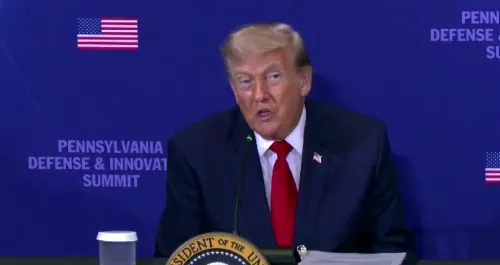
President Donald Trump announced a proposed $1.5 trillion defence budget at the Pennsylvania Defense and Innovation Summit on Wednesday, 16 July .
Trump cited a prior $1 trillion military investment under his administration and called the new figure a necessary next step.
Defence Secretary Pete Hegseth described the budget as a generational shift bigger than Ronald Reagan ’s military build-up, focused on AI, autonomous systems, quantum tech, and space.
Nearly $10 billion in new defence investments were announced across Pennsylvania , involving General Dynamics , Lockheed Martin , Hanwha Defense USA , Blackstone , and JPMorgan Chase .
The proposed budget requires Congressional approval through the annual appropriations process.
US President Donald Trump has announced that his administration will seek a $1.5 trillion defence budget, framing the proposed outlay as an essential investment to modernise the military, accelerate weapons production, and fortify America's industrial base against escalating global security threats. The announcement was made on Wednesday at the Pennsylvania Defense and Innovation Summit.
What Trump Said
Speaking at the summit, Trump cited what he described as record military investments already made during his presidency. “Under the Trump administration, we’ve invested a record $1 trillion in the United States military,” he said. “And next year, I’m proud to say… $1.5 trillion we’re going up to. We need it. It’s all made in the USA.”
Trump argued that the expanded defence spend would generate manufacturing jobs nationwide by ramping up production of ships, submarines, aircraft, missiles, and advanced military systems. “We have the best quality in the world, but we need a little more speed,” he said, referring specifically to submarines and missiles.
Pentagon’s Case for a Generational Shift
Defence Secretary Pete Hegseth called the proposed budget a historic investment that would reshape the Pentagon for a new era of warfare driven by artificial intelligence, autonomous systems, quantum technologies, and space capabilities. “This is a generational investment in the future of our warfighting capabilities that our country has not seen since Ronald Reagan,” Hegseth said. “And this one is bigger.”
Hegseth added that the Defence Department was overhauling procurement practices to encourage competition and reduce bureaucracy. “Our bureaucracy was built to keep most of you out,” he said. “We’ve been waging a war of attrition against the Pentagon bureaucracy to open up the aperture and make sure competition and speed and innovation and commercial options have a seat at the table.”
Pennsylvania Summit: Nearly $10 Billion in New Commitments
The summit featured announcements of nearly $10 billion in new defence-related investments across Pennsylvania, spanning shipbuilding, submarine production, missile manufacturing, robotics, artificial intelligence, and energy technologies. Senior executives from General Dynamics, Lockheed Martin, Hanwha Defense USA, Blackstone, and JPMorgan Chase joined administration officials to outline projects linked to the defence industrial base.
Hegseth emphasised that the administration was determined to ensure emerging technology companies could compete alongside established contractors. “If you’re ahead now and you get ahead of the game, you’re going to be way ahead,” he said.
Congressional Hurdle Ahead
The proposed $1.5 trillion defence budget will require approval from Congress as part of the annual appropriations process. The administration has argued that increased spending is necessary to modernise ageing military infrastructure, expand production capacity, and maintain the United States’ technological edge in an increasingly competitive global security environment. This comes amid heightened geopolitical tensions and an ongoing debate in Washington over federal spending priorities.
Point of View
And the political arithmetic in Congress is far from settled. Trump is simultaneously using the proposal as a national security argument and a domestic jobs pitch — a dual framing designed to build bipartisan cover. But the Reagan comparison cuts both ways: Reagan’s build-up also ballooned the deficit and triggered fierce legislative battles. What’s missing from the summit’s enthusiasm is any credible offset plan. With federal debt already at record levels, the question is not whether America can build a $1.5 trillion military — it is who pays for it and what gets cut.
NationPress
14 Oct 2026
Frequently Asked Questions
What is Trump’s proposed $1.5 trillion defence budget?
It is a proposed annual defence spending plan announced by President Donald Trump at the Pennsylvania Defense and Innovation Summit on 16 July, aimed at modernising the US military, accelerating weapons production, and expanding the defence industrial base. The budget would require Congressional approval.
How does the $1.5 trillion figure compare to current US defence spending?
Trump cited a $1 trillion military investment already made under his administration, making the proposed $1.5 trillion a significant escalation. Defence Secretary Pete Hegseth described it as the largest generational investment since Ronald Reagan’s military build-up in the 1980s.
What technologies will the new defence budget prioritise?
According to Defence Secretary Hegseth, the budget will focus on artificial intelligence, autonomous systems, quantum technologies, and space capabilities, alongside traditional platforms such as ships, submarines, aircraft, and missiles.
What was announced at the Pennsylvania Defence and Innovation Summit?
Nearly $10 billion in new defence-related investments across Pennsylvania were announced, covering shipbuilding, submarine production, missile manufacturing, robotics, AI, and energy technologies. Major firms including General Dynamics, Lockheed Martin, Hanwha Defense USA, Blackstone, and JPMorgan Chase participated.
Does the $1.5 trillion defence budget need Congressional approval?
Yes. The proposed budget must go through Congress as part of the annual appropriations process. Its passage is not guaranteed and will depend on negotiations over federal spending priorities.