Trump to Bestow Medal of Honor on Three Heroic Soldiers
Synopsis
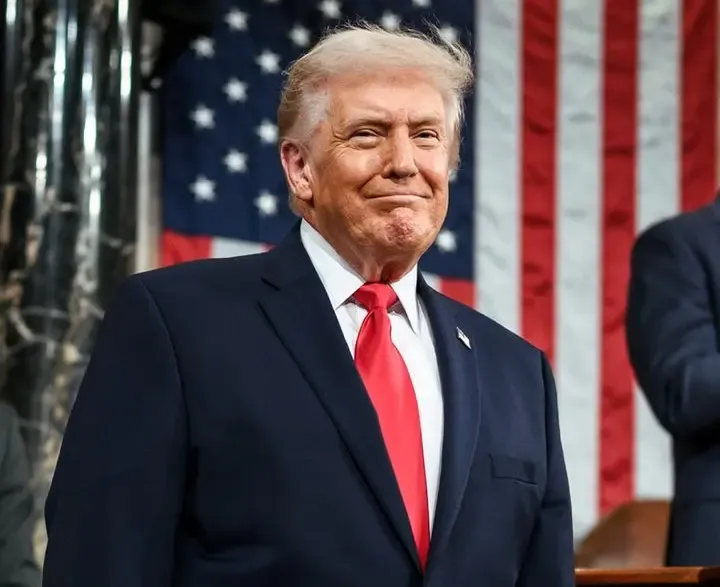
On March 2, US President Donald Trump will present the Medal of Honor to three distinguished soldiers, honoring their extraordinary bravery during pivotal conflicts in US history, including World War II and the war in Afghanistan.
Key Takeaways
President Trump will award the Medal of Honor on March 2.
The award recognizes exceptional bravery of three soldiers.
Master Sergeant Roderick W.
Edmonds acted to protect Jewish-American POWs during WWII.
Staff Sergeant Michael H.
Ollis displayed heroism during an attack in Afghanistan.
Command Sergeant Major Terry P.
Richardson saved lives in Vietnam under fire.
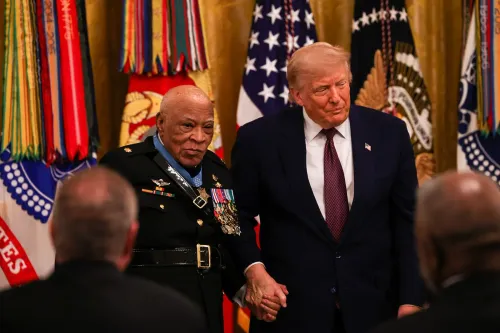
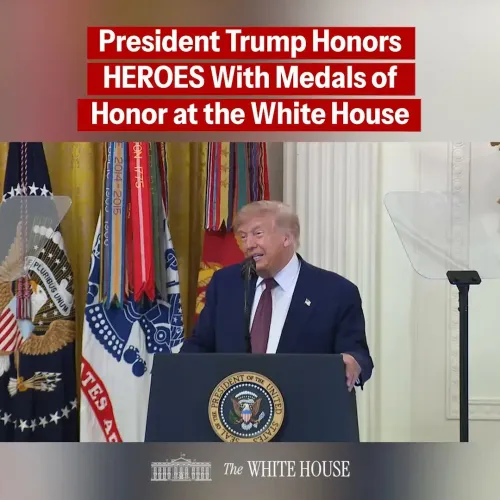
Washington, Feb 27 (NationPress) On March 2, US President Donald Trump will honor three brave US Army soldiers with the esteemed Medal of Honor, acknowledging their extraordinary acts of “gallantry and intrepidity beyond the call of duty” during conflicts such as World War II, Vietnam, and the Afghan War.
The White House has announced that this distinguished military medal will be awarded posthumously to Master Sergeant Roderick (Roddie) W. Edmonds and Staff Sergeant Michael H. Ollis, alongside Command Sergeant Major Terry P. Richardson, US Army (Retired).
Master Sergeant Edmonds will be recognized for his courageous actions between January 27, 1945, and March 30, 1945, as a prisoner of war in Germany. When he arrived at Stalag IXA in Ziegenhain, he encountered a German directive that only Jewish-American prisoners were to report for roll call, under threat of execution.
Understanding that this segregation of over 200 Jewish-American POWs could lead to “persecution and likely death,” Edmonds instructed all 1,200 American prisoners to present themselves.
When the Nazi commandant confronted him, brandishing a pistol against his forehead and demanding the identification of Jewish prisoners or facing execution, Edmonds “fearlessly stood his ground.” He warned the commandant that such an execution would be a war crime. Ultimately, the officer lowered his weapon and abandoned further attempts to segregate the prisoners.
In subsequent weeks, as Allied forces advanced, Edmonds continued his act of defiance. He commanded prisoners to break ranks and return to their barracks upon the arrival of German transports, compelling the guards to flee the camp, thereby leaving the 1,200 Americans safe.
Staff Sergeant Ollis is being honored for his courageous actions on August 28, 2013, during a complex enemy attack at Forward Operating Base Ghazni in Afghanistan. This assault involved vehicle-borne improvised explosive devices, suicide vests, indirect fire, and small arms fire.
After directing fellow soldiers to take cover in bunkers, Ollis re-entered a structure to assess for casualties and moved toward the enemy force that had breached the perimeter. Alongside a Coalition Forces officer, and “armed only with rifles”, he joined other forces to fend off the attack.
While under constant fire, an insurgent confronted them at close range. With “complete disregard for his own safety,” Ollis positioned himself between the insurgent and a wounded officer. He fired and incapacitated the assailant, but the insurgent’s suicide vest detonated, fatally wounding him, as reported by the White House.
Then-Staff Sergeant Richardson is receiving recognition for his actions on September 14, 1968, near Loc Ninh in the Republic of Vietnam. Engaged by heavy fire from a North Vietnamese Army battalion, he braved intense machine gun fire on three separate occasions to save injured soldiers, as stated by the White House.
Recognizing that his company was encircled, he advanced to Hill 222 to direct tactical air strikes, only to realize it was an enemy regimental base camp. Despite sustaining injuries from a sniper, he continued to direct air strikes for seven hours and later refused medical evacuation. His actions “saved the lives of 85 fellow soldiers.”
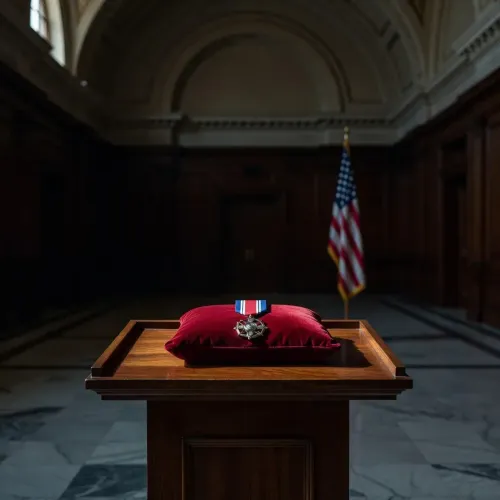
The Medal of Honor is awarded to armed forces members who demonstrate conspicuous gallantry and intrepidity at the risk of their own lives, exceeding the call of duty.
Since its inception during the American Civil War, over 3,500 service members have been bestowed with this medal, which remains the United States’ highest military honor, presented by the President on behalf of Congress, recognizing remarkable bravery in combat across various wars and eras.
Point of View
It is important to recognize the sacrifices made by individuals in service to their country. The awarding of the Medal of Honor not only commemorates their heroism but also serves as a reminder of the values of courage and commitment that define our nation.
NationPress
26 Sept 2026
Frequently Asked Questions
What is the Medal of Honor?
The Medal of Honor is the United States' highest military decoration, awarded to members of the Armed Forces for conspicuous gallantry and intrepidity at the risk of their lives above and beyond the call of duty.
Who are the soldiers receiving the Medal of Honor?
The soldiers receiving the Medal of Honor are Master Sergeant Roderick W. Edmonds, Staff Sergeant Michael H. Ollis, and Command Sergeant Major Terry P. Richardson, US Army (Retired).
When will the awards take place?
The awards will take place on March 2.
What historical conflicts do these awards pertain to?
The awards recognize acts of bravery during World War II, the Vietnam War, and the war in Afghanistan.
Is the Medal of Honor awarded posthumously?
Yes, the Medal of Honor can be awarded posthumously, as seen in the cases of Master Sergeant Roderick W. Edmonds and Staff Sergeant Michael H. Ollis.