Trump honours Satya Nadella, Musk, 5 tech giants at New Golden Age Summit
Synopsis
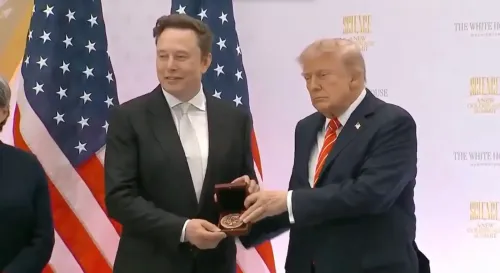
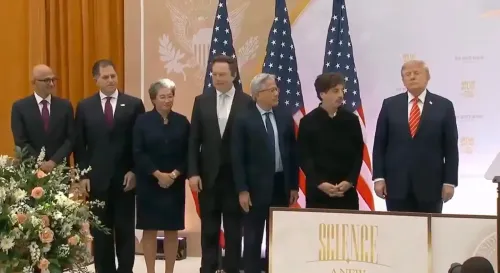
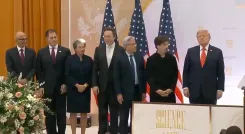
At the New Golden Age Summit, President Trump handed America's highest science and technology medals to six titans — Satya Nadella, Elon Musk, Sergey Brin, Jensen Huang, Lisa Su and Michael Dell — in a ceremony that doubled as a statement of intent: AI, semiconductors, and space are the new pillars of American power, and these are the people the administration is betting on.
Key Takeaways
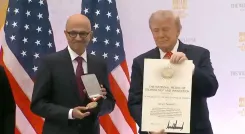
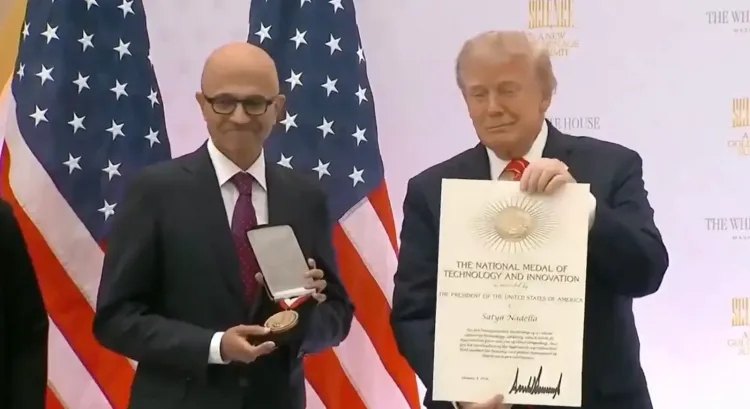
Donald Trump presented the National Medal of Technology and Innovation to Satya Nadella and Michael Dell at the New Golden Age Summit on 9 October 2026 .
Elon Musk , Sergey Brin , Jensen Huang , and Lisa Su received the National Medal of Science .
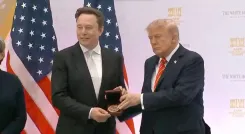
Trump called Musk a 'modern day Thomas Edison' and described Nadella as the driving force behind Microsoft's AI transformation.
Trump said 'The entire world is now running on Nvidia,' while honouring Jensen Huang .
The administration outlined priority areas including quantum computing , nuclear energy , AI , and a quantum computer target by 2028 .
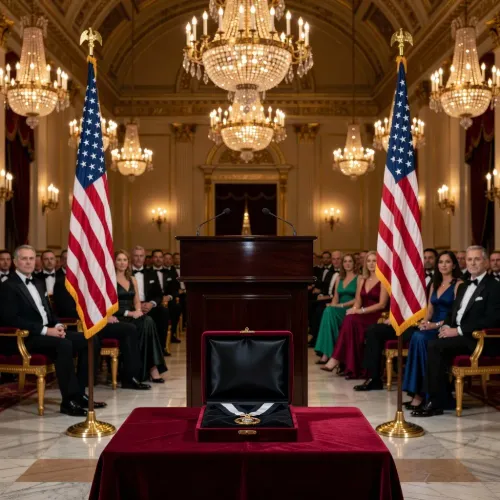
US President Donald Trump on 9 October 2026 bestowed America's highest honours for scientific and technological achievement on six of the country's most influential technology leaders at the New Golden Age Summit in Washington, describing their contributions as foundational to America's global leadership in the 21st century. Among those honoured was Satya Nadella, the Indian-origin chief executive of Microsoft, who received the National Medal of Technology and Innovation.
Who Received What
Satya Nadella and Dell Technologies founder Michael Dell were presented with the National Medal of Technology and Innovation — the country's premier recognition for technological achievement. The National Medal of Science went to Elon Musk (founder of SpaceX), Google co-founder Sergey Brin, Nvidia CEO Jensen Huang, and AMD CEO Lisa Su. The ceremony brought together dominant figures from artificial intelligence, semiconductor design, cloud computing, and space exploration.
Trump on Nadella: 'Early Leader in Super Intelligence'
Trump singled out Nadella for special praise, crediting him with transforming Microsoft over more than three decades. 'For more than three decades, Satya Nadella has been a key figure in the transformation of Microsoft,' Trump said. The President credited Nadella with building out Microsoft's cloud computing capabilities and extending its reach to businesses, students, and consumers worldwide. 'Then he had the vision to make Microsoft an early leader in super intelligence,' Trump added. 'Satya, we are honoured to give you the National Medal of Technology and Innovation. It is so well deserved. Congratulations, Satya,' Trump said. The official award citation recognised Nadella's leadership in revitalising Microsoft for the cloud era and building infrastructure for the global deployment of advanced artificial intelligence.
Musk, Brin, Huang, Su and Dell: What They Were Recognised For
Trump described Elon Musk as a 'modern day Thomas Edison' and called the SpaceX founder a 'national treasure,' highlighting his work on reusable rockets, the Starlink satellite network, and space exploration more broadly. Sergey Brin was recognised for developing the search algorithms that reshaped global access to information; Trump noted that Brin had returned to Google to personally advance progress in superintelligence. Jensen Huang received his medal for advancing graphics processing technology that now underpins much of the world's artificial intelligence infrastructure — 'The entire world is now running on Nvidia,' Trump said. Lisa Su was honoured for her contributions to semiconductor engineering and high-performance computing, while Michael Dell was cited for making personal computers widely accessible and building a global technology enterprise.
Broader Scientific Priorities Outlined
Beyond the individual honours, Trump used the summit to lay out his administration's scientific agenda. He cited quantum computing, nuclear energy, artificial intelligence, and space exploration as priority areas, and said the United States was working toward developing a quantum computer capable of scientific discovery by 2028. He also referenced the Genesis mission and a White House accord on superintelligence aimed at maintaining American technological leadership in the years ahead.
Significance of the Medals
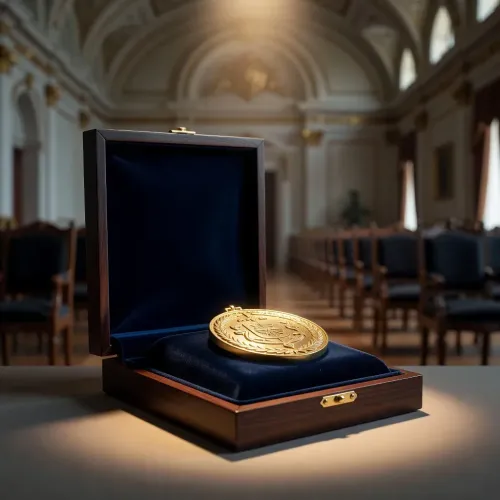
The National Medal of Science is awarded by the President to individuals who have made outstanding contributions to scientific knowledge. The National Medal of Technology and Innovation honours achievements that have demonstrably advanced technological progress and innovation within the United States. Both are administered through the White House and represent the highest civilian recognition in their respective domains. This ceremony is notable for clustering multiple recipients across AI, semiconductors, and space — reflecting the current administration's stated focus on sustaining American dominance in deep technology.
Point of View
Huang and Su, Trump lends the administration's tech agenda a bipartisan scientific credibility it might otherwise lack. Notably, the inclusion of Sergey Brin, who has historically kept distance from Washington, signals that Silicon Valley's wariness of the current White House is thawing in the AI era. For India, Nadella's medal is a soft-power moment, but the harder question is whether Washington's AI-first industrial policy — quantum by 2028, the Genesis mission, the superintelligence accord — will pull capital and talent away from allied ecosystems, including India's own emerging deep-tech sector.
NationPress
9 Oct 2026
Frequently Asked Questions
Who received the National Medal of Technology and Innovation at the New Golden Age Summit?
Satya Nadella, CEO of Microsoft, and Michael Dell, founder of Dell Technologies, received the National Medal of Technology and Innovation at the New Golden Age Summit on 9 October 2026. The medal is the United States' highest recognition for technological achievement.
Why did Trump honour Satya Nadella?
Trump honoured Satya Nadella for transforming Microsoft over more than three decades, building its cloud computing infrastructure, and positioning the company as an early leader in artificial intelligence and superintelligence. The award citation specifically recognised Nadella's role in enabling the global deployment of advanced AI.
What is the National Medal of Science and who won it at the summit?
The National Medal of Science is the United States' highest presidential recognition for outstanding contributions to scientific knowledge. At the New Golden Age Summit, it was awarded to Elon Musk, Sergey Brin, Jensen Huang, and Lisa Su.
What did Trump say about Elon Musk at the ceremony?
Trump called Elon Musk a 'modern day Thomas Edison' and described him as a national treasure. He highlighted Musk's achievements in SpaceX's reusable rockets, the Starlink satellite network, and space exploration.
What scientific goals did Trump outline at the New Golden Age Summit?
Trump outlined quantum computing, nuclear energy, artificial intelligence, and space exploration as his administration's scientific priorities. He specifically said the US was working toward developing a quantum computer capable of scientific discovery by 2028, and referenced the Genesis mission and a White House accord on superintelligence.