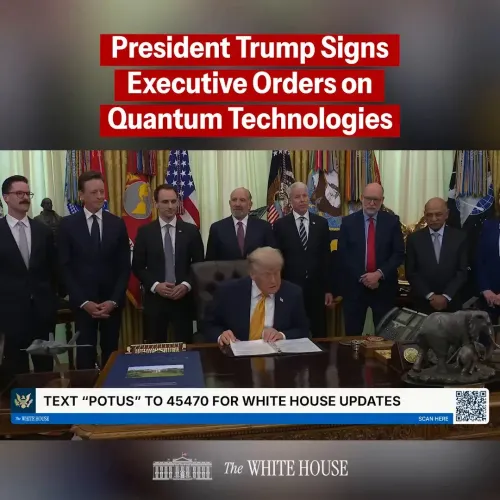
Trump sets 2028 quantum computing goal at New Golden Age Summit
Synopsis
At the New Golden Age Summit, Trump did not just speak about technology — he staked a geopolitical claim. A 2028 quantum computing deadline, a White House Accord on Superintelligence, four small modular reactors already online, and a Mars mission in the offing: the agenda is the most sweeping American science-and-tech declaration in decades, explicitly framing innovation as the new frontier of great-power competition.
Key Takeaways
Donald Trump set a 2028 target to deliver a quantum computer for scientific discovery, announced at the New Golden Age Summit on 9 October 2026 .
The administration launched the Genesis mission to apply superintelligence to major scientific problems, and brokered the White House Accord on Super Intelligence .
Trump said four cutting-edge small modular reactors were activated this year, with regulatory barriers being removed for further nuclear deployment.
NASA's Artemis programme will aim to establish a permanent American presence on the Moon, with Mars identified as the next major destination.
Michael Kratsios of the White House Office of Science and Technology Policy framed the agenda as a revival of America's greatest scientific eras, citing the Manhattan Project and Apollo landing as precedents.
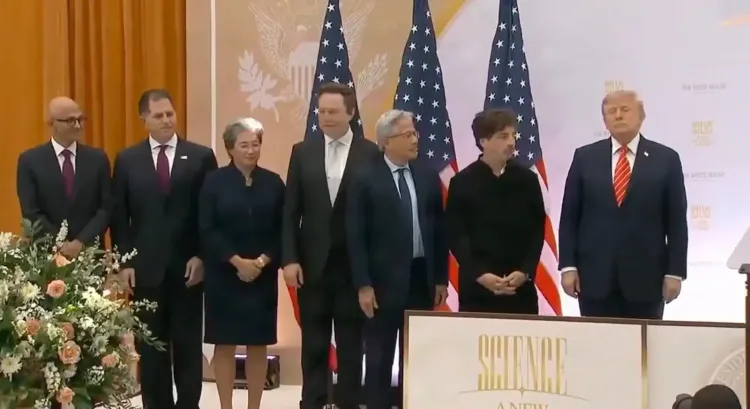
Six technology leaders received the National Medal of Science and National Medal of Technology and Innovation at the summit.
US President Donald Trump on 9 October 2026 announced a target to deliver a quantum computer for scientific discovery by 2028, unveiling a sweeping technology agenda at the New Golden Age Summit in Washington that also encompasses superintelligence, next-generation nuclear energy, and renewed American missions to the Moon and Mars.
The announcement positions quantum computing alongside artificial intelligence and advanced energy as the three pillars of the administration's scientific programme — a signal of how broadly the White House is defining technological competition with rival powers.
Quantum Computing and the 2028 Target
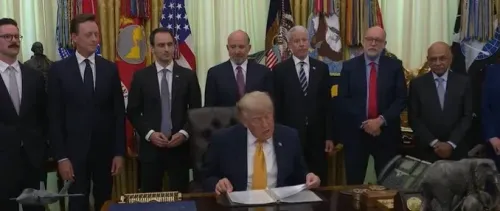
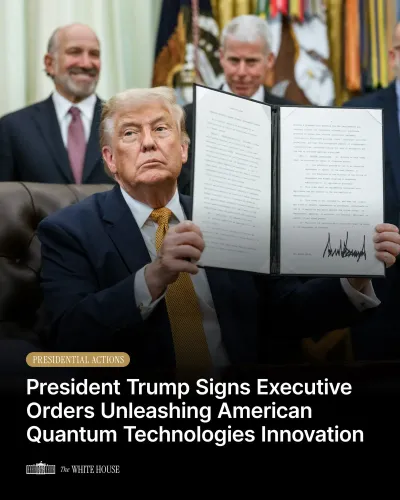
'I signed an order to support the advancement of quantum computing and set the goal of delivering a quantum computer for scientific discovery by 2028,' Trump said at the summit. Quantum computing harnesses principles of quantum mechanics to process information in ways conventional computers cannot, with potential applications spanning materials science, chemistry, and medicine. Researchers caution, however, that significant technical hurdles remain before large-scale practical systems become widely available.
Nuclear Energy and Regulatory Overhaul
Trump said his administration was actively removing regulatory obstacles to deploying next-generation nuclear energy systems. 'Our country started up four cutting-edge small modular reactors just this year alone,' he said. Small modular reactors (SMRs) are compact nuclear units seen as a faster-to-deploy alternative to conventional large-scale plants, and their acceleration signals a deliberate energy diversification push alongside the AI-driven power demand surge.
Superintelligence and the Genesis Mission
The US President also highlighted the Genesis mission, an administration initiative designed to deploy advanced artificial intelligence to tackle complex scientific problems. 'We've also created the Genesis mission to solve some of the biggest mysteries in science and technology with superintelligence,' Trump said. He added that the White House had brokered a new accord on superintelligence the previous week: 'Last week, we brokered the White House Accord on Super Intelligence, keeping America at the forefront of Super Intelligence.'
Moon, Mars and the Artemis Programme
Trump reaffirmed plans to establish a permanent American presence on the Moon under NASA's Artemis programme. 'American astronauts will soon return to establish a permanent American presence on the Moon,' he said. Mars was described as the next major destination, with Trump directly addressing NASA Administrator Jared Isaacman — 'We're gonna be going to Mars pretty soon, Jared?' — to underline the administration's ambitions. The Artemis programme is also designed to build the technologies and operational experience required for eventual human missions to Mars.
Broader Context and What Officials Said
Michael Kratsios, Director of the White House Office of Science and Technology Policy, invoked the Manhattan Project, the development of integrated circuits, the Apollo Moon landing, and the early internet as benchmarks the administration aspires to match. 'Today, our dream is a new golden age of scientific progress and technological innovation,' Kratsios said. The summit also recognised six prominent technology leaders with the National Medal of Science and the National Medal of Technology and Innovation. The breadth of the agenda — from subatomic computing to interplanetary exploration — reflects a deliberate effort to frame American scientific ambition as a geopolitical asset, not merely a domestic policy priority.
Point of View
Scientifically useful quantum machines remain years beyond current capability curves, and no administration order changes the underlying physics. The White House Accord on Superintelligence, meanwhile, is light on verifiable commitments; its real function appears to be signalling leadership in an AI race that is already reshaping alliances. What is genuinely notable is the nuclear angle: four SMRs activated in a single year would be a substantial shift if the numbers hold, and the regulatory rollback could set a precedent other nations follow. Mainstream coverage risks treating this as a vision speech — the harder question is which of these targets come with funded programmes, measurable milestones, and independent oversight.
NationPress
9 Oct 2026
Frequently Asked Questions
What is Trump's 2028 quantum computing target?
President Trump announced at the New Golden Age Summit on 9 October 2026 that he had signed an order to support quantum computing development, with a goal of delivering a functional quantum computer for scientific discovery by 2028. Quantum computers use quantum mechanical principles to process information far beyond the reach of conventional machines, with potential uses in chemistry, medicine, and materials science — though significant technical challenges remain.
What is the Genesis mission announced by Trump?
The Genesis mission is a White House initiative designed to use advanced artificial intelligence — described by Trump as 'superintelligence' — to tackle some of the most complex unsolved problems in science and technology. It was announced alongside the White House Accord on Super Intelligence, which the administration says is intended to keep the United States at the forefront of AI development.
What did Trump say about nuclear energy at the summit?
Trump said the administration had started up four cutting-edge small modular reactors in the current year alone and was removing regulatory barriers to deploy next-generation nuclear energy systems more broadly. Small modular reactors are compact nuclear units considered faster and cheaper to build than conventional large-scale plants.
What are the US plans for Moon and Mars exploration?
Trump reaffirmed that American astronauts would return to the Moon under NASA's Artemis programme to establish a permanent presence, and identified Mars as the next major destination for human space exploration. NASA Administrator Jared Isaacman was acknowledged at the summit for his leadership of the space agency.
Who is Michael Kratsios and what did he say?
Michael Kratsios is the Director of the White House Office of Science and Technology Policy. At the summit, he invoked America's past scientific achievements — the Manhattan Project, integrated circuits, the Apollo Moon landing, and the early internet — as the standard the current administration aims to match, describing the goal as a 'new golden age of scientific progress and technological innovation.'