Trump defends Iran strikes, says it's not a new war: 'America First'
Synopsis
Trump went on NBC to defend striking Iran — and didn't flinch. He rejected the 'broken promise' charge, claimed B-2 bombers 'totally obliterated' Iranian nuclear sites, and offered Tehran a stark binary: a 'strong deal' or further strikes. Whether his claims of decisive success hold up to independent scrutiny is the question the world is now asking.
Key Takeaways
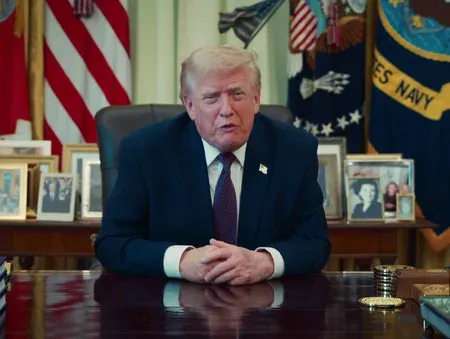
US President Donald Trump defended American military strikes against Iran in an interview on NBC's Meet the Press on 7 June .
Trump denied breaking his no-new-wars pledge, saying: 'I didn't guarantee no war.
I don't like these endless wars.
This is not an endless war.' He claimed B-2 bombers launched approximately 9–10 months ago 'totally obliterated' an Iranian nuclear site.
Trump said the US is 'almost finished' and is pursuing either a negotiated deal or further military action.
The Iran nuclear dispute has been a central US foreign policy issue for over two decades , spanning multiple administrations.
US President Donald Trump on Sunday, 7 June defended American military strikes against Iran, pushing back firmly against suggestions that the operation contradicted his long-standing pledge to keep the United States out of new wars. Speaking in an exclusive interview on NBC's Meet the Press, Trump framed the action as a necessary measure to prevent Tehran from acquiring a nuclear weapon — and insisted it would not become another protracted Middle East conflict.
Trump's Defence of the Strikes
When asked directly whether the military campaign broke a campaign promise he had repeated since 2015, Trump was unequivocal. 'No. No,' he replied. 'I had to stop a country, very powerful, very dangerous country from having a nuclear weapon because they'd use it,' he said. 'I'm doing our country a service. It's America first.'
Trump also disputed the premise of the question, clarifying his earlier position. 'First of all, I didn't guarantee no war,' he said. 'I don't like these endless wars. This is not an endless war.'
The Decision to Act
Trump described a high-stakes internal deliberation before authorising the strikes. 'At the hottest point in the history of our country, I took Scott Howard, I took Pete, I took everybody into a room. I said, I have to do this country, this world, the Middle East, Israel, everybody a favour. You have Iran. They're going to have a nuclear weapon,' he said.
He added that he had previously terminated the Obama-era nuclear agreement with Iran before ordering the military action. 'I terminated the deal,' Trump said. 'Then I sent the B-2 bombers in about nine, 10 months ago. And they obliterated, totally obliterated the site.'
Claims of Decisive Military Success
Trump made sweeping claims about the scale of American military achievements, asserting that the operation had fundamentally degraded Iran's capabilities. 'We took over Venezuela in a matter of minutes. We destroyed the capability of Iran in a matter of days. Nobody's ever seen anything like it,' he said.
He further stated: 'It's not a quagmire. I just wiped out the military of a very dangerous country and I wiped out the nuclear threat.' These claims have not been independently verified, and analysts caution that assessments of Iran's residual military and nuclear capacity remain contested.
Diplomacy Still on the Table — With a Warning
Despite the military action, Trump indicated that a negotiated settlement remained possible, though he paired the offer with a stark threat. 'I'm gonna do it either through negotiation where we're very close to a deal, or I'm gonna blow the hell out of them, to be honest with you,' he said. He added that the United States was 'almost finished' and anticipated either a deal or a definitive resolution. 'They cannot have a nuclear weapon,' he reiterated.
Decades of US-Iran Nuclear Tensions
The dispute over Iran's nuclear programme has been a defining issue in American foreign policy for more than two decades. Successive administrations — from George W. Bush through Barack Obama and Joe Biden — sought to contain Tehran's nuclear ambitions through a combination of sanctions, multilateral diplomacy, and international monitoring under the International Atomic Energy Agency (IAEA). Trump's first term saw him exit the 2015 Joint Comprehensive Plan of Action (JCPOA), reimposing sweeping sanctions. The latest military escalation marks a significant departure from the diplomatic track that had, until recently, remained nominally active.
With Trump signalling that the United States is close to either a deal or further strikes, the next few weeks will be critical in determining the shape of the post-conflict order in the Middle East.
Point of View
A hardened regional proxy network, and a nuclear knowledge base that cannot be bombed away. History suggests that military destruction of nuclear infrastructure, from Iraq in 1981 to Syria in 2007, delays programmes but rarely ends them. Trump's binary — deal or more bombs — leaves little room for the messy, protracted diplomacy that non-proliferation actually requires.
NationPress
22 Oct 2026
Frequently Asked Questions
Why did Trump order military strikes on Iran?
Trump said he authorised the strikes to prevent Iran from acquiring a nuclear weapon, describing Tehran as a 'very powerful, very dangerous country' that would use such a weapon. He framed the action as a matter of national and allied security under an 'America First' doctrine.
Did the Iran strikes contradict Trump's promise to avoid new wars?
Trump rejected that characterisation in his NBC interview on 7 June, saying he never guaranteed 'no war' — only that he opposed 'endless wars.' He argued the Iran operation is limited and not a prolonged military engagement.
What did Trump claim the B-2 bombers achieved in Iran?
Trump claimed that B-2 bombers, deployed roughly nine to ten months before the interview, 'totally obliterated' an Iranian nuclear site. These claims have not been independently verified by analysts or allied governments.
Is the US open to a diplomatic deal with Iran?
Trump indicated diplomacy remains possible, saying the US is 'very close to a deal.' However, he simultaneously warned he would 'blow the hell out of them' if negotiations fail, framing it as a binary choice between a strong deal and further military action.
What is the background of the US-Iran nuclear dispute?
The dispute spans more than two decades, with successive US administrations using sanctions, diplomacy, and international monitoring to prevent Iran from developing a nuclear weapon. Trump exited the 2015 JCPOA during his first term and reimposed sanctions; the latest military strikes represent a significant escalation beyond previous policy approaches.