Trump Launches Ratepayer Protection Pledge on Data Center Energy Costs

Synopsis
President Trump has announced the Ratepayer Protection Pledge, directing data center companies to bear their own energy infrastructure costs rather than passing them to ordinary American electricity consumers, the White House said on July 28, 2026.
Key Takeaways
The White House announced the Ratepayer Protection Pledge on July 28, 2026 , attributed to President Donald Trump .
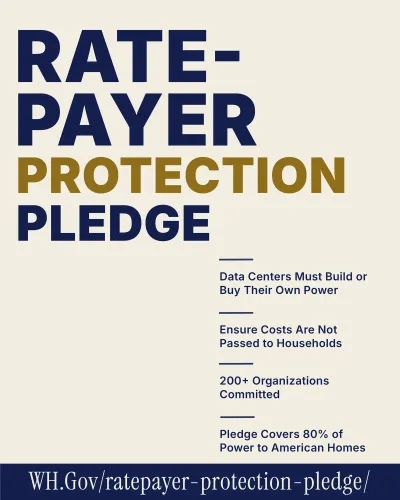
The pledge aims to make data center companies pay for their own energy and grid-upgrade costs, rather than those costs being passed to ordinary ratepayers.
Surging electricity demand from AI and cloud computing data centers has intensified the debate over who should fund US grid upgrades.
The move extends Trump's first-term consumer-protection energy agenda into the AI infrastructure era.
Specific legal provisions and enforcement mechanisms of the pledge have not yet been publicly detailed .
Federal and state-level regulatory responses will determine how broadly the pledge is implemented.
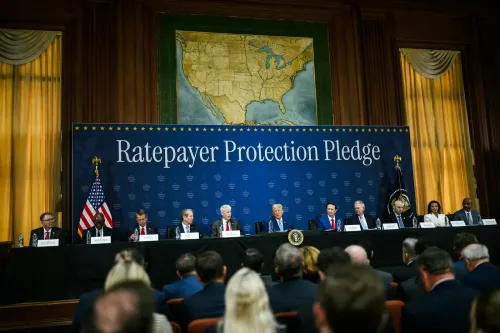
The White House announced on Monday, July 28, 2026, that President Donald Trump is promising to make companies pay for data center energy costs through a new initiative called the Ratepayer Protection Pledge, framing the move as a direct consumer protection measure for American electricity users.
Context
The White House post states that President Trump is 'promising to make companies pay for data center energy costs with his Ratepayer Protection Pledge,' describing it as 'what protecting American consumers looks like.' The announcement was accompanied by a video featuring local media coverage of the pledge.
The pledge targets a growing tension in the United States energy market: as large technology companies build and expand data centers to power cloud computing and artificial intelligence workloads, electricity demand has surged sharply since the early 2020s, raising questions about who should bear the cost of upgrading the power grid.
Policy Backdrop
The rapid expansion of data centers across the United States has placed significant pressure on electricity grids, prompting a national debate over cost allocation. Utility providers and consumer advocates have long argued that large commercial users — not ordinary ratepayers — should shoulder the infrastructure upgrades their operations require.
During his first term from 2017 to 2021, President Trump pursued an 'America First' energy agenda that emphasised domestic production and shielding consumers from higher utility costs through deregulation. The Ratepayer Protection Pledge appears to extend that consumer-first framing into the current debate over AI and cloud infrastructure energy demands.
Energy cost allocation in the United States sits at the intersection of federal oversight — primarily through the Federal Energy Regulatory Commission — and state-level utility regulation, making any national pledge complex to implement uniformly.
Stakeholders and Impact
Ordinary electricity consumers stand to benefit most directly if data center operators are required to fund grid upgrades independently, preventing those costs from being passed through to residential and small-business utility bills. Consumer advocacy groups have raised alarms in recent years as grid-upgrade costs have increasingly appeared in household electricity rates.
Data center operators and large technology companies would face higher direct costs under such a framework, a shift from the current model in many states where infrastructure expenses are socialised across the broader ratepayer base. Utility providers sit in the middle, managing the infrastructure and potentially subject to new cost-recovery rules.
The pledge, as signalled by the White House, is positioned as a corrective to what the administration characterises as an unfair burden on everyday Americans at a time when AI-driven electricity demand is accelerating.
What's Next
The specific provisions, legal mechanism, and enforcement framework of the Ratepayer Protection Pledge have not yet been detailed in publicly available records. Observers will watch for formal executive orders, regulatory guidance from federal energy authorities, or legislative proposals in Congress that give the pledge binding force.
State legislatures and utility regulators are also likely to respond, given that much of the regulatory authority over electricity rates sits at the state level. How individual states align with or push back against the federal signal will determine the pledge's practical reach for American consumers.
Point of View
The White House is entering a complex jurisdictional space where federal signalling must ultimately be translated into action by FERC and state utility commissions. The pledge fits a broader pattern of using executive statements to set political expectations ahead of formal rulemaking, a strategy that generates immediate public messaging value while the harder regulatory work unfolds more slowly. For India, which is navigating its own surge in data center investment and grid-capacity questions, the US debate offers a live policy reference point on cost allocation frameworks.
NationPress
27 Jul 2026
Frequently Asked Questions
What is Trump's Ratepayer Protection Pledge?
The Ratepayer Protection Pledge is an initiative announced by the White House under President Donald Trump that aims to require data center companies to pay for their own energy and electricity grid-upgrade costs, rather than those expenses being passed on to ordinary American consumers through higher utility bills.
Why are data centers causing electricity costs to rise in the US?
The rapid expansion of data centers to support cloud computing and artificial intelligence has driven sharp increases in US electricity demand since the early 2020s. Utility providers have sought to recover the cost of grid upgrades from the broader ratepayer base, raising household and small-business electricity bills.
How will the Ratepayer Protection Pledge be enforced?
The specific legal provisions and enforcement mechanisms have not yet been publicly detailed . Implementation would likely require formal executive orders, regulatory action by federal energy authorities, or legislation, and would intersect with state-level utility regulation.
Who benefits from Trump's data center energy pledge?
Ordinary American electricity consumers — residential users and small businesses — stand to benefit most if data center operators are required to fund grid infrastructure independently, preventing those costs from appearing in standard utility bills.
What is the US federal role in electricity regulation?
At the federal level, the Federal Energy Regulatory Commission (FERC) oversees interstate power markets, but much of the day-to-day regulation of electricity rates and utility operations sits with individual state utility commissions , making uniform national implementation of any pledge complex.