Trump Rules Out Iran Strike Before US Midterm Elections
Synopsis
President Trump publicly pledged the US will not attack Iran before the November 3rd Midterm Elections, while acknowledging Iran is in severe economic and military distress. The statement, issued by the White House on October 8, 2026, constrains US military options for a defined window but leaves the post-election landscape explicitly open.
Key Takeaways
Trump declared the United States will not attack Iran before the November 3rd Midterm Elections .
Trump publicly acknowledged Iran is in 'very bad condition, both Economically and Militarily.' The statement was issued via the official White House account on October 8, 2026 .
The pledge constrains US military action for a specific window, but is silent on the post-election period.
By linking a military posture to a domestic electoral date, Trump has introduced a rare, explicit public timeline into US-Iran strategic signalling.
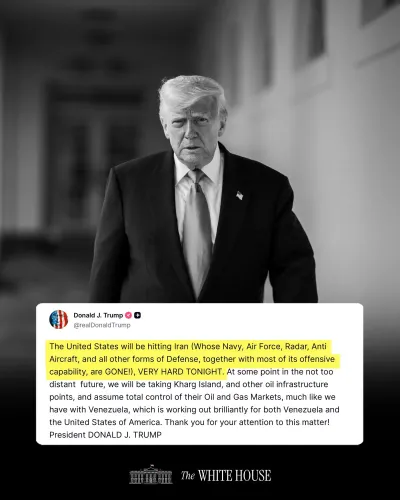
With Iran already under severe economic and military strain, President Donald J. Trump has drawn a sharp, public line: the United States will not strike Iran before the November 3rd Midterm Elections — and he wants the world to know it. The declaration, issued through the White House's official account on Thursday, October 8, 2026, is as notable for what it rules out as for what it leaves open.
The statement in full: a public pledge tied to a political calendar
Trump's words were unambiguous: 'I want to make it clear to everybody that, while Iran is in very bad condition, both Economically and Militarily... we will not be attacking Iran at any time prior to the Midterm Elections.' By tethering a military commitment to a domestic political date, the President has done something unusual — he has publicly constrained his own executive war-making options, at least for a defined window. The phrase 'at any time prior to' is doing enormous work here: it forecloses action before November 3rd but is silent on everything after.
Iran's economic and military condition: the pressure Trump acknowledged
Trump's characterisation of Iran as being in 'very bad condition, both Economically and Militarily' reflects a situation shaped by cascading sanctions, currency collapse, and the broader attrition of prolonged maximum-pressure policy. By acknowledging Iran's weakness publicly, Washington is sending a signal to both allies and adversaries: the leverage exists, the military option remains on the table, but it will not be exercised before polling day. The acknowledgement itself is strategic — it frames restraint as a position of strength, not hesitation.
Why the Midterm date changes the geopolitical calculus
Midterm elections in the United States traditionally reshape the legislative balance, and any military action in the weeks before November 3rd would inevitably be read through a domestic political lens. Trump's announcement removes that uncertainty for a fixed period — a move that could theoretically reduce the risk of miscalculation by Tehran or regional actors who might otherwise fear an October surprise. But it equally signals that the post-election landscape carries no such guarantee, a message with its own weight for every government watching.
Whether this is deterrence, diplomacy, or domestic politics — it is almost certainly all three. And the clock is now running.
Point of View
Calendar-bound reassurance is rarely issued — it trades operational flexibility for diplomatic predictability, potentially reducing the risk of accidental escalation in a volatile window. However, the silence on the post-November 3rd period is itself a message, one that will be read very carefully in Tehran, Tel Aviv, and Riyadh. The statement also reflects a pattern in Trump's diplomatic style — using public declarations to signal both restraint and latent threat simultaneously.
NationPress
8 Oct 2026
Frequently Asked Questions
Will the US attack Iran before the 2026 Midterm Elections?
No. President Trump explicitly stated the United States will not attack Iran at any time before the November 3rd Midterm Elections. The statement was issued by the White House on October 8, 2026.
What did Trump say about Iran's current condition?
Trump described Iran as being in 'very bad condition, both Economically and Militarily,' signalling that US pressure on Iran has taken a significant toll, even as he ruled out a military strike before the Midterms.
When are the US Midterm Elections in 2026?
The US Midterm Elections are scheduled for November 3rd, 2026. Trump's statement explicitly links his no-strike pledge to this date.
Does Trump's statement mean the US will never attack Iran?
No. The pledge only covers the period before November 3rd. Trump's statement is silent on what happens after the Midterm Elections, leaving the post-election window open-ended.
Why does a US attack on Iran matter for India?
Any US military action against Iran could disrupt oil supplies through the Strait of Hormuz, spike global crude prices, and affect Indian shipping and energy costs, given India's significant economic ties with both the US and Iran.