Trump Suggests Iran Negotiations Could Stabilize the Middle East
Synopsis
President Trump believes that ongoing negotiations with Iran may lead to significant stability in the Middle East, a region critical to global energy supplies. The talks are seen as crucial for both regional peace and economic implications worldwide.
Key Takeaways
Negotiations with Iran may lead to long-term stability in the Middle East.
Both the U.S. and Iran are showing interest in finalizing a deal.
The outcome could have significant impacts on global oil prices.
Trump warns of military action if talks fail.
Domestic immigration policies are linked to the broader political climate.
Washington, March 23 (NationPress) President Donald Trump stated on Monday that discussions with Iran have the potential to foster long-lasting stability in the Middle East, a region crucial for global energy resources and host to millions of expatriates.
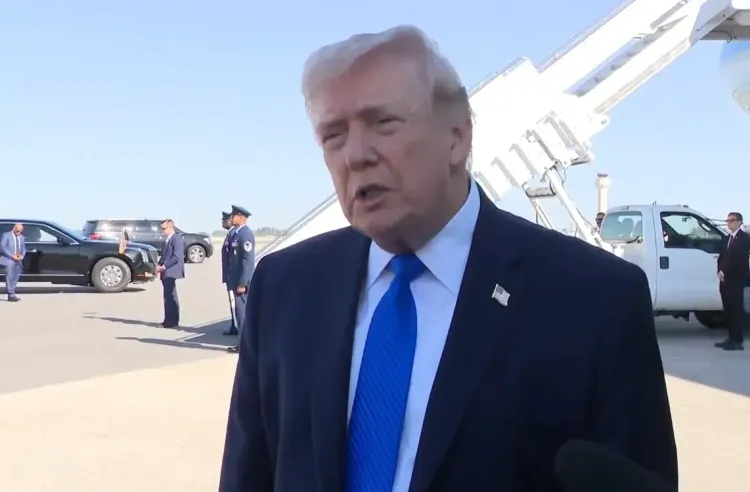
During a media interaction at a Miami airport, Trump remarked that the United States and Iran have engaged in "very, very strong talks" and are nearing a possible agreement. He mentioned that the conversations encompassed "almost all points of agreement" and could swiftly progress towards a deal.
"They are eager to finalize a deal. We are also interested in making a deal," Trump noted, adding that both parties are operating within a "five-day period" to evaluate advancements.
However, he cautioned that failure to reach an agreement could result in continued military action. "If the talks proceed well, we will likely settle this matter. Otherwise, we will continue our military operations," he told reporters.
In his comments, Trump reaffirmed that "we will never possess a nuclear weapon," emphasizing the need for "no enrichment" and broader objectives for regional peace. "Our goal is to achieve peace in the Middle East," he stated, suggesting that a deal would be "invaluable for Israel" and advantageous for nations like Saudi Arabia, the United Arab Emirates, Qatar, Kuwait, and Bahrain.
He implied that Iran had initiated the current round of discussions. "They reached out. I did not initiate contact. They are keen on making a deal," Trump explained, alluding to a planned strike on Iranian infrastructure that had been called off. "Why would they want that?" he added.
Trump also indicated that the United States could assume control of Iran’s enriched uranium as part of any agreement. "If we reach an arrangement with them, we will take it ourselves," he stated.
Discussing the internal situation in Iran, Trump mentioned that many leadership factions had been eliminated in previous conflict phases. "We have eliminated numerous leadership groups. They are all gone," he said, indicating that the remaining leaders are "very representative of the country."
He acknowledged the unpredictability of the outcome, saying, "I guarantee nothing. All I am asserting is that we are currently facing a genuine possibility of reaching an agreement."
On oil markets, Trump noted that a deal could lead to immediate global repercussions. "The price of oil will plummet as soon as an agreement is finalized," he remarked.
Additionally, Trump addressed domestic matters, including the deployment of Immigration and Customs Enforcement (ICE) agents at U.S. airports. He advised agents against wearing masks in that environment. "I didn’t find it appropriate for an airport setting," he stated, while also defending ICE’s broader enforcement responsibilities.
He attributed the ongoing federal shutdown and immigration issues to Democrats. "This is all the Democrats' doing," he asserted, while commending ICE as "a highly skilled group of individuals" performing "a commendable job."
On military actions, Trump justified earlier strikes on Iran’s nuclear facilities, claiming they had significantly delayed its program. "If we hadn't taken action... they would have achieved a nuclear weapon within two weeks to a month," he asserted.
For nations like India, developments in the Gulf have direct implications for energy security and the wellbeing of large expatriate communities, making the outcomes of these talks closely monitored.
Point of View
It's crucial to recognize the complexity of diplomatic negotiations in the Middle East. While the potential for peace is promising, the outcomes remain uncertain and require careful scrutiny.
NationPress
22 Sept 2026
Frequently Asked Questions
What did Trump say about Iran negotiations?
Trump indicated that negotiations with Iran could lead to long-term stability in the Middle East, emphasizing that both parties are eager to finalize a deal.
What are the implications of these talks?
The discussions could significantly affect global energy markets and regional peace, especially for countries like Israel and Saudi Arabia.
What did Trump mention about military actions?
Trump warned that failure to reach an agreement could result in continued military action against Iran.
How could a deal with Iran impact oil prices?
Trump stated that oil prices could drop significantly as soon as an agreement with Iran is reached.
What role does immigration policy play in this context?
Trump criticized Democrats for the ongoing federal shutdown and discussed the role of ICE agents at U.S. airports.