Trump, Thai PM Sign Reciprocal Trade Deal, Zero U.S. Tariffs
Synopsis
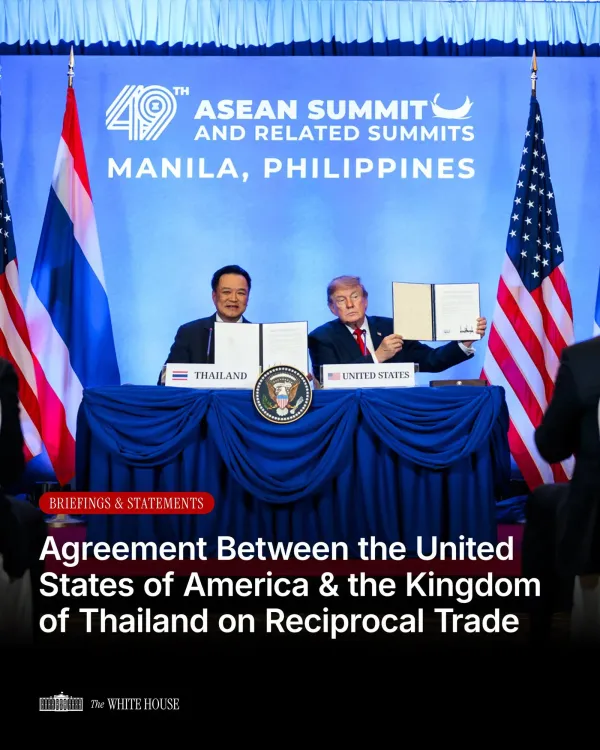
President Trump and Thai Prime Minister Charnvirakul signed a reciprocal trade agreement on November 17, 2026, eliminating all tariffs on U.S. exports and securing an estimated $2.6 billion in Thai agricultural purchases — continuing the administration's bilateral trade-first strategy.
Key Takeaways
President Trump and Thai PM Charnvirakul signed a reciprocal trade agreement on November 17, 2026 .
The deal eliminates all tariffs on U.S. exports entering Thailand.
Thailand commits to an estimated $2.6 billion in purchases of U.S. agricultural products.
The agreement follows the structural model of the USMCA (2018) and the U.S.-China Phase One deal (2020) — tariff removal paired with purchase commitments.
Implementation timelines, product categories, and enforcement mechanisms will be the key metrics to watch in coming months.
The deal reinforces the U.S. strategy of deepening bilateral economic ties in Southeast Asia as a counterweight to Chinese regional influence.
A new chapter in U.S.-Thailand economic ties opened on Tuesday, November 17, 2026, as President Donald Trump and Thai Prime Minister Charnvirakul signed a reciprocal trade agreement that eliminates all tariffs on U.S. exports and locks in an estimated $2.6 billion in Thai purchases of American agricultural goods — a deal the White House is billing as a defining win for American farmers and exporters.
What the deal actually does for American farmers
At its core, the agreement is built on two pillars: full tariff elimination on U.S. exports entering Thailand, and a firm commitment from Bangkok to buy an estimated $2.6 billion worth of U.S. agricultural products. For American grain growers, meat producers, and agribusinesses that have long eyed Southeast Asia as an underpenetrated market, the numbers are significant. Thailand is itself a major agricultural economy — a top global exporter of rice, rubber, and processed foods — which makes the symmetry of the deal politically meaningful on both sides.
The White House announced the signing on its official communications channel, stating that the agreement secures 'a major win for American farmers, American businesses, and U.S.-Thailand trade.' The framing is deliberate: by anchoring the headline figure to agriculture, the administration signals its continued focus on rural constituencies who have been central to Trump's political coalition.
Thailand's place in the America First trade playbook
This is not the first time an American administration has used bilateral deals to bypass the slower machinery of multilateral negotiations. The USMCA in 2018 set the template — replacing NAFTA with a reciprocity-first framework that demanded measurable market access in exchange for continued preferential terms. The U.S.-China Phase One deal of 2020 then applied similar logic to agricultural purchase commitments, with Beijing pledging hundreds of billions in American goods. The Thailand agreement appears to follow that same structural DNA: a purchase pledge paired with tariff removal, with both sides able to claim domestic victory.
Thailand has historically been a constructive U.S. economic partner in Southeast Asia, and Washington has long sought to deepen that relationship as a counterweight to China's regional economic gravity. A clean bilateral deal — outside the stalled frameworks like the Trans-Pacific Partnership — fits the administration's preference for speed and direct accountability over multilateral consensus.
What comes next: timelines, commitments, and verification
The critical question now is implementation. Purchase commitments of $2.6 billion mean little without clear timelines, product categories, and enforcement mechanisms. Observers will watch closely for congressional notifications, any implementing legislation, and the first quarterly trade data showing whether Thai import volumes from the U.S. actually shift. The Phase One China deal offered a cautionary lesson: ambitious purchase targets on paper do not always translate to delivery on the ground.
For India, watching from the sidelines, the deal adds another data point to a broader pattern — the U.S. is actively rewarding trading partners who agree to reduce barriers and absorb American agricultural surpluses. Any economy that has delayed or stalled a similar bilateral conversation with Washington may find itself at a competitive disadvantage in U.S. market access negotiations ahead.
The flags are up, the handshake is done. Now the numbers have to follow.
Point of View
Reciprocity-first' trade doctrine — quick bilateral deals that deliver headline numbers on agriculture and tariffs, bypassing the slower consensus-building of multilateral forums. The $2.6 billion purchase pledge echoes the Phase One China deal, which showed both the political appeal and the execution risk of commitment-based frameworks. For Southeast Asia, the deal signals that Washington is actively competing for economic alignment in the region, raising the cost of delay for other partners yet to finalise their own bilateral terms with the U.S. The real test will come in quarterly trade data — whether Thai import volumes from America actually move is what turns a signing ceremony into a genuine policy win.
NationPress
17 Nov 2026
Frequently Asked Questions
What did Trump and the Thai Prime Minister sign on November 17 2026?
They signed a reciprocal trade agreement that eliminates all tariffs on U.S. exports to Thailand and includes an estimated $2.6 billion commitment by Thailand to purchase American agricultural products.
Who is Thai Prime Minister Charnvirakul?
Charnvirakul is identified in the White House announcement as the current Thai Prime Minister who signed the trade agreement with President Trump on November 17, 2026.
How much will Thailand buy in U.S. agricultural goods under the deal?
The agreement secures an estimated $2.6 billion in U.S. agricultural purchases by Thailand, though specific product categories and timelines are yet to be publicly detailed.
How does this U.S.-Thailand deal compare to previous Trump trade agreements?
It follows the same structural model as the USMCA (2018) and the U.S.-China Phase One deal (2020), combining tariff removal with specific purchase commitments — a signature feature of the Trump administration's bilateral trade strategy.
What does the U.S.-Thailand trade deal mean for India?
The deal signals that the U.S. is actively rewarding partners who remove barriers and commit to American agricultural imports. Countries, including India, that have not yet finalised bilateral trade terms with Washington may face greater competitive pressure in future market-access negotiations.