White House Says Trump Boosted Farm Exports, Dairy Up 61% to EU

Synopsis
The White House announced on June 5, 2026, that President Trump has expanded US agricultural exports, with dairy shipments rising 41% to Japan, 48% to the Middle East, and 61% to the EU. The claim builds on a bilateral trade strategy that includes the 2019 US-Japan deal and USMCA.
Key Takeaways
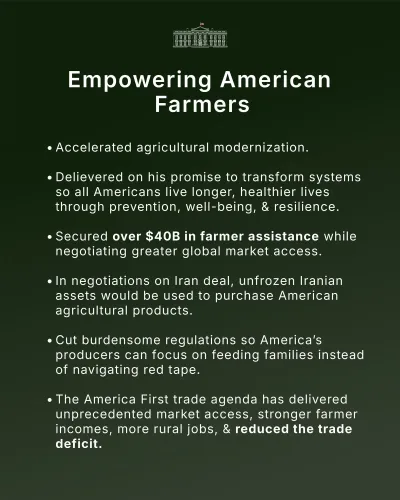
The White House announced on June 5, 2026 , that President Trump has expanded exports of meat, poultry, soybeans, biofuels, and dairy .
US dairy exports have reportedly surged 41% to Japan , 48% to the Middle East , and 61% to the European Union .
The gains are framed as the result of Trump's bilateral trade strategy, which includes the 2019 US-Japan Trade Agreement and the USMCA .
The EU dairy figure of 61% would represent a significant market-access breakthrough in a historically contested trade relationship.
Independent verification is expected through upcoming USDA Foreign Agricultural Service export data releases.
American dairy farmers and agribusiness exporters are the primary domestic beneficiaries of the reported export growth.
The White House announced on Friday, June 5, 2026, that President Donald Trump has expanded American agricultural exports across key markets, citing sharp rises in dairy shipments to Japan, the Middle East, and the European Union.
Context
The official White House post states that Trump 'has delivered for American farmers by expanding exports of meat, poultry, soybeans, biofuels, and dairy.' The announcement highlights three specific dairy export figures: a 41% surge to Japan, a 48% increase to the Middle East, and a 61% jump to the European Union. No baseline period or absolute volume figures were provided in the post.
The claim positions the administration's trade agenda as a direct win for the American agricultural sector, a constituency that has been central to Trump's political coalition across both his presidential terms.
Policy Backdrop
The Trump administration's agricultural trade strategy has historically relied on bilateral agreements rather than multilateral frameworks. The 2019 US-Japan Trade Agreement reduced tariffs on a range of American farm products including dairy, beef, and pork, opening a significant channel for US exporters into one of Asia's wealthiest consumer markets.
The United States-Mexico-Canada Agreement (USMCA), which came into force in 2020, also created new dairy and poultry export opportunities by revising the terms of North American agricultural trade. Meanwhile, the 2020 US-China Phase One deal included commitments from Beijing to purchase American soybeans, meat, and dairy, partially unwinding the damage caused by retaliatory tariffs that followed the 2018-2019 US steel and aluminium tariff disputes.
The EU has long been a contested market for American dairy and meat, with disputes over tariff-rate quotas and non-tariff barriers — including regulations on hormone-treated beef and chlorinated poultry — complicating market access. A 61% rise in dairy exports to the EU would mark a significant breakthrough if verified by official trade data.
Stakeholders and Impact
American dairy farmers and agribusiness exporters stand to benefit most directly from expanded market access. The US dairy sector has faced sustained pressure from domestic oversupply and volatile global commodity prices, making export growth a critical relief valve for producers.
For Japan and Middle Eastern importers, increased US dairy flows could affect local pricing and supply chains. In the EU, any significant rise in American dairy imports would be closely watched by European farm lobbies, who have historically opposed US agricultural market access in trade negotiations.
Broader agricultural categories cited in the post — meat, poultry, soybeans, and biofuels — involve millions of American producers and touch on some of the most politically sensitive dimensions of US trade policy.
What's Next
Independent verification of the cited export percentages is expected through upcoming USDA Foreign Agricultural Service data releases, which track US agricultural trade flows by commodity and destination. Analysts will examine whether the gains reflect new bilateral tariff concessions, currency effects, or shifts in global demand.
Any fresh tariff-reduction talks between the United States and the EU or Japan will be closely watched as a signal of whether the current export momentum can be institutionalised into durable trade architecture. For American farmers, the durability of these gains — rather than a single-year surge — will determine the long-term impact of the administration's trade approach.
Point of View
Tariff-first approach. The 61% EU dairy figure is the most politically significant claim, given the EU's historically high resistance to American agricultural imports; if verified, it would represent a genuine policy win. However, the absence of baseline periods or absolute volumes in the post means the numbers will face scrutiny before they translate into durable political capital.
NationPress
24 Sept 2026
Frequently Asked Questions
What did the White House say about US farm exports in June 2026?
The White House announced on June 5, 2026, that President Trump has expanded American agricultural exports including meat, poultry, soybeans, biofuels, and dairy, citing dairy export surges of 41% to Japan, 48% to the Middle East, and 61% to the EU.
Why have US dairy exports to the EU increased under Trump?
The White House attributes the increase to Trump's trade policy, which has used bilateral negotiations and tariff leverage to open markets. The EU has historically been a difficult market for US dairy due to tariff-rate quotas and regulatory barriers, making a 61% rise — if verified — a notable development.
What trade deals has Trump used to boost agricultural exports?
Key agreements include the 2019 US-Japan Trade Agreement, which reduced tariffs on US dairy and meat, and the USMCA (effective 2020), which revised North American dairy trade terms. The 2020 US-China Phase One deal also included Chinese purchase commitments for US farm goods.
How does this affect Indian readers or India-US trade?
While this announcement focuses on US exports to Japan, the Middle East, and the EU, shifts in global agricultural trade flows — particularly in soybeans and dairy — can affect commodity prices and supply chains that touch Indian importers and food-processing industries.
Where can I find verified data on US agricultural export figures?
The USDA Foreign Agricultural Service publishes regular trade data reports on US agricultural exports by commodity and destination country, and upcoming releases are expected to either confirm or contextualise the figures cited in the White House post.