Trump threatens to double Alaska pipeline price if South Korea delays sign-off

Synopsis
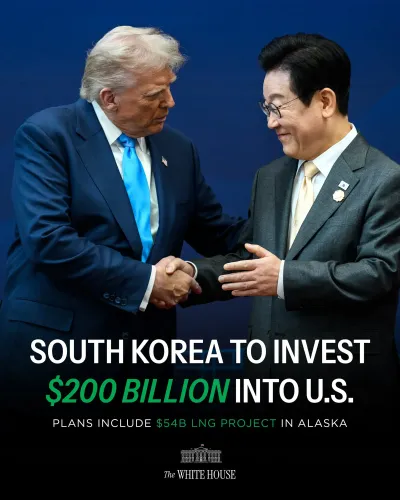
Trump publicly threatened to double the price South Korea would pay for the Alaska LNG pipeline project after being told live by a reporter that Seoul had not yet signed off — a sharp, unscripted escalation that puts US pressure on a key ally in full public view, with no deadline or mechanism specified.
Key Takeaways
President Donald Trump warned South Korea on 3 October 2026 that it could face doubled prices on the Alaska LNG pipeline if it does not sign soon.
Trump made the remarks at the White House before departing on Marine One , in response to a reporter’s question.
Seoul has said it is still studying the proposal and has not signed off on the project.
Trump did not specify what exactly would be doubled or provide a formal deadline.
The Alaska LNG project would pipe gas from Alaska’s North Slope to a southern Alaska export facility, targeting Asian energy markets.
US President Donald Trump on 3 October 2026 warned South Korea that it could face a significantly higher price for the Alaska LNG pipeline project if Seoul does not commit to the deal soon, after reporters informed him that South Korea had said it was still studying the proposal. The remarks, made at the White House before Trump departed aboard Marine One, mark a sharp escalation in US pressure on a key Asian ally over a flagship energy infrastructure initiative.
How the Warning Unfolded
The exchange began when a reporter challenged Trump, noting that South Korea had not yet signed off on the project and was still evaluating it. Trump initially appeared relaxed, saying he was comfortable if Seoul chose not to participate and that he would simply charge them more. But he then stopped to seek clarification.
“Wait, no. Wait, they said they didn’t sign off?” Trump asked, before sharpening his tone considerably.
“Tell ‘em if they don’t sign shortly, I’m going to double it up. Okay?” Trump told reporters.
He did not specify what exactly would be doubled, nor did he set a formal deadline for South Korea to make a decision.
What the Alaska LNG Project Is
The Alaska LNG project is designed to transport natural gas from Alaska’s North Slope through a pipeline across the state to a liquefied natural gas (LNG) facility in southern Alaska. From there, LNG would be exported to overseas markets. Asian economies — including South Korea, Japan, and others with high demand for imported energy — have been identified as key potential customers for the project.
South Korea’s Position
Seoul has reportedly not rejected the project outright but has not yet committed to it either, describing its current stance as a period of study and evaluation. Trump’s rejection of the suggestion that he had “jumped the gun” by previously implying South Korean participation suggests the two sides may have been at different stages of understanding regarding the deal’s status.
Wider Context and What It Means
The warning comes amid a broader pattern of Trump administration pressure on trading partners and allies to align with US energy export ambitions. Notably, the Alaska LNG project has faced years of financing and feasibility hurdles, and Washington has been actively courting Asian buyers to make the economics viable. South Korea is one of the world’s largest importers of LNG, making its participation strategically significant for the project’s long-term outlook.
Critics argue that Trump’s approach — threatening price increases without a defined timeline or mechanism — risks complicating negotiations with a close security and trade partner at a sensitive moment in US-Asia relations. How Seoul responds to this public pressure is expected to shape the project’s near-term trajectory.
Point of View
But its strategic logic is thin. Telling a critical ally — mid-negotiation, in public — that you’ll double the price if they don’t hurry is as likely to stiffen resistance in Seoul as it is to accelerate a deal. South Korea is one of the world’s largest LNG buyers, and Washington needs its participation to make the Alaska project financially credible. The real story here is the gap between Trump’s earlier implication of South Korean buy-in and Seoul’s apparent non-commitment — a credibility gap the administration has not yet addressed. Undefined threats with no deadline or mechanism attached tend to invite delay rather than resolve it.
NationPress
3 Oct 2026
Frequently Asked Questions
What did Trump say about South Korea and the Alaska pipeline?
Trump warned that South Korea could face a doubled price on the Alaska LNG pipeline project if Seoul does not sign on soon. He made the remarks at the White House on 3 October 2026, after a reporter told him South Korea had said it was still studying the proposal.
What is the Alaska LNG pipeline project?
The Alaska LNG project is designed to transport natural gas from Alaska’s North Slope through a pipeline to an LNG export facility in southern Alaska, from where liquefied natural gas would be shipped to overseas markets. Asian economies, including South Korea, are seen as major potential customers given their high demand for imported energy.
Has South Korea agreed to the Alaska pipeline deal?
No. South Korea has said it has not yet signed off on the project and is still studying the proposal. This is what prompted Trump’s warning about a potential price increase.
What exactly did Trump threaten to double?
Trump said he would ‘double it up’ if South Korea did not sign shortly, but he did not specify what exactly would be doubled — whether the price per unit of LNG, fees, or another cost component. He also gave no formal deadline.
Why does South Korea’s participation matter for the Alaska LNG project?
South Korea is one of the world’s largest importers of liquefied natural gas, making its commitment strategically and financially significant for the Alaska project. Asian demand is central to the project’s economic viability, and without major buyer commitments, securing financing for the infrastructure remains challenging.