Trump's Trade Agenda Fuels US Auto Manufacturing Revival
Synopsis
The White House credited President Trump's tariff regime and USMCA trade rules with supercharging auto manufacturing in Michigan. The administration's 25 percent steel tariffs and raised regional content requirements under USMCA are cited as the twin engines of a domestic production revival in America's auto heartland.
Key Takeaways
The White House announced on 27 July 2026 that President Trump's trade agenda is reviving American auto manufacturing, with Michigan as the focal point.
The administration imposed 25 percent tariffs on steel and 10 percent on aluminium in 2018 under Section 232 national security authority.
The USMCA , effective 2020 , raised regional value content for passenger vehicles to 75 percent , compelling greater North American sourcing.
Michigan 's auto sector — home to major assembly plants and supplier networks — is the primary stated beneficiary of these combined measures.
Upcoming Bureau of Labor Statistics manufacturing data will be the key independent test of the administration's resurgence claims.
For India , sustained US auto protectionism is a variable in bilateral trade and component-export strategy.
The White House on Monday, 27 July 2026, declared that President Donald Trump's trade agenda is driving a resurgence in American automobile manufacturing, with Michigan — the historic heart of the US auto industry — cited as a primary beneficiary of the administration's protectionist economic strategy.
Context
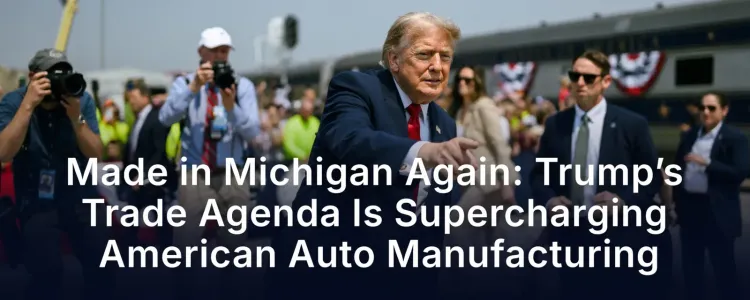
The post, titled 'Made in Michigan Again: President Trump's Trade Agenda Is Supercharging American Auto Manufacturing,' frames the current manufacturing environment as a direct result of sustained White House trade policy. Michigan has long been synonymous with American auto production, housing major assembly plants and a dense network of component suppliers that together employ hundreds of thousands of workers.
The state's auto sector has historically been among the most sensitive to shifts in trade policy, currency valuations, and global supply-chain dynamics, making it a key political and economic bellwether for any administration pursuing an industrial revival.
Policy Backdrop
The Trump administration's trade playbook has two foundational pillars. First, in 2018, the administration imposed 25 percent tariffs on steel and 10 percent tariffs on aluminium imports under Section 232 of the Trade Expansion Act, invoking national security authority to shield domestic metal producers — and by extension, auto manufacturers dependent on domestic steel supply chains.
Second, the administration renegotiated the decades-old NAFTA agreement, replacing it with the United States-Mexico-Canada Agreement (USMCA), which came into effect in 2020. The USMCA raised regional value content requirements for passenger vehicles to 75 percent, compelling automakers to source a greater share of components from within North America rather than from lower-cost offshore suppliers.
Together, these measures were designed to tilt the competitive landscape in favour of domestic production — a strategy the White House now characterises as bearing fruit in Michigan and beyond.
Stakeholders and Impact
Michigan's auto workers and manufacturers are the most directly affected constituency. The state's manufacturing employment has fluctuated sharply over decades in response to trade liberalisation, automation, and global demand cycles, and the administration's framing positions current conditions as a reversal of that long decline.
Broader stakeholders include component suppliers across the Midwest, steel and aluminium producers whose output feeds auto assembly lines, and consumers who may face pricing effects from reduced import competition. For India, which exports auto components and finished vehicles to the United States, sustained American protectionism in this sector remains a variable worth tracking in bilateral trade negotiations.
What's Next
Analysts and policymakers will watch upcoming Bureau of Labor Statistics manufacturing employment releases closely to assess whether the White House's characterisation of a manufacturing resurgence is borne out by official data. Any new Section 232 or Section 301 tariff actions targeting auto components would signal a further escalation of the administration's industrial policy posture.
With Michigan remaining a pivotal swing state in American electoral politics, the administration's emphasis on auto manufacturing gains is as much a political signal as an economic one — and the coming months will test whether the policy narrative is matched by durable job and output growth.
Point of View
Anchoring economic policy in a state that is both an industrial symbol and a political prize. The combination of Section 232 metals tariffs and USMCA content rules represents a coherent, if contested, industrial strategy — one that prioritises domestic supply-chain depth over consumer price efficiency. Whether the resurgence is structural or cyclical will determine its political durability; manufacturing employment gains that reverse before the next election cycle would undercut the narrative significantly. For trade partners including India, the signal is clear: the current US administration views protectionism in autos and metals as a settled policy, not a negotiating chip.
NationPress
28 Jul 2026
Frequently Asked Questions
What is Trump's trade policy doing to US auto manufacturing?
The Trump administration's 25 percent steel tariffs under Section 232 and the USMCA's 75 percent regional content requirement are designed to make domestic auto production more competitive by raising costs for imported materials and components. The White House says these measures are driving a manufacturing resurgence, particularly in Michigan.
What is the USMCA and how does it affect car manufacturing?
The USMCA — United States-Mexico-Canada Agreement — replaced NAFTA in 2020. It requires that at least 75 percent of a passenger vehicle's value come from within North America, pushing automakers to source more parts from the US, Canada, and Mexico rather than from Asia or Europe.
Why is Michigan important for American auto manufacturing?
Michigan is the historic centre of the US auto industry, home to major assembly plants and thousands of component suppliers. Employment in the state's auto sector is closely tied to trade policy, and it serves as both an economic bellwether and a key political battleground.
What are Section 232 tariffs and why were they imposed on steel?
Section 232 of the Trade Expansion Act allows the US president to impose tariffs on national security grounds. In 2018, President Trump used this authority to levy 25 percent tariffs on imported steel and 10 percent on aluminium, aiming to protect domestic producers that supply industries including auto manufacturing.
How does US auto trade policy affect India?
India exports auto components and, to a lesser extent, finished vehicles to the United States. Sustained American protectionism in the auto sector — through tariffs and high content requirements — can limit market access for Indian exporters and is a factor in ongoing bilateral trade discussions.