White House Says Trump Policies Are Shrinking US Trade Deficit
Synopsis
The White House on June 10, 2026 credited President Trump's trade and deregulation policies for a rapid decline in the US trade deficit. The claim, posted on X, draws on a policy lineage stretching from 2017-era tariffs and the USMCA to ongoing regulatory rollbacks — though economists note multiple macroeconomic factors drive the trade balance.
Key Takeaways
The White House posted on June 10, 2026 that the US trade deficit is 'FALLING fast' due to President Trump 's trade and deregulation policies.
The Trump administration's trade strategy includes Section 232 tariffs on steel and aluminium and Section 301 tariffs on roughly $360 billion of Chinese goods imposed between 2018 and 2019 .
The USMCA , which replaced NAFTA and took effect in 2020 , is a key first-term trade achievement aimed at rebalancing North American trade.
Executive Order 13771 (2017) mandated a two-for-one regulatory reduction rule across federal agencies as part of the deregulation push.
Economists note the trade deficit is also shaped by US growth rates , dollar strength , and global commodity prices , not policy alone.
For India , shifts in US trade enforcement posture have direct implications for exporters of textiles, pharmaceuticals, and engineering goods.
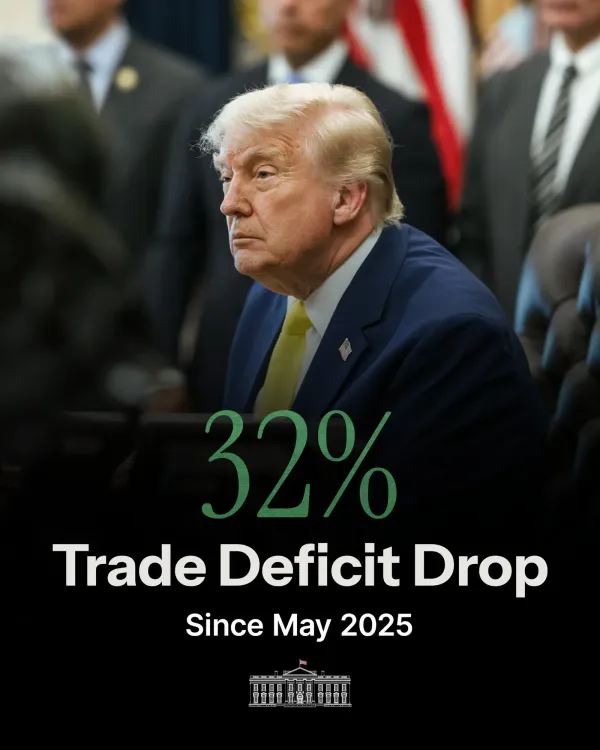
The White House on Wednesday, June 10, 2026, credited President Donald Trump's trade policies and deregulation drive for a rapid decline in the United States trade deficit, posting the claim on its official X account alongside a graphic.
The post stated: 'Thanks to President Trump's effective trade policies and deregulation efforts, America's trade deficit is FALLING fast.'
Context
The US trade deficit — the gap between the value of goods and services the country imports and what it exports — is a closely watched economic indicator published monthly by the Commerce Department's Census Bureau and the Bureau of Economic Analysis. A falling deficit is typically presented by the current administration as evidence that its economic strategy is working.
The White House post does not cite a specific month's figure or a percentage change, but the accompanying image appears to illustrate a downward trend. The precise 2026 trade-balance statistics have not been independently verified by NationPress.
Policy Backdrop
The Trump administration's trade toolkit draws heavily on actions begun during Trump's first term (2017–2021). In 2018, the administration imposed tariffs on steel and aluminium imports under Section 232 national-security authority, and launched a Section 301 investigation that resulted in tariffs on roughly $360 billion worth of Chinese goods between 2018 and 2019.
On the regulatory side, Executive Order 13771, signed in 2017, required federal agencies to eliminate two existing regulations for every new one introduced — a policy the administration credited with reducing the compliance burden on American businesses. The United States–Mexico–Canada Agreement (USMCA), which replaced NAFTA and took effect in 2020, was also a signature first-term achievement aimed at rebalancing North American trade flows in favour of US manufacturers.
Economists broadly note that trade deficits are shaped by a range of macroeconomic variables — including US GDP growth rates, the strength of the US dollar, and global commodity prices — in addition to tariff and regulatory policy. Successive administrations, Republican and Democrat alike, have cited monthly Commerce Department releases selectively to support their trade narratives.
Stakeholders and Impact
US manufacturers and domestic producers of steel, aluminium, and other goods subject to import competition are the primary intended beneficiaries of the tariff strategy. However, American agricultural exporters have historically faced retaliatory tariffs from trading partners — particularly China — when broad import levies are imposed, creating cross-cutting pressures within the US economy.
Importers and retailers, who rely on lower-cost foreign inputs, have in past tariff cycles passed some costs on to consumers. The net effect on the overall trade balance remains a subject of ongoing debate among trade economists, who point out that a stronger domestic economy can itself widen a deficit by boosting consumer demand for imports.
What's Next
Upcoming monthly US trade balance releases from the Commerce Department will be closely watched to validate or challenge the White House's claim. Any new tariff actions, bilateral negotiation announcements, or further deregulation executive orders expected in late 2026 could add further momentum — or introduce fresh volatility — to the trade figures the administration is highlighting.
For India, which runs a goods trade surplus with the United States, shifts in US trade enforcement posture and any sector-specific tariff moves remain a key variable for exporters of textiles, pharmaceuticals, and engineering goods.
Point of View
It frames two distinct policy levers as a unified success story, pre-empting any attribution of the improvement to broader macroeconomic tailwinds. For India-watchers, the signal matters: a White House doubling down on trade-balance metrics is one that is likely to intensify bilateral pressure on surplus trading partners. The post also sets up the Commerce Department's upcoming monthly releases as high-stakes political scorecards for the remainder of 2026.
NationPress
26 Oct 2026
Frequently Asked Questions
Why is the US trade deficit falling in 2026?
The White House attributes the decline to President Trump's trade policies — including tariffs — and deregulation efforts. Economists also point to factors such as US growth rates, dollar strength, and global commodity prices as contributors to trade-balance movements.
What is the US trade deficit and why does it matter?
The US trade deficit is the gap between the value of goods and services America imports and what it exports. A large deficit is seen by some as a sign of weak competitiveness; others argue it reflects strong domestic demand and a healthy economy.
What trade policies has Trump used to reduce the trade deficit?
Key measures include Section 232 tariffs on steel and aluminium, Section 301 tariffs on roughly $360 billion of Chinese goods, and the USMCA trade agreement that replaced NAFTA in 2020.
How does Trump's deregulation policy affect trade?
Executive Order 13771, signed in 2017, required two regulations to be cut for every new one introduced, aiming to lower costs for US manufacturers and make American exports more competitive globally.
What does a falling US trade deficit mean for India?
India runs a goods trade surplus with the United States, so a more aggressive US trade enforcement posture could mean greater scrutiny of Indian exports in sectors such as textiles, pharmaceuticals, and engineering goods.