Nobel Peace Prize for Navi Pillay: UN chief hails award as tribute to human rights defenders
Synopsis
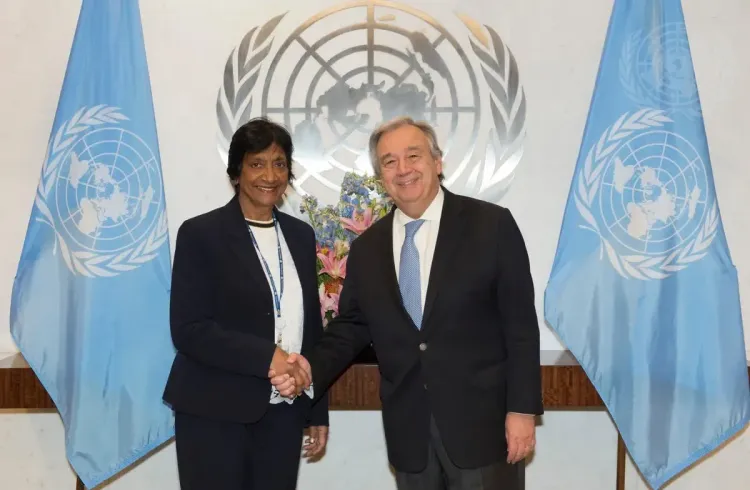
Navi Pillay — who defended Nelson Mandela under apartheid, presided over the Rwanda genocide tribunal, and investigated the occupied Palestinian territory — has won the Nobel Peace Prize. UN Secretary-General Guterres called it a tribute to all defenders of international law. The award lands at a moment when those very institutions are under acute pressure.
Key Takeaways
Navanethem 'Navi' Pillay , former UN High Commissioner for Human Rights of Indian origin, won the Nobel Peace Prize , announced on 9 October 2026 .
UN Secretary-General António Guterres called the award 'a tribute to all those working to uphold and defend international law, the rule of law and human rights.' Current Human Rights High Commissioner Volker Türk described it as 'a proud moment for the global human rights movement.' Pillay's career includes defending Nelson Mandela during apartheid, serving as president of the International Criminal Tribunal for Rwanda , and chairing the UN Inquiry on the Occupied Palestinian Territory .
Guterres noted she faced criticism from virtually all countries for her fierce independence in calling out human rights violations.
United Nations Secretary-General António Guterres on Friday, 9 October 2026, congratulated Navanethem 'Navi' Pillay on winning the Nobel Peace Prize, calling the honour 'a tribute to all those working to uphold and defend international law, the rule of law and human rights, and secure peace, justice and human dignity.'
Pillay, a former UN High Commissioner for Human Rights of Indian origin, becomes one of the most prominent South African jurists to receive the Nobel Peace Prize — a recognition that carries particular weight given the current global environment of rising pressure on multilateral institutions.
Guterres Pays Tribute to Pillay's Legacy
Guterres highlighted that Pillay's lifelong commitment to justice began in South Africa, where she defended Nelson Mandela and others who resisted the apartheid regime. 'She has shown that the force of law must prevail over the law of force and that defending human rights is the surest safeguard against injustice,' he said.
He added that 'the Nobel Committee reminded the world that peace must be built on lasting principles, not the will of the powerful' — a pointed statement at a time when international legal frameworks face unprecedented strain from major powers.
Current Human Rights Chief Calls It a 'Proud Moment'
Volker Türk, the current UN High Commissioner for Human Rights, said the award was 'a proud moment for the global human rights movement.' He stressed the timeliness of the recognition: 'At a time when human rights are under attack on so many fronts, including from those who wield enormous power, this award is particularly poignant.'
Türk offered perhaps the most succinct summation of Pillay's standing in international legal circles: 'She embodies international law.'
A Career That Spanned Landmark International Cases
Guterres noted that Pillay's work spans some of the most consequential legal processes of the modern era. She served as an international judge and later as president of the International Criminal Tribunal for Rwanda, adjudicating cases related to international crimes, including the Rwandan genocide.
More recently, she chaired the UN Independent International Commission of Inquiry on the Occupied Palestinian Territory, a role that drew intense scrutiny from multiple governments and underscored her reputation for fierce independence. Guterres noted that as Human Rights High Commissioner, Pillay faced criticism from virtually all countries precisely because she called out violations regardless of political alliances.
Why the Nobel Award Resonates Now
The Nobel Committee's choice carries unmistakeable symbolism. With international humanitarian law under stress in multiple active conflict zones — and multilateral bodies increasingly bypassed by powerful states — Pillay's recognition is widely seen as a reaffirmation of the rules-based international order.
For India, the honour carries additional significance: Pillay is of Indian origin, and her decades-long advocacy has placed the values of the Indian legal diaspora on the world stage.
The award is expected to renew debate over the resourcing and independence of UN human rights mechanisms, with rights groups already calling for stronger protections for human rights mandate-holders who face political blowback.
Frequently Asked Questions
Who is Navi Pillay and why did she win the Nobel Peace Prize?
Navanethem 'Navi' Pillay is a South African jurist of Indian origin and former UN High Commissioner for Human Rights, awarded the Nobel Peace Prize in 2026 for her decades-long defence of international law and human rights. Her career spans landmark cases including the International Criminal Tribunal for Rwanda and the UN Inquiry on the Occupied Palestinian Territory.
What did UN Secretary-General Guterres say about the Nobel award?
Guterres called the award 'a tribute to all those working to uphold and defend international law, the rule of law and human rights, and secure peace, justice and human dignity.' He also said Pillay 'has shown that the force of law must prevail over the law of force.'
What is Navi Pillay's connection to the Rwandan genocide tribunal?
Pillay served as an international judge and president of the International Criminal Tribunal for Rwanda, presiding over cases related to international crimes including the Rwandan genocide. It remains one of the most significant chapters of her legal career.
Why is the Nobel Peace Prize for Pillay considered timely?
Current Human Rights High Commissioner Volker Türk described the award as 'particularly poignant' at a time 'when human rights are under attack on so many fronts, including from those who wield enormous power.' The recognition comes amid widespread pressure on multilateral human rights institutions.
What is Navi Pillay's connection to India?
Navi Pillay is of Indian origin, which gives the Nobel award added significance in India. Her recognition places the contributions of the Indian legal diaspora to international human rights on the global stage.