UNGA 2026: World leaders warn selective law enforcement is fracturing global order
Synopsis
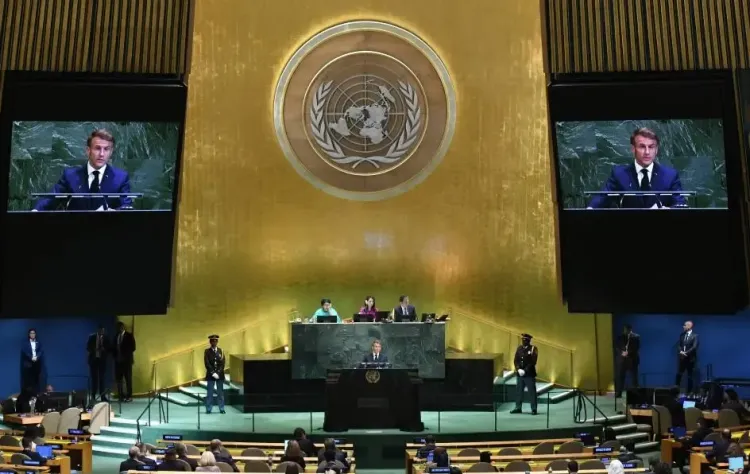
At UNGA 2026, leaders from across the globe delivered an unusually direct indictment of double standards in international law — with France, Jordan, Qatar, Ghana and Slovenia all warning that the rules-based order is cracking under the weight of its own inconsistencies. The debate over Gaza has become a flashpoint for a much larger crisis of institutional legitimacy.
Key Takeaways
World leaders at the UN General Assembly on 27 September 2026 warned that selective enforcement of international law is weakening the global order.
French President Emmanuel Macron called for a choice between international justice and 'the law of the jungle,' reaffirming support for the ICJ .
Jordan's King Abdullah II and Qatar's Amir Sheikh Tamim demanded equal application of international rules, specifically citing Palestine .
Ghanaian President John Mahama warned of a 'dangerous drift towards unilateralism' and called for an end to diplomatic language that obscures civilian suffering.
Slovenian PM Janez Janša proposed an independent mechanism to measure selectivity in global crisis responses.
Palestinian President Mahmoud Abbas spoke by recorded video after his delegation was reportedly denied visas, warning the conflict threatens a two-state solution.
World leaders at the UN General Assembly (UNGA) on 27 September 2026 delivered a pointed collective warning: selective enforcement of international law is eroding the credibility of institutions built after World War II to prevent conflict and hold governments accountable. Speakers from Europe, the Middle East, Africa and the Caribbean argued that rules lose legitimacy when applied to some states but waived for politically powerful ones or their allies.
Key Statements from World Leaders
French President Emmanuel Macron framed the challenge in stark terms, asking whether the international community wanted a rules-based civilised order or a return to 'the law of the jungle.' Macron reaffirmed France's support for the International Court of Justice (ICJ) and opposed what he described as a growing 'order of impunity.' 'There cannot be peace without justice,' he said.
Qatar's Amir Sheikh Tamim bin Hamad Al Thani argued that no just international order was possible while Palestine remained what he called a blind spot in multilateral accountability. 'The law must apply equally to all,' the Amir said. Jordan's King Abdullah II pointed to existing mechanisms — sanctions, asset freezes, embargoes, diplomatic isolation — and noted they had not been applied consistently in addressing Israel's conduct. 'Resolutions end where they begin, on paper,' he said.
Israeli Prime Minister Benjamin Netanyahu pushed back, arguing that attacks against Israelis received insufficient international attention while media focus fell heavily on alleged settler violence. Netanyahu characterised Israel's military operations as a direct response to the 7 October Hamas attack and continuing threats from Iran.
Palestinian President Mahmoud Abbas, speaking via recorded video after his delegation was reportedly denied visas, warned that the conflict threatened both the existence of the Palestinian people and the viability of a two-state solution.
Africa and the Caribbean Add Their Voices
Ghanaian President John Mahama cautioned against what he called 'a dangerous drift towards unilateralism, lawlessness and the erosion of multilateral norms.' He supported a two-state solution, condemned acts of terrorism by Hamas, and urged the international community to stop obscuring civilian suffering through diplomatic language.
Guyanese President Irfaan Ali identified climate disasters, food insecurity, inequality and conflict as serious crises, but argued that the weakening of multilateralism itself could prove the most consequential of all. Several speakers linked the debate over Gaza to other active conflicts, contending that inconsistent international responses damage the credibility of the entire multilateral system.
Proposals to Measure Selectivity
Slovenian Prime Minister Janez Janša proposed creating an independent mechanism to systematically compare major global crises against the actual international responses they received. The review would examine the scale, duration and severity of emergencies alongside the diplomatic, humanitarian and legal action taken — not to impose political conclusions, he said, but to surface measurable patterns of selectivity.
Dutch Prime Minister Rob Jetten defended the International Criminal Court (ICC) against efforts to weaken it, drawing on its founding legacy from the Nuremberg and Tokyo trials. He called on middle powers to actively protect international accountability structures. Switzerland's President Guy Parmelin urged governments to uphold international law, noting that engagement between opposing sides need not require moral equivalence but could still open pathways back to negotiation.
The Architecture Under Strain
The ICJ resolves legal disputes between states, while the ICC can prosecute individuals accused of genocide, war crimes and crimes against humanity. Both institutions, however, depend heavily on state recognition, cooperation and compliance — precisely the elements speakers argued are now fraying. This represents a systemic vulnerability: the rules-based order is only as strong as the willingness of its most powerful members to submit to it.
India has consistently supported the UN Charter, the peaceful settlement of disputes, and respect for sovereignty. New Delhi has also argued that international institutions must become more representative and that consistent application of rules is essential if the multilateral system is to retain the confidence of the Global South. With the UNGA debate now on record, attention turns to whether these speeches translate into coordinated diplomatic action or remain, as Jordan's King Abdullah II warned, words that end where they begin.
Point of View
The Middle East, Africa and the Caribbean — signals that frustration with double standards in international law has moved well beyond the usual critics of Western-led institutions. What is striking is the structural argument: leaders are no longer just demanding action on Gaza, they are questioning whether the rules-based order can survive selective application at all. The proposal for an independent selectivity-measurement mechanism is modest but pointed — it shifts the burden of proof onto institutions rather than aggrieved states. India's position, supporting both sovereign equality and institutional reform, places it at the centre of the Global South's growing demand for a more representative multilateralism.
NationPress
27 Sept 2026
Frequently Asked Questions
What did world leaders say at the UN General Assembly on 27 September 2026?
Leaders from Europe, the Middle East, Africa and the Caribbean warned that selective enforcement of international law is eroding the credibility of global institutions. They argued that rules lose legitimacy when applied inconsistently based on political power or alliances.
What did Emmanuel Macron say at UNGA 2026?
French President Emmanuel Macron said there could be no peace without justice and asked whether nations wanted a rules-based civilised order or a return to 'the law of the jungle.' He reaffirmed France's support for the International Court of Justice and opposed what he called a growing order of impunity.
Why was Palestinian President Mahmoud Abbas not present at the UNGA debate?
Palestinian President Mahmoud Abbas spoke via a recorded video after his delegation was reportedly denied visas to attend in person. He warned that the conflict threatened the existence of the Palestinian people and the viability of a two-state solution.
What did Slovenia propose at the UN General Assembly?
Slovenian Prime Minister Janez Janša proposed creating an independent mechanism to compare major global crises against the scale of international responses they received. The goal, he said, was not to dictate political conclusions but to reveal measurable patterns of selectivity in how the international community responds to emergencies.
What is India's position on international law and the UN system?
India has consistently supported the UN Charter, peaceful settlement of disputes, and respect for sovereignty. New Delhi has also argued that international institutions must become more representative and that rules must be applied consistently if the multilateral system is to retain the confidence of the Global South.