How are the US and UAE Supporting the India Corridor and Expanding AI Collaborations?
Synopsis
The recent Economic Policy Dialogue between the US and UAE has resulted in significant commitments towards the India-Middle East-Europe Economic Corridor (IMEC) and advancements in artificial intelligence. With a focus on regional connectivity and mutual investment, this partnership could reshape economic dynamics in the region.
Key Takeaways
US and UAE reaffirm support for IMEC.
Commitment of $1.4 trillion investment from UAE to the US.
Focus on enhancing regional connectivity .
Strengthening trade and investment ties.
Emphasis on artificial intelligence and other advanced technologies.
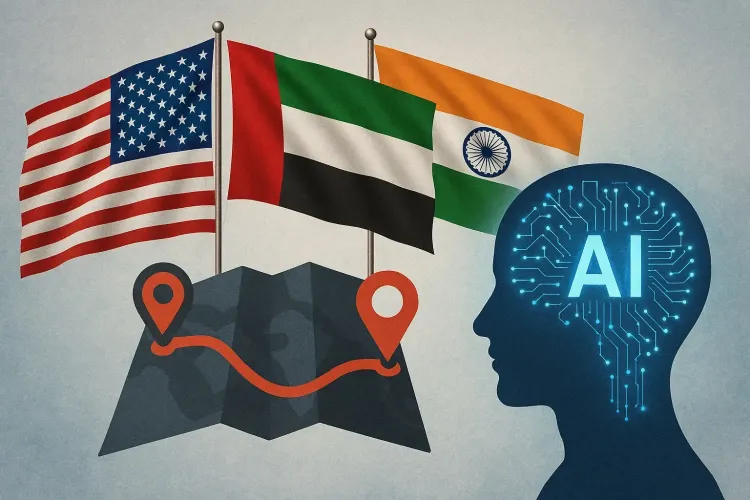
Washington, Jan 27, (NationPress) The United States and the United Arab Emirates have reaffirmed their commitment to the India-Middle East-Europe Economic Corridor while enhancing collaboration in trade, investment, and artificial intelligence during their recent Economic Policy Dialogue held in Abu Dhabi earlier this month.
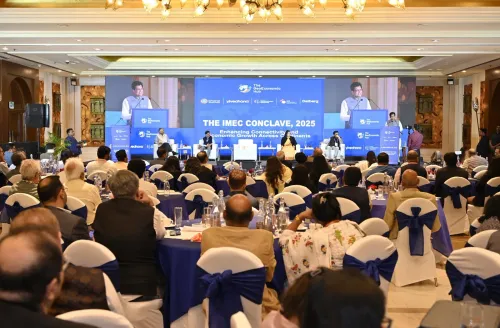
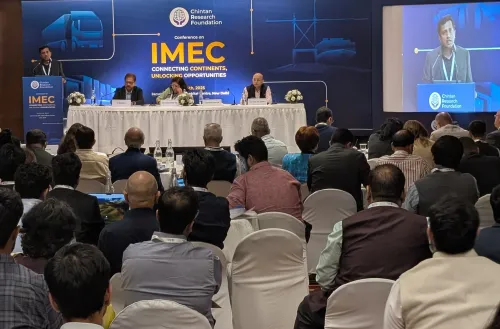
The two nations expressed that the corridor, referred to as IMEC, is a key initiative aimed at improving regional connectivity, particularly through the expansion of port and rail infrastructure that links India to Europe via the Middle East.
The eleventh U.S.-UAE Economic Policy Dialogue occurred on January 15, co-chaired by UAE Minister of State Saeed Mubarak Al Hajeri and U.S. Under Secretary of State for Economic Affairs Jacob Helberg, according to a joint statement issued on Tuesday.
Officials emphasized the strategic significance of bilateral trade and investment. They pointed out that the UAE has been the largest U.S. trade partner in the Gulf region for nearly two decades, with the U.S. maintaining a substantial trade surplus with the UAE.
Both nations remarked that open markets and clear regulatory frameworks have facilitated enhanced trade and investment productivity for both economies. They underscored the growing cooperation in sectors such as critical minerals, advanced technology, energy, manufacturing, and life sciences.
The delegations reiterated the UAE’s commitment to invest $1.4 trillion in the United States over the next decade, reinforcing its status as America's largest economic partner in the region.
Al Hajeri pointed out the magnitude of economic relations, revealing that total non-oil trade between the two nations exceeded $38 billion in 2024. Preliminary figures for 2025 indicated bilateral non-oil trade of $19.3 billion within the first half of the year, reflecting a year-on-year growth of 3.4 percent and benefiting U.S. industries including energy, aviation, and technology.
Helberg stressed the importance of enhancing economic security and ensuring reliable supply chains. He highlighted mutual interests in advanced manufacturing, artificial intelligence, energy abundance, and digital infrastructure, asserting that these areas could bolster the alignment between economic policies and national security.
The delegations agreed to explore cooperation in areas involving I2U2 countries, including energy security, critical minerals, and water security.
Point of View
I believe this alliance between the US and UAE marks a pivotal moment in international relations and economic cooperation. The commitment to the India-Middle East-Europe Economic Corridor can potentially reshape trade dynamics in the region, fostering innovation and economic growth. At NationPress, we recognize the significance of such partnerships in strengthening global economies and ensuring sustainable development.
NationPress
19 Sept 2026
Frequently Asked Questions
What is the India-Middle East-Europe Economic Corridor?
The India-Middle East-Europe Economic Corridor (IMEC) is an initiative aimed at enhancing regional connectivity through improved port and rail infrastructure linking India to Europe via the Middle East.
What commitments did the UAE make during the dialogue?
The UAE pledged to invest $1.4 trillion in the United States over the next decade, reinforcing its position as America's largest regional economic partner.
What are the key areas of cooperation discussed?
Key areas of cooperation include trade, investment, artificial intelligence, energy security, critical minerals, and water security.
Why is bilateral trade important between the US and UAE?
Bilateral trade is crucial as the UAE has been the largest U.S. trade partner in the Gulf region for nearly two decades, contributing significantly to both economies.
How does this partnership impact global markets?
This partnership could reshape economic dynamics in the region, fostering innovation and growth, which may positively influence global markets.