Pentagon's New Defense Strategy: Aiming to Deter China in the Indo-Pacific

Synopsis
The Trump administration's revised defense strategy emphasizes deterring China in the Indo-Pacific, urging allies to enhance their security roles. Pentagon chief Elbridge Colby outlines key objectives in maintaining regional stability and ensuring military readiness against potential threats.
Key Takeaways
New Defense Doctrine: Focuses on deterring China in the Indo-Pacific.
Allies' Responsibilities: Urges US allies to enhance their defense capabilities.
Strategic Focus: Centers on maintaining a favorable power balance in Asia.
First Island Chain: Key operational focus for US military deterrence.
Regional Cooperation: Strengthens partnerships with nations sharing concerns about China.
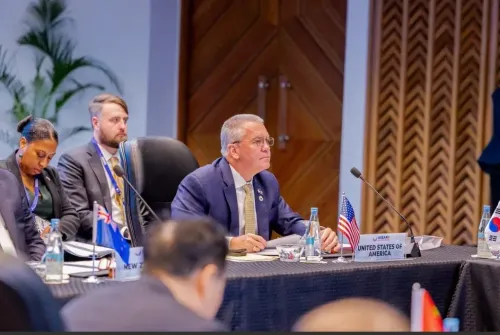
Washington, March 4 (NationPress) The latest defense doctrine from the Trump administration emphasizes the importance of deterring China in the Indo-Pacific region, while encouraging US allies to take on greater responsibility for their own security, as stated by Pentagon policy chief Elbridge Colby during testimony before the Senate Armed Services Committee.
In his remarks regarding the 2026 National Defense Strategy (NDS), Colby highlighted that military planning is focused on maintaining a favorable power balance in Asia, while urging allies to ramp up their defense spending and capabilities.
“This strategy is centered on our military efforts to maintain a favorable power balance in the Indo-Pacific, which is the largest market globally,” Colby pointed out.
He clarified that the US does not aim for a confrontation with China but instead seeks to prevent Beijing from asserting dominance over the region.
“Our intention is not to strangle China or force a change in its government,” Colby explained. “Instead, we aim to stop China from becoming the predominant power in the Indo-Pacific.”
Colby informed the committee that the primary operational focus of the Pentagon is to deter Chinese military expansion along the first island chain, which stretches from Japan through Taiwan to the Philippines.
“Achieving effective defensive capabilities along this first island chain is the main priority for the US armed forces,” he emphasized.
He further noted that the ability to counter Chinese aggression in this area is crucial for Washington to maintain stability in Asia while remaining adaptable to respond to crises globally.
“Our interests are substantial due to the significance of the market in the Indo-Pacific,” he remarked.
The strategy also prioritizes enhancing cooperation with regional partners and allies who share concerns about China’s growing military might.
“It’s essential to highlight that our strategy aligns well with the interests of our allies in the Indo-Pacific,” Colby stated, adding that many nations in the region desire to uphold their autonomy and resist the influence of any single power.
Colby underlined that this new strategy is based on the concept of burden sharing, expecting allies to take on more responsibility for regional security.
“Despite the unmatched capabilities of the American military, our resources are not limitless,” Colby said.
He advocated for affluent allies in Europe and Asia to boost their defense budgets and play a more significant role in deterrence measures.
“Numerous allies have effectively reduced their military forces since the Cold War, which is an untenable situation,” he remarked. “This is both unreasonable and unsustainable.”
The strategy calls for NATO allies in Europe to spearhead conventional defense efforts against Russia, while encouraging partners such as South Korea to take the lead in deterring North Korea.
Colby also pointed out the necessity of expanding US defense manufacturing to ensure long-term competitiveness against China and other adversaries.
“The NDS demands nothing less than a national mobilization of our industrial capacity,” he declared.
This mobilization would enable the US to swiftly produce advanced weapon systems for both its forces and those of its allies.
“It is vital that we can equip our forces and those of our partners with the best weaponry efficiently and at scale,” Colby stated.
While the strategy positions China as a central concern in US defense planning, Colby reassured senators that Washington will address threats from other regions, including Russia, Iran, and North Korea.
“We are acutely aware that there are other significant threats globally,” he remarked.
However, he stressed the importance of not overstretching US military commitments.
“We cannot undertake every mission everywhere at all times,” Colby asserted.
For nations throughout the Indo-Pacific, including India, the strategy’s focus on preserving a balance of power underscores Washington’s long-term goal of collaborating with regional partners to prevent any single nation from asserting dominance over Asia.
Point of View
The revised defense strategy from the Pentagon represents a significant pivot towards enhancing US military posture in the Indo-Pacific. This approach not only emphasizes the need for regional allies to bolster their defenses but also reflects the intricacies of balancing power dynamics in a rapidly evolving geopolitical landscape.
NationPress
29 Sept 2026
Frequently Asked Questions
What is the main focus of the new US defense strategy?
The main focus is to deter China's influence in the Indo-Pacific while encouraging allies to enhance their own defense capabilities.
Who is Elbridge Colby?
Elbridge Colby is the Pentagon policy chief who testified about the new defense strategy before the Senate Armed Services Committee.
What does the strategy say about US allies?
The strategy emphasizes that US allies should take greater responsibility for their own security and increase defense spending.
What is the 'first island chain'?
The 'first island chain' refers to a strategic arc in the Indo-Pacific stretching from Japan through Taiwan to the Philippines, which is a focus for US military operations.
How does the strategy address global threats?
While centering on China, the strategy acknowledges other global threats including those from Russia, Iran, and North Korea.