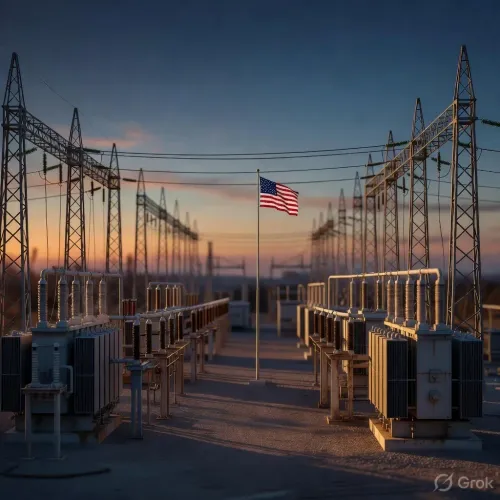
US invokes emergency power authority for 65 million in Mid-Atlantic

Synopsis
The Trump administration has pulled a rarely-used federal lever — Section 202(c) of the Federal Power Act — to keep a Maryland power plant running beyond its limit through mid-November, serving 65 million people. The move lays bare how AI-driven data centre growth and plant retirements are pushing the US grid toward its limits, with emergency orders becoming a recurring tool rather than a last resort.
Key Takeaways
Energy Secretary Chris Wright issued an emergency order on 20 August under Section 202(c) of the Federal Power Act .
The order covers the US Mid-Atlantic region , serving approximately 65 million people across 13 states and Washington, D.C.
PJM Interconnection and Talen Energy Corporation are authorised to operate Wagner Generating Station Unit 4 in Anne Arundel County, Maryland beyond its existing limit.
The order remains effective from 20 August through 17 November 2025 .
Rising demand from data centres , AI systems , and manufacturing — alongside plant retirements — is the primary driver of grid stress.
Northern Virginia has been identified as a key demand hotspot due to its concentration of global data centre infrastructure.
The Trump administration has invoked emergency federal authority to safeguard electricity supplies across the US Mid-Atlantic region, which serves roughly 65 million people across 13 states and Washington, D.C. The order, issued on 20 August, aims to head off potential power outages during periods of peak demand in the coming months.
The Emergency Order
Energy Secretary Chris Wright issued the directive under Section 202(c) of the Federal Power Act, a provision that grants the Energy Secretary authority to mandate temporary generation or transmission measures when shortages or reliability failures threaten consumers. The order will remain in effect from 20 August through 17 November.
Specifically, it authorises PJM Interconnection — the regional transmission organisation coordinating electricity across much of the Mid-Atlantic — to work with Talen Energy Corporation to operate Unit 4 at the Wagner Generating Station in Anne Arundel County, Maryland, beyond its current operating limit. PJM had formally requested federal intervention, citing anticipated need for the unit during high-demand periods.
What the Energy Secretary Said
'Energy shortfalls for 65 million Americans are simply unacceptable,' Wright said. He added that previous orders in the Mid-Atlantic region 'have helped keep the lights on,' and expressed confidence that the current order would do the same. Wright further described the directive as helping 'temporarily address the urgent need to strengthen grid reliability and ensure Americans across the mid-Atlantic region have access to affordable, reliable, and secure energy regardless of whether the sun shines or wind blows.'
Why the Grid Is Under Strain
The emergency order underscores mounting pressure on US electricity infrastructure as utilities face a convergence of challenges: extreme weather events, the accelerating retirement of older power plants, and a sharp surge in demand driven by data centres, artificial intelligence systems, and expanding manufacturing facilities.
The Mid-Atlantic region hosts some of the country's densest concentrations of data centres. Northern Virginia, in particular, has become a leading global hub for facilities that process and store internet and cloud-computing traffic. Technology companies are committing billions of dollars to new data centre construction as AI adoption accelerates — infrastructure that requires large, uninterrupted power supplies for both computing equipment and cooling systems.
Broader Grid Reliability Concerns
The surge in power consumption has compelled federal and state authorities to confront a fundamental question: whether existing electricity generation and transmission infrastructure can keep pace with planned development. This is not the first such emergency order for the Mid-Atlantic; Wright noted that previous interventions under the same authority have been deployed in the region.
Notably, Section 202(c) orders are typically reserved for situations where officials determine that shortages or reliability problems pose a direct risk to consumers — signalling that grid managers view the upcoming demand window as a genuine stress period, not a precautionary exercise.
What Happens Next
The order keeps Wagner Unit 4 operational through mid-November, covering the tail end of summer cooling demand and the onset of winter heating season. Longer term, federal and state regulators face pressure to accelerate grid investment and permitting for new generation capacity to reduce dependence on emergency measures.
Point of View
Supercharged by AI investment, is outpacing both new generation build-out and grid permitting timelines. Keeping old plants alive through emergency decrees buys time, but it does not resolve the underlying capacity gap — and it raises legitimate questions about whether the regulatory framework for grid planning is fit for the AI era.
NationPress
5 Oct 2026
Frequently Asked Questions
Why did the US invoke emergency power authority on 20 August?
The Trump administration invoked emergency authority under Section 202(c) of the Federal Power Act to prevent potential power outages in the Mid-Atlantic region, which supplies electricity to about 65 million people. Grid operator PJM Interconnection requested the intervention, citing anticipated high electricity demand in the coming months.
What does the emergency order actually do?
It allows PJM Interconnection and Talen Energy Corporation to operate Unit 4 at the Wagner Generating Station in Anne Arundel County, Maryland, beyond its current operating limit. The order is effective from 20 August through 17 November 2025.
What is Section 202(c) of the Federal Power Act?
Section 202(c) is a provision that grants the US Energy Secretary authority to direct temporary electricity generation or transmission measures during emergencies. It is typically invoked when officials determine that power shortages or reliability failures pose a direct risk to consumers.
Why is the US Mid-Atlantic power grid under stress?
The grid faces a convergence of pressures: extreme weather events, the retirement of older power plants, and a rapid surge in electricity demand from data centres, artificial intelligence systems, and manufacturing facilities. Northern Virginia alone has become a major global hub for data centres, requiring large and uninterrupted power supplies.
Who is affected by this emergency order?
The order covers the US Mid-Atlantic region, encompassing 13 states and Washington, D.C., with a combined population of approximately 65 million people. PJM Interconnection coordinates electricity supply across this entire footprint.