US midterm elections 2026: Voters head to polls in Trump referendum

Synopsis
Americans are voting in what Trump himself called 'the most important midterm of our lifetime' — a de facto referendum on his tariff war, Gulf conflict, and sliding approval ratings. With 57 million ballots already cast and Democrats leading in polls at 52.1%, the results could hand the opposition enough power to stall Trump's final two years in office.
Key Takeaways
US midterm elections began on Tuesday, 3 November 2026 , with polling open from Vermont to Alaska .
57 million of 174 million eligible voters had already cast early or mail ballots as of Monday evening.
RealClear Politics aggregation shows Democratic support in Congressional races at 52.1 per cent ; most polls indicate Democrats are likely to win the House .
Trump's job approval has fallen from 50.3 per cent at the start of his second term to 39.1 per cent , with disapproval at 58.8 per cent .
Inflation at 3.7 per cent and the Gulf conflict — including a US strike on Qeshm Island, Iran — have dominated voter concerns.
Trump announced a cut of $4 billion in aid to Israel on Tuesday morning , hours before polls opened.
US midterm elections are underway on Tuesday, 3 November 2026, with Americans casting ballots across all 50 states in what President Donald Trump himself called 'the most important midterm I believe in our lifetime.' The vote is being watched closely around the world as a referendum on Trump's presidency, his tariff-driven trade war, and the ongoing Gulf conflict — both of which have rattled the global economy.
How Voting Is Unfolding
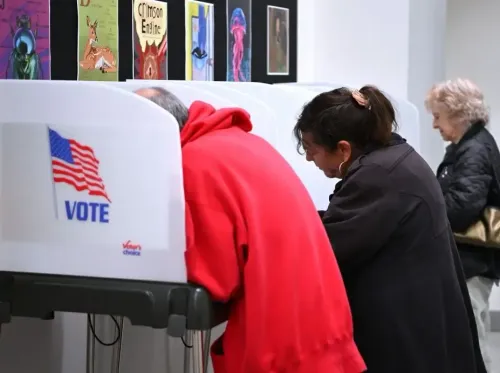
The first polling booths opened in Vermont at 5 am local time (3:30 pm IST), with Alaska set to close last at 9 pm local time (11:30 am Wednesday IST). As of Monday evening, 57 million of the 174-million-strong electorate had already cast ballots by mail or at early voting centres. Some technical glitches were reported on the day: voting machines failed to function in Westchester, a county north of New York City, prompting officials to ask voters to submit paper ballots instead.
The first trend signals are expected around midnight Washington time (10:30 am Wednesday in India), though final results may take days or even weeks, given the likelihood of recounts and legal challenges.
What Is at Stake
Trump's name does not appear on ballots for the 435 House of Representatives seats, 35 Senate seats, 36 governorships, or the thousands of state and local legislative races on the ballot. Yet the president has explicitly framed the contest as a verdict on his leadership, repeatedly urging voters: 'Pretend I am on the ballot.'
Most polls point to Democrats winning control of the House, while control of the Senate remains contested. The RealClear Politics (RCP) aggregation of polls shows overall support for Democrats in Congressional elections at 52.1 per cent.
Trump's Falling Approval and Economic Pressures
Trump's job approval rating has dropped sharply — from 50.3 per cent in the first week of his second term to 39.1 per cent now — while his disapproval rating has climbed to 58.8 per cent, according to the RCP aggregation. Inflation, which hit 3.7 per cent in September, has compounded voter anxiety, particularly on food and everyday consumer goods, even as the economy grew 3.4 per cent in the latest quarter. Trump won the 2024 presidential election with 49.8 per cent of the vote.
After 32 days of campaigning across 20 states with 30 rallies — much of it concentrated in reliably Republican 'red states' — Trump acknowledged on Monday: 'For some reason, the sitting President doesn't win the midterms, but we gave this a very strong shot.'
Gulf Conflict and the Israel Aid Announcement
On the eve of polling, the US confirmed it had struck Qeshm Island in Iran on Monday with what officials described as a 'small-scale defensive measure' targeting missiles — a fresh reminder of the Gulf conflict that has pushed up petrol, diesel, and food prices. Separately, on Tuesday morning, Trump announced he would cut $4 billion in aid to Israel, stating on Fox News: 'We give them more than anybody else, and they no longer need it.' He claimed Israeli Prime Minister Benjamin Netanyahu had agreed with him.
What a Democratic Sweep Could Mean
Should Democrats secure the House, they would have the legislative leverage to constrain Trump's agenda in the final two years of his second — and constitutionally last — term. A Democratic Senate majority would compound that constraint. Analysts, however, note that Trump could respond by governing more aggressively through executive orders, pushing the boundaries of presidential authority and leaving the courts to arbitrate. He could also intensify the use of the Justice Department against political opponents and perceived critics. The midterm result will also serve as an early test of polling accuracy after years of contested forecasts.
Point of View
Not a mandate-building one. The more consequential question is not who wins the House, but what Trump does if he loses it: a president willing to govern by executive order and deploy the Justice Department against opponents represents an institutional stress the US constitutional framework has rarely faced at this speed or intensity. India and other trading partners watching from the sidelines have a direct stake — any further escalation of the Gulf conflict or trade war in a lame-duck Congress environment could arrive without the legislative guardrails a divided government theoretically provides.
NationPress
4 Nov 2026
Frequently Asked Questions
What are the US midterm elections 2026 about?
The 2026 US midterm elections are a nationwide vote on all 435 House of Representatives seats, 35 Senate seats, 36 governorships, and thousands of state and local offices. Though President Trump is not on the ballot, he has framed the vote as a referendum on his presidency, tariff policies, and the Gulf conflict.
When will US midterm election results be known in India?
The first trend signals are expected around midnight Washington time, which translates to approximately 10:30 am Wednesday IST. However, final results may take days or even weeks due to potential recounts and legal challenges.
What do polls say about the 2026 US midterm outcome?
Most polls indicate that Democrats are likely to win control of the House of Representatives, while the Senate race remains closely contested. The RealClear Politics aggregation of polls shows overall Democratic support in Congressional elections at 52.1 per cent.
How has Trump's approval rating changed ahead of the midterms?
Trump's job approval rating has fallen from 50.3 per cent in the first week of his second term to 39.1 per cent, according to the RealClear Politics aggregation. His disapproval rating has risen to 58.8 per cent, driven largely by inflation and the ongoing Gulf conflict.
What happens if Democrats win control of the House and Senate?
A Democratic House majority would give the opposition the power to block or modify Trump's legislative agenda in the final two years of his second and last term. A Democratic Senate majority would compound that constraint. Analysts note Trump could respond by escalating the use of executive orders and challenging congressional authority through the courts.