Should the US Act on the 'Tech Triad' to Keep Up with China?
Synopsis
As China rapidly advances its military technologies, the US is urged to adopt a comprehensive approach focusing on nuclear energy, AI, and autonomous systems. Learn how a unified strategy can ensure national security and technological superiority.
Key Takeaways
The US needs a unified strategy for nuclear energy, AI, and autonomous systems.
China is advancing rapidly in military technologies by integrating these fields.
Nuclear energy is vital for powering AI initiatives.
Private US companies lead in AI but lack governmental support for energy initiatives.
Regulatory reforms are essential for fostering innovation and collaboration.
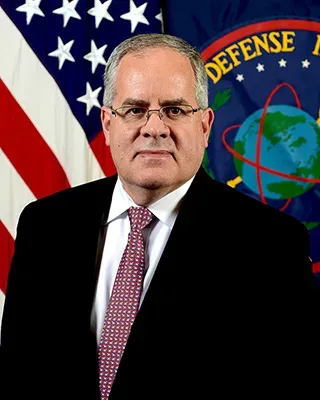
Washington, Jan 13 (NationPress) The United States must act swiftly to implement a unified national strategy aimed at advancing nuclear energy, artificial intelligence, and autonomous systems if it wishes to maintain its competitive edge over China in the realm of emerging military technologies, as articulated in a recent commentary by prominent aerospace and defense leader Vivek Lall.
In his piece published in National Review, Lall underscores that while China unveiled its nuclear triad in September 2025, its more significant strides have been in what he terms a “tech triad” that combines nuclear energy, AI, and autonomous systems.
He notes that Beijing has progressed “at lightning speed” in interlinking these technologies, whereas the United States has only just begun to grasp their interrelations.
“You have to hand it to the Chinese Communist Party: It comprehends the broader picture,” Lall asserts, emphasizing that China identifies nuclear energy, AI, and autonomous systems as the foundational elements of future military might.
According to Lall, nuclear energy is essential for providing the reliable electricity necessary for sophisticated AI, while AI facilitates autonomy in diverse platforms, from coordinated drone swarms to unmanned aircraft.
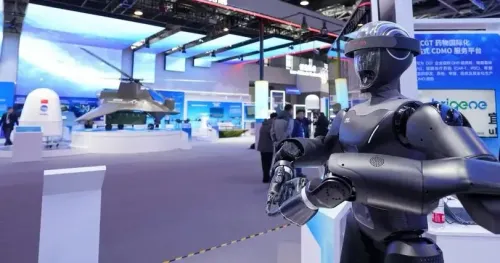
He highlights China’s ongoing construction of 34 nuclear reactors, with plans for nearly 200 additional units, as part of a strategic initiative to support energy-hungry AI models. He adds that China is already harnessing substantial electricity to utilize AI for military applications, including robotic scout dogs and war-game simulations. As more nuclear facilities come online, he predicts that Chinese AI initiatives like DeepSeek will experience rapid advancements, enabling power projection across land, sea, air, space, and cyberspace.
Conversely, Lall criticizes the U.S. approach as disjointed. Despite private U.S. firms leading in AI innovation globally, he notes the absence of a corresponding national commitment to energizing it, pointing out that there are currently no large-scale nuclear reactors being constructed in the United States.
He references President Donald Trump’s recent National Security Strategy as a potential framework, asserting that the “future of military power” will hinge on “AI, quantum computing, and autonomous systems, plus the energy required to fuel these domains.”
Lall urges the administration to mandate the Department of War and Department of Energy to execute a National Integration Initiative without delay.
This initiative, he argues, should eliminate regulatory barriers, simplify licensing and review processes, loosen export restrictions with allies, and fund high-impact demonstration projects, while empowering the private sector rather than supplanting it.
Point of View
The United States must prioritize a cohesive strategy that integrates nuclear energy, AI, and autonomous systems. This approach not only enhances national security but also positions the US to effectively compete on the global stage.
NationPress
8 Oct 2026
Frequently Asked Questions
What is the 'tech triad' mentioned in the article?
The 'tech triad' refers to the integration of nuclear energy, artificial intelligence, and autonomous systems, which are seen as critical components of future military capabilities.
Why is the US lagging behind China in military technologies?
The US has been criticized for having a fragmented approach, lacking a coordinated national strategy similar to China's rapid advancements in linking nuclear energy, AI, and autonomous systems.
What is the National Integration Initiative?
The National Integration Initiative is a proposed framework aimed at eliminating regulatory barriers, simplifying processes, and fostering collaboration between government and the private sector to advance military technologies.