Lake Powell, Lake Mead: US proposes 10-year water framework with 40% cuts
Synopsis
The US federal government has moved to take control of Colorado River water allocation, proposing cuts of up to 40% for Arizona, California, and Nevada as combined storage in Lake Powell and Lake Mead hits its lowest level since 1963. With a 26-year drought deepening and 40 million people at stake, this framework could reshape water politics across the American West for a generation.
Key Takeaways
The US Bureau of Reclamation released a final environmental review on 1 August establishing a 10-year framework for Lake Powell and Lake Mead .
Water deliveries to Arizona , California , and Nevada could be cut by up to 3.7 billion cubic metres — 40% of their combined Colorado River allocation.
Combined reservoir storage is at its lowest since Lake Powell began filling in 1963 .
The basin has endured a 26-year drought ; 2026 may see record-low snowpack, according to federal authorities.
Operational rules will be reviewed every two years through 2036 , allowing adjustments based on river conditions.
Approximately 40 million people across the US West and Mexico depend on the Colorado River .
The US Bureau of Reclamation has released a final environmental review establishing a 10-year operational framework for Lake Powell and Lake Mead — the country's two largest reservoirs — that could impose water delivery cuts of up to 40% on three southwestern states amid deepening divisions over how to share the Colorado River's shrinking supply. The review was made public on 1 August.
What the Framework Covers
The guidelines set out operational rules to be updated every two years through 2036, allowing federal authorities to adjust water releases, conservation requirements, and cutbacks in response to real-time river conditions. Crucially, the document outlines that annual water deliveries to Arizona, California, and Nevada could be reduced by as much as 3.7 billion cubic metres — equivalent to 40% of their combined Colorado River allocation and slightly exceeding Arizona's full yearly entitlement.
The remaining four basin states — Colorado, New Mexico, Utah, and Wyoming — are expected to participate through voluntary conservation measures rather than mandatory cuts. Federal authorities also retain the authority to release water from upstream reservoirs to protect Lake Powell's storage levels, according to the review.
What Officials Said
US Interior Secretary Doug Burgum described the framework as designed to maintain a 'reliable and resilient' river system while preserving space for future negotiations among the seven basin states. Assistant Secretary for Water and Science Andrea Travnicek said the plan 'balances flexibility and predictability' for the approximately 40 million people who depend on the river for their water supply.
The Scale of the Crisis
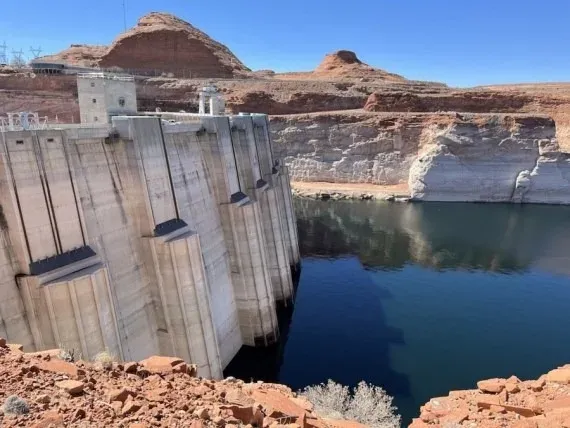
The Bureau of Reclamation highlighted that the basin has been gripped by a 26-year drought, warning that 2026 may see record-low snowpack levels. Combined storage across Lake Powell and Lake Mead has fallen to its lowest point since Lake Powell began filling in 1963 — underscoring the severity of the supply crisis.
The agency cautioned that even unprecedented reductions may not be sufficient to stabilise storage under extreme drought conditions. The Colorado River sustains urban water supplies, agriculture, tribal communities, hydropower generation, and ecosystems across the US West and into Mexico.
Why Seven States Cannot Agree
The seven basin states have long been divided over how to distribute cuts as the river's flow declines faster than century-old water compacts anticipated. The lower-basin states — Arizona, California, and Nevada — face the steepest mandatory reductions under the new framework, a prospect that has fuelled political resistance, particularly from California, which holds some of the river's oldest and largest water rights. This comes amid years of failed voluntary negotiations, which ultimately compelled federal intervention.
What Comes Next
With the final environmental review now public, the framework moves toward formal adoption. The two-year review cycle built into the guidelines means operational rules could shift significantly by 2028 depending on reservoir levels and drought trajectory. Water managers, agricultural interests, and tribal nations across the region are expected to scrutinise the implementation closely as the 2026 snowpack season approaches.
Point of View
A disparity that will invite legal challenges. More troubling is the agency's own admission that even unprecedented reductions may not stabilise storage under extreme drought — meaning the framework may be politically costly yet hydrologically insufficient. The real test is whether the two-year review cycle produces adaptive management or merely deferred conflict.
NationPress
1 Aug 2026
Frequently Asked Questions
What is the US Bureau of Reclamation's new framework for Lake Powell and Lake Mead?
It is a 10-year operational plan released on 1 August that sets rules — updated every two years through 2036 — for managing water releases, conservation, and cutbacks from Lake Powell and Lake Mead based on Colorado River conditions. The framework gives federal authorities power to impose steep water cuts on lower-basin states.
How much could water deliveries to Arizona, California, and Nevada be cut?
Annual water deliveries to the three states could be reduced by up to 3.7 billion cubic metres — equivalent to 40% of their combined Colorado River allocation and slightly more than Arizona's full yearly share. The cuts are mandatory, unlike the voluntary conservation expected from upper-basin states.
Why are Lake Powell and Lake Mead at such low levels?
Combined storage in the two reservoirs has fallen to its lowest point since Lake Powell began filling in 1963, driven by a 26-year drought across the Colorado River basin. Federal authorities have warned that 2026 may see record-low snowpack, further straining supply.
Who are the seven Colorado River basin states?
The seven states are Arizona, California, Nevada, Colorado, New Mexico, Utah, and Wyoming. Under the new framework, the lower-basin states — Arizona, California, and Nevada — face mandatory cuts, while the upper-basin states participate through voluntary conservation.
How many people depend on the Colorado River?
Approximately 40 million people rely on the Colorado River for urban water supplies, agriculture, hydropower, and ecosystem needs across the US West and into Mexico, according to the Bureau of Reclamation.