US to control 80% of global computing power by 2028: Scott Bessent

Synopsis
US Treasury Secretary Scott Bessent has put a number on America's AI ambitions: 80 per cent of global computing power by 2028, up from 60 per cent today. Speaking in Asheville, he tied the projection directly to Trump's regulatory and energy policies — and said AI is already reshaping manufacturing and pharma, not just tech.
Key Takeaways
Treasury Secretary Scott Bessent projected the US will hold 80 per cent of global computing power by 2028 , up from 60 per cent in 2025.
Bessent credited President Trump 's regulatory, tax, and energy policies for creating investment certainty.
AI is expanding into manufacturing , pharmaceuticals , and supply-chain management , beyond the tech sector.
Private-sector executives joined a G20 session in North Carolina for the first time, discussing AI integration.
Construction of data centres is boosting employment, with construction unions actively defending such projects.
Bessent said US economic growth is ‘re-accelerating’ despite uncertainty from the Iran conflict .
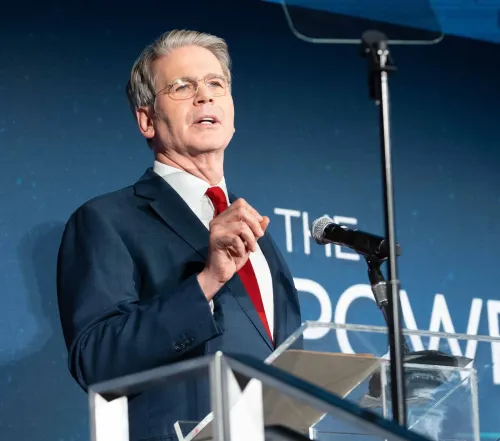
Treasury Secretary Scott Bessent has projected that the United States will command approximately 80 per cent of global computing power by 2028, up from roughly 60 per cent in 2025, as Washington accelerates its dominance in Artificial Intelligence (AI). Bessent made the remarks during a fireside conversation with Larry Kudlow in Asheville, North Carolina, describing the US as the world's foremost AI superpower.
The Computing Power Projection
“We are going to go up from about, call it, 60% in 2025. By 2028, the US will have 80 per cent of global computing power here, which is just extraordinary,” Bessent said. The projection underscores a rapid concentration of advanced computing infrastructure within American borders, driven by surging investment in data centres, semiconductors, and high-capacity transmission networks.
Bessent attributed the expansion to President Donald Trump's regulatory, tax, and energy policies, which he argued had provided the certainty businesses needed to commit capital to factories, technology, and infrastructure. “The President's policies have laid the groundwork for this economy,” he said.
AI Spreading Beyond the Tech Sector
The Treasury Secretary highlighted that artificial intelligence is no longer confined to Silicon Valley — it is being integrated into manufacturing, pharmaceuticals, and supply-chain management. For the first time, private-sector executives from pharmaceutical and manufacturing companies participated in a G20 session held in North Carolina, according to Bessent.
“They talked about how they were integrating AI into them,” Bessent said. “And it was fascinating to see the ecosystems that are developing, the productivity, the higher level of precision manufacturing both across their supply chains and their customer bases.” He characterised the transformation as still in its early stages, with significant employment and industrial growth ahead.
Policy Framework and Private Investment
Bessent pointed to a technology track being held in Chapel Hill by the Commerce Department and the White House technology office, which was showcasing American technology companies and the administration's approach to private investment. “We want to set the guardrails, create incentives, and then let our private sector build,” he said. “And that is where a nation's wealth is created.”
The US also benefits from its status as a major energy producer and exporter — a structural advantage as AI data centres consume increasing volumes of electricity. Bessent noted that construction unions had actively defended data centre projects against growing opposition, with union representatives reportedly stating they would “go after anyone who attacks these because these are great projects.”
Broader Economic Outlook
Beyond AI, Bessent described the wider US economy as resilient and said growth appeared to be re-accelerating despite uncertainty stemming from the Iran conflict. “Growth, I believe, is re-accelerating,” he said. “Everyone agreed that growth has been better than they thought it would have been given the Iran conflict.”
Washington has long treated leadership in advanced computing as both an economic priority and a matter of national security. The latest projections suggest that lead is widening — with consequences for every nation competing in the global AI race, including India, which is building its own data centre and semiconductor ambitions.
Point of View
The rules it sets for AI development effectively become the world's rules. For nations like India racing to build sovereign AI capacity, the window to establish independent compute infrastructure is narrowing faster than most policy timelines account for.
NationPress
17 Oct 2026
Frequently Asked Questions
What did Scott Bessent say about US computing power?
Treasury Secretary Scott Bessent said the United States will control approximately 80 per cent of global computing power by 2028, rising from roughly 60 per cent in 2025. He made the remarks during a fireside conversation in Asheville, North Carolina, describing the US as the world's AI superpower.
What is driving the US rise in global computing capacity?
Bessent attributed the expansion to President Trump's regulatory, tax, and energy policies, which he said created certainty for businesses investing in technology and infrastructure. The US also benefits from being a major energy producer, which is critical as AI data centres consume large volumes of electricity.
How is AI affecting sectors beyond technology?
According to Bessent, AI is being integrated into manufacturing, pharmaceuticals, and supply-chain management. Private-sector executives from these industries participated in a G20 session in North Carolina, where they discussed how AI is improving precision manufacturing and supply-chain efficiency.
What role are data centres playing in the US AI expansion?
Data centres are central to the US computing power build-up, driving demand for advanced semiconductors, electricity, and construction. Bessent noted that construction unions have actively supported these projects, calling them significant sources of employment.
What did Bessent say about the broader US economy?
Bessent described the US economy as resilient and said growth appeared to be re-accelerating despite uncertainty from the Iran conflict, noting that outcomes had been better than most observers expected.