US to hold 80% of global computing power by 2028: Bessent

Synopsis
US Treasury Secretary Scott Bessent says America will control 80% of global computing power by 2028 — up from 50% today — leaving China at just 15% and the rest of the world to share the remainder. His blunt dismissal of Europe ('Nothing') and China's central-planning model signals Washington is treating AI supremacy as the defining geopolitical contest of the decade.
Key Takeaways
Treasury Secretary Scott Bessent projected the US will hold 80% of global computing power by 2028 , up from 50% in 2025.
Bessent said China will hold roughly 15% of global compute by 2028, with the rest of the world sharing the remainder.
He credited America's AI lead to private-sector innovation , arguing China's central-planning model 'will never work.' Bessent called for de-risking — not decoupling — from China, prioritising reshoring of semiconductors , medicines , and critical minerals .
He dismissed Europe's AI position in one word — 'Nothing' — blaming regulatory-first culture and absence of major cloud players.
He warned students: 'Someone who knows how to use AI will take your job.'
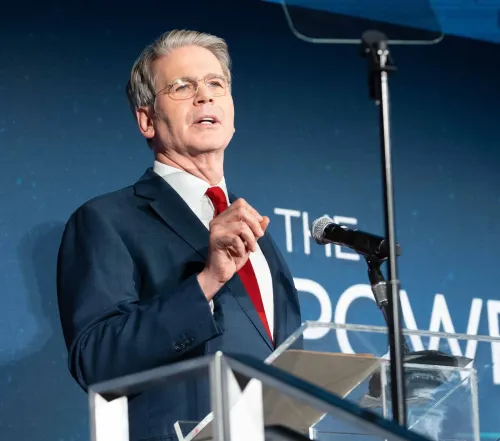
Treasury Secretary Scott Bessent has projected that the United States will command 80 per cent of global computing power by 2028, framing the artificial intelligence race as a defining strategic contest between Washington and Beijing. Bessent made the remarks during a wide-ranging conversation at SMU's Cox School of Business in Dallas, underscoring how central AI infrastructure has become to US economic and national security thinking.
The Computing Power Projection
Bessent stated that the US held 50 per cent of global computing capacity in 2025 and was rapidly extending that lead. 'In 2025, the US had 50 per cent of global computing power. By 2028, we're going to have 80 per cent of global computing power,' he said. When asked how much China would hold, Bessent replied: 'China will be 15, and the rest of the world will be the rest of the world.'
Computing power — often referred to as compute — encompasses the chips, data centres, and energy infrastructure required to train and operate advanced AI systems. Access to it has emerged as a primary measure of national and corporate capability in the AI era.
Organic Innovation vs Central Planning
Bessent attributed America's lead to private-sector dynamism rather than state-directed investment. 'Why do we have this big lead in AI? And it's all been completely organic in AI,' he said. He contrasted this with China's approach, arguing: 'The Chinese have their model. They have central planning on AI, which will never work.'
He stressed the urgency of maintaining the advantage. 'We are ahead of the Chinese. We have to stay ahead because if we get behind, nothing else matters,' Bessent said. This framing positions AI supremacy not merely as a commercial goal but as a prerequisite for broader geopolitical relevance.
De-Risking, Not Decoupling
The Treasury secretary also addressed Washington's wider economic relationship with Beijing, drawing a distinction between decoupling and de-risking. 'I managed the China relationship for the US. And I say we don't want to decouple, but we have to de-risk,' he said. He cited the Covid-era supply chain disruptions as evidence of the dangers of over-dependence on overseas production, identifying semiconductors, medicines, and critical minerals as strategic industries that should be reshored for national security reasons.
Notably, Bessent said Washington had included private companies in a G20 session on AI — describing it as the first such move under the current US presidency — where manufacturing, pharmaceutical, and medical technology executives discussed AI applications in supply chains and customer services.
Europe Written Off, Students Warned
Bessent offered a blunt assessment of Europe's standing in the global AI contest. Asked what was happening there in AI, he answered simply: 'Nothing.' He noted that Europe has no large cloud company comparable to Microsoft, Amazon, or Google in the US, or Alibaba and Tencent in China, attributing the gap to risk aversion and a regulatory-first approach.
He also issued a direct warning to students about AI's impact on employment. 'AI is probably not going to take your job. Someone who knows how to use AI will take your job,' he said — a line that captured the dual nature of the technology as both opportunity and displacement risk.
With the US-China AI rivalry intensifying, Bessent's projections signal that Washington views compute dominance as a non-negotiable pillar of its long-term strategic posture.
Point of View
And projections made by a sitting Treasury secretary at a business school carry an inherent advocacy dimension. More substantively, the framing of AI as an organic, private-sector triumph glosses over the billions in public subsidies — from CHIPS Act funding to defence contracts — that underpin US semiconductor and data centre capacity. The dismissal of Europe as contributing 'Nothing' is politically pointed but analytically incomplete; the EU's regulatory posture is a constraint, not an absence of activity. What Bessent's remarks do confirm is that Washington has fully internalised compute as a geopolitical currency — and that the de-risking agenda will increasingly shape trade, investment, and technology policy in ways that affect partners well beyond China.
NationPress
24 Oct 2026
Frequently Asked Questions
What did Scott Bessent say about US computing power by 2028?
Treasury Secretary Scott Bessent projected that the United States will hold 80 per cent of global computing power by 2028, up from 50 per cent in 2025. He made the remarks at SMU's Cox School of Business in Dallas, framing compute dominance as central to America's strategic competition with China.
How much computing power will China have by 2028 according to Bessent?
Bessent said China will hold approximately 15 per cent of global computing power by 2028, with the remainder shared among the rest of the world. He argued that China's central-planning approach to AI 'will never work' compared to America's organic, private-sector-led model.
What is the difference between decoupling and de-risking in Bessent's framing?
Bessent said the US does not want to fully decouple from China economically but must de-risk by reducing dependence on Chinese supply chains for strategic goods. He specifically identified semiconductors, medicines, and critical minerals as sectors that should be reshored for national security reasons.
Why did Bessent say Europe is falling behind in AI?
Bessent bluntly assessed Europe's AI position as 'Nothing,' attributing the gap to risk aversion and a regulatory-first approach. He noted Europe lacks any large cloud company comparable to Microsoft, Amazon, or Google in the US, or Alibaba and Tencent in China.
What is 'computing power' or 'compute' in the context of AI?
Computing power — often called compute — refers to the chips, data centres, and energy infrastructure used to train and operate AI systems. It has become a key benchmark of national and corporate capability in advanced artificial intelligence, making it a focal point of the US-China strategic rivalry.