Vivek Ramaswamy Champions Jobs, Homes, and Vocational Paths for Young Americans
Synopsis
Entrepreneur Vivek Ramaswamy pledged on October 23, 2026 to champion high-paying jobs, affordable housing, and non-college educational paths for young Americans, echoing themes from his 2024 presidential campaign and post-DOGE policy positioning.
Key Takeaways
Entrepreneur Vivek Ramaswamy posted on October 23, 2026 about conversations with young Americans seeking economic opportunity.
He named three priorities: high-paying jobs, more affordable homes, and educational paths beyond college .
The message builds on themes from his 2024 Republican presidential campaign , where he championed vocational training over four-year degrees.
Ramaswamy is founder of Strive Asset Management and a former co-lead of the DOGE advisory effort.
Proposals on vocational education funding and housing supply reform are expected to emerge in the 2027 legislative sessions .
His framing fits a broader Republican push to build a tangible, generational economic pitch for younger voters.
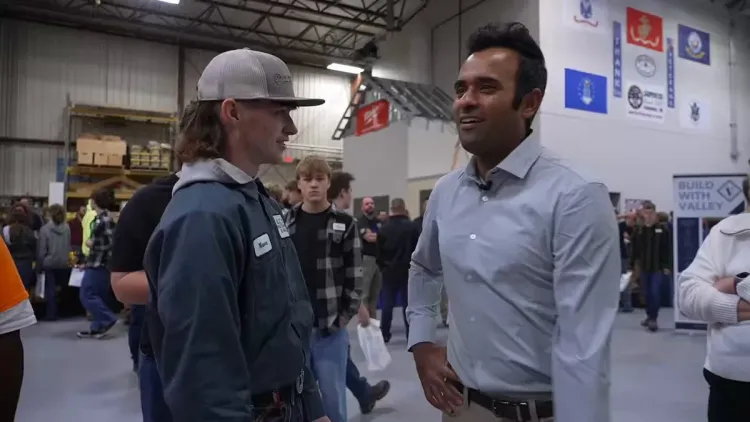
A generation ready to work hard — but locked out of affordable homes, decent wages, and educational paths that don't saddle them with debt. Entrepreneur Vivek Ramaswamy stepped into that conversation on Friday, October 23, 2026, posting on X about a series of conversations he had the previous day with young Americans hungry for a shot at the American Dream.
Ramaswamy wrote directly: 'They're ready to work hard and I'm ready to fight for them to have a path to get there: high-paying jobs, more affordable homes, and educational paths beyond just college.' Three demands. No jargon. The framing was unmistakable — an agenda, not just a sentiment.
The Three-Point Case Against the Status Quo
The trio of priorities Ramaswamy named — high-paying jobs, housing affordability, and non-college educational pathways — maps directly onto the fault lines of the current American economic anxiety. Student loan burdens have pushed millions of young Americans to question whether a four-year degree is still the only credible on-ramp to the middle class. Meanwhile, housing costs in major metros have made homeownership feel like a mirage for anyone under 35.
During his 2024 Republican presidential campaign, Ramaswamy consistently championed vocational training and skilled trades as legitimate, high-value alternatives to college — a pivot away from what critics of credentialism call the 'degree-or-nothing' culture that has dominated career counselling for decades. That message hasn't changed; if anything, it has sharpened.
Ramaswamy's Position After DOGE and the 2024 Race
As the founder and executive chairman of Strive Asset Management and a former co-lead of the Department of Government Efficiency (DOGE) advisory effort, Ramaswamy occupies an unusual perch: part private-sector operator, part political force-in-waiting. His post carries the register of someone preparing the ground for a policy push — or a political re-entry. Whether through Congressional proposals on vocational education funding or housing supply reforms expected to surface in 2027 legislative sessions, the issues he named are already on the agenda of several Republican-aligned think tanks and state legislatures.
The broader pattern is clear: post-2024, a strand of Republican economic messaging has moved away from abstract deficit talk toward a more tangible, generational pitch — one that asks young voters what they actually need to build a life. Ramaswamy is positioning himself squarely inside that lane.
Why This Resonates Beyond American Borders
The credentialism debate and the housing crunch are not uniquely American problems. From Mumbai to London to Toronto, policymakers are grappling with the same question: how do you build economic pathways for young people when traditional institutions — universities, housing markets, corporate hiring pipelines — are failing to deliver? Ramaswamy's three-point framework gives that global anxiety a sharp American political address.
The fight for the next generation's economic future is no longer a background hum. It is the main event — and on October 23, 2026, Ramaswamy made clear he intends to stay in the ring.
Point of View
Housing, and alternative education is not new Republican territory, but Ramaswamy's DOGE credibility gives it a technocratic edge that differentiates it from generic party messaging. It signals preparation for a 2027 policy influence campaign, possibly ahead of another electoral run, at a moment when credentialism fatigue and housing unaffordability are uniquely potent voter concerns. The question is whether the fight he promises translates into concrete legislative action or remains a compelling political brand.
NationPress
23 Oct 2026
Frequently Asked Questions
What did Vivek Ramaswamy say about the American Dream in October 2026?
Ramaswamy posted on October 23, 2026 that he spoke with young people eager to work hard, and pledged to fight for their access to high-paying jobs, more affordable homes, and educational pathways beyond a traditional college degree.
What is Vivek Ramaswamy's current role in 2026?
As of 2026, Vivek Ramaswamy is the founder and executive chairman of Strive Asset Management and a former co-lead of the DOGE government-efficiency advisory effort, following his 2024 Republican presidential campaign.
What alternatives to college does Vivek Ramaswamy support?
Ramaswamy has consistently advocated for vocational training and skilled trades as high-value alternatives to four-year college degrees, arguing they offer real economic mobility without the burden of student debt.
What is DOGE and what was Ramaswamy's role in it?
DOGE, the Department of Government Efficiency advisory effort, was a body focused on reducing federal spending and improving government operations. Ramaswamy served as a co-lead of the advisory effort.
Why is housing affordability a key issue for young Americans in 2026?
Rising home prices in major US cities have made homeownership increasingly inaccessible for people under 35, making affordable housing a central demand among younger voters and a growing focus of Republican economic messaging.