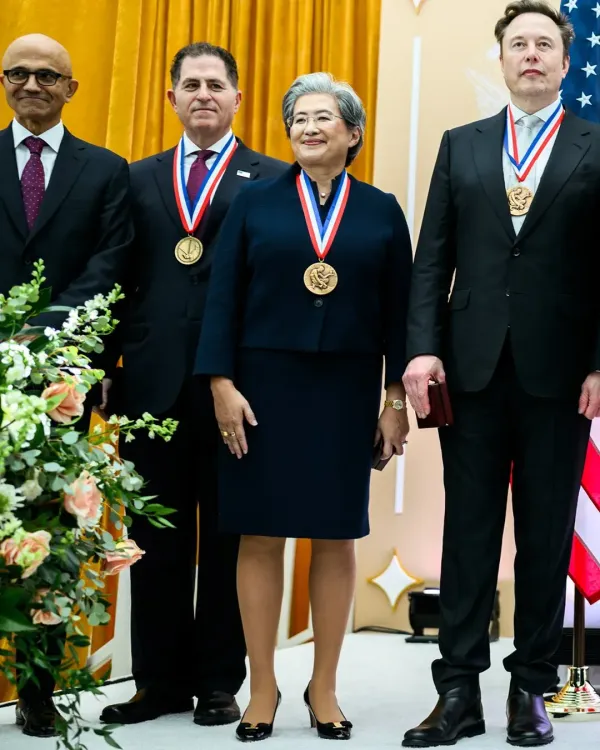
White House honours AMD CEO Lisa Su with National Medal of Science
Synopsis
The White House has awarded AMD CEO Lisa Su the National Medal of Science, honouring her transformation of AMD into a global semiconductor leader and her role in enabling the world's first exascale supercomputer through chiplet-based chip design.
Key Takeaways
Lisa Su , CEO of AMD , has been awarded the National Medal of Science by the White House .
Su is credited with transforming AMD from a struggling chipmaker into a global technology leader.
Her work on chiplet-based integration revolutionised semiconductor design and computer performance.
AMD's processors helped power the world's first exascale supercomputer , capable of one quintillion calculations per second .
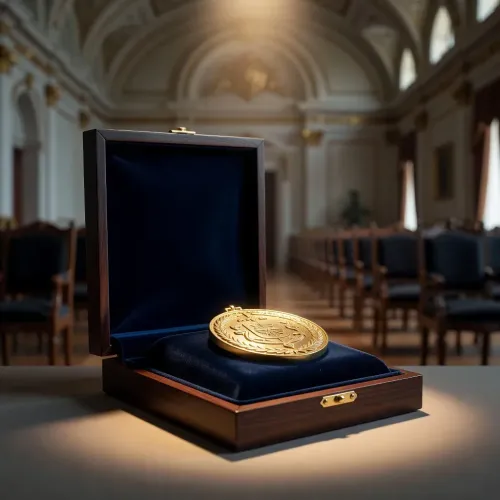
The National Medal of Science is the United States' highest scientific distinction, awarded by the President.
AMD has a significant engineering presence in Hyderabad and Bengaluru , making this recognition relevant to India's tech sector.
A semiconductor pioneer who rebuilt a struggling chipmaker into a global powerhouse has just received America's highest scientific honour. The White House announced on Thursday, October 8, 2026, that AMD Chief Executive Lisa Su has been awarded the National Medal of Science — recognition of a career that reshaped how the world computes.
From struggling chipmaker to tech supergiant
When Lisa Su took the helm at AMD (Advanced Micro Devices), the company was burning cash and widely seen as a distant also-ran to Intel. What followed was one of the most dramatic corporate and technological turnarounds in Silicon Valley history. Su bet the company on a bold new chip architecture, and that bet paid off spectacularly — AMD's processors eventually matched and then outperformed its larger rival across consumer, data centre, and high-performance computing markets.
The White House credited Su with transforming AMD into a 'tech supergiant' and 'revolutionising computer performance through semiconductor innovation and chiplet-based integration.' That last phrase matters: chiplet design — breaking a processor into smaller, specialised tiles that communicate at high speed — became a defining engineering strategy of the 2020s, and AMD was its most visible champion.
The exascale milestone that clinched it
The citation points to one achievement above all others: helping power the world's first exascale supercomputer. An exascale machine can perform one quintillion (10¹⁸) calculations per second — a threshold scientists had chased for over a decade. Crossing it unlocks simulation capabilities for climate modelling, drug discovery, nuclear-stockpile stewardship, and artificial-intelligence research at scales previously impossible. Su's chips sitting at the heart of that machine is not a ceremonial footnote; it is the engineering proof-of-concept behind the medal.
What the National Medal of Science means
The National Medal of Science is awarded by the President of the United States and administered by the National Science Foundation. It is the nation's pre-eminent scientific distinction, honouring individuals whose work has made exceptional contributions to knowledge in the physical, biological, mathematical, behavioural, or engineering sciences. Past recipients include luminaries across physics, biology, and computer science — placing Su in a lineage of foundational American innovators.
For the global technology industry — and for India's vast semiconductor-watching community, given AMD's deep engineering footprint in Hyderabad and Bengaluru — the award signals that chiplet-based design and high-performance computing are now firmly at the centre of how governments and institutions define scientific leadership.
A girl who studied electrical engineering at MIT, built chips at IBM, and then saved a company the industry had written off — now holds America's top science medal. The arc doesn't get much sharper than that.
Point of View
Now validated at the highest level, has become a template other chip designers are racing to replicate. For India, watching closely as it builds its own semiconductor ecosystem through the India Semiconductor Mission, the recognition underscores that chip design talent — not just fabrication — is where the next wave of geopolitical leverage will be decided.
NationPress
9 Oct 2026
Frequently Asked Questions
What is the National Medal of Science and who awards it?
The National Medal of Science is the United States' highest scientific honour, awarded by the President and administered by the National Science Foundation. It recognises exceptional contributions to knowledge in science and engineering.
Why did Lisa Su receive the National Medal of Science?
Lisa Su was awarded the medal for transforming AMD into a leading technology company, revolutionising computer performance through semiconductor innovation and chiplet-based integration, and helping power the world's first exascale supercomputer.
What is a chiplet and why does it matter?
A chiplet is a small, specialised chip tile that can be combined with other chiplets to build a larger, more powerful processor. AMD's pioneering use of chiplet-based design allowed it to deliver higher performance at lower cost, reshaping the semiconductor industry.
What is an exascale supercomputer?
An exascale supercomputer can perform one quintillion — or 10 to the power of 18 — calculations per second. It is a milestone scientists pursued for over a decade, enabling breakthroughs in climate science, drug discovery, and artificial intelligence research.
Does AMD have operations in India?
Yes, AMD has significant engineering and research centres in Hyderabad and Bengaluru, making Lisa Su's recognition and AMD's technological achievements directly relevant to India's growing semiconductor and technology workforce.