White House Calls Environmental Protestor 'Pro-Algae' and Likely Paid
Synopsis
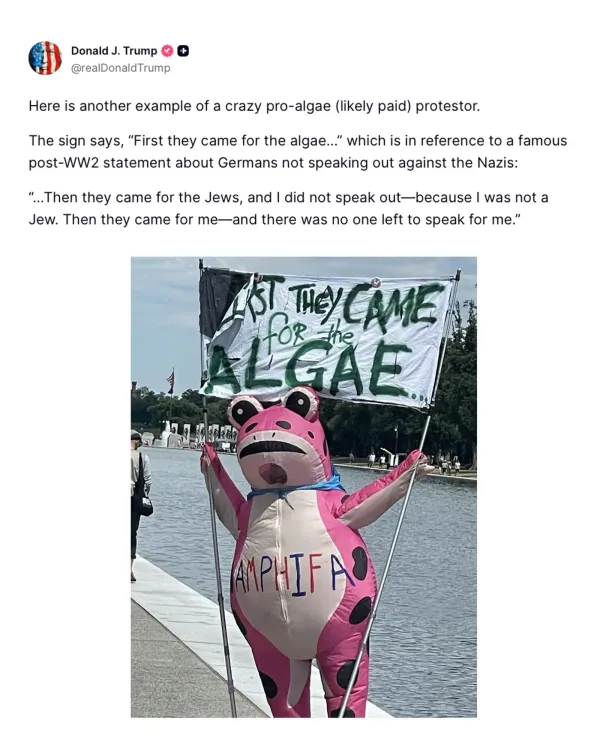
The White House labelled an environmental demonstrator a 'crazy pro-algae (likely paid) protestor' in an X post on 23 June 2026, sharing an image of the individual and offering no supporting evidence for the 'paid' claim, continuing a pattern of the administration using official accounts to question activist motives.
Key Takeaways
The White House posted on X on 23 June 2026 describing an environmental demonstrator as a 'crazy pro-algae (likely paid) protestor.' The post included one image of the individual but provided no identification, location, or evidence of external funding.
The phrase 'another example' in the post implies this is part of a series of similar posts targeting environmental activists.
The administration offered no evidence to substantiate the claim that the protestor was paid.
The post fits a documented pattern of U.S. government social media accounts questioning the motives of policy opponents, particularly on environmental issues.
Civil liberties and environmental advocacy groups are likely to challenge the use of an official government account to publicly mock a private individual.
The White House, the official communications account of the Executive Office of the President of the United States, posted on X on 23 June 2026 labelling an environmental demonstrator as a 'crazy pro-algae (likely paid) protestor,' sharing an image of the individual without providing further identification or context.
Context
The post, which included one image, described the person shown as 'another example' — implying prior similar posts — of a demonstrator whose motivations the administration characterised as suspect. The phrase 'likely paid' is a recurring rhetorical device used to suggest that protest activity is externally funded rather than organically motivated, though the White House offered no evidence to support the claim in this post.
The reference to 'pro-algae' activism appears to situate the demonstrator within debates over algae-related environmental or energy policy, though the specific protest event, location, and the individual's identity were not disclosed in the post.
Policy Backdrop
Official U.S. government social media accounts have periodically used digital platforms to question the motives or funding sources of protestors, particularly those opposing administration environmental positions. This pattern reflects a broader strategy of narrative management around policy opposition, where characterising activists as paid or fringe actors is intended to diminish the perceived legitimacy of dissent.
Environmental activism in the United States has long intersected with contentious debates over regulations covering water quality, biofuel policy, and ecological conservation — all areas where algae-related science and industry have featured in policy discussions in recent years.
Stakeholders and Impact
Environmental advocacy groups are likely to push back against the White House framing, arguing that labelling activists as 'paid' without evidence delegitimises constitutionally protected protest. Civil liberties organisations have previously raised concerns about government accounts targeting private individuals on social media platforms.
For the broader activist community, the post signals that the current administration is prepared to use its official communications infrastructure to publicly mock and question individual demonstrators, a tactic that critics argue has a chilling effect on public participation in civic life.
What's Next
It remains to be seen whether the White House will follow this post with formal policy statements on environmental enforcement or further commentary on demonstrations at official events. The post may also prompt responses from environmental organisations, members of Congress, or civil liberties advocates who monitor the administration's use of official government accounts for political messaging. Any escalation in the administration's posture toward environmental protestors will be closely watched ahead of upcoming legislative debates on ecological and energy regulation.
Point of View
But deploying it from an official state account raises distinct questions about the line between political communication and government targeting of private citizens. The 'pro-algae' framing, however unusual, suggests the administration is actively working to frame niche environmental causes as fringe or absurd, a strategy that could influence how undecided voters perceive the broader environmental movement. Observers will watch whether this becomes a sustained communications pattern ahead of any major environmental legislation or regulatory rollback.
NationPress
23 Jun 2026
Frequently Asked Questions
What did the White House post about the protestor?
The White House posted on X on 23 June 2026 calling an environmental demonstrator a 'crazy pro-algae (likely paid) protestor,' sharing an image of the person without identifying them or providing evidence for the 'paid' claim.
What does 'pro-algae protestor' mean?
'Pro-algae protestor' appears to refer to an environmental activist advocating for algae-related ecological or energy policy, though the White House post did not specify the exact cause or protest event.
Is it legal for the White House to call protestors 'paid' on social media?
While the White House is legally permitted to post commentary on public demonstrations, civil liberties advocates argue that using an official government account to target and mock private individuals — especially without evidence — raises serious First Amendment and due process concerns.
Has the US government done this before?
Yes, U.S. government and administration-affiliated social media accounts have periodically questioned the motives or funding of protestors, particularly those opposing environmental or energy policies, as part of broader narrative management strategies.
What could happen next after this White House post?
Environmental advocacy groups, civil liberties organisations, and members of Congress may respond publicly. The administration could also follow up with formal policy statements on environmental enforcement or continue similar social media messaging targeting activists.