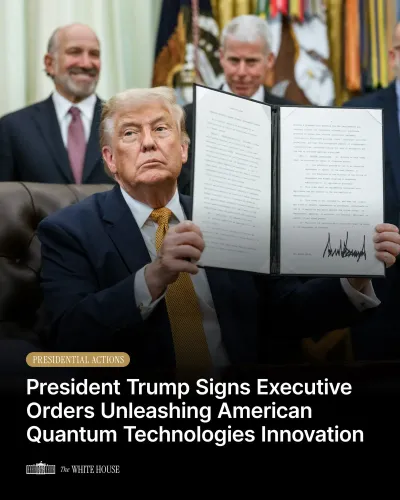
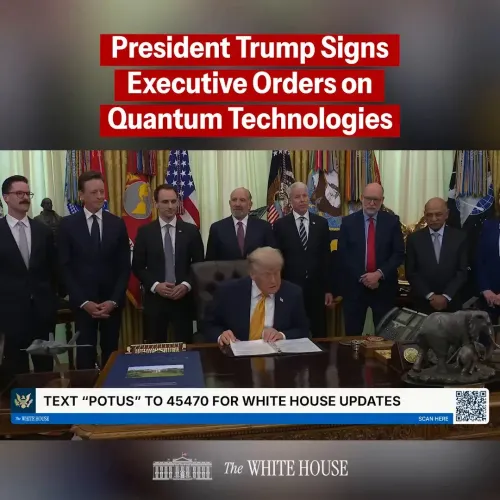
White House Highlights Next Frontier of Quantum Innovation
Synopsis
The White House on 23 June 2026 flagged 'The Next Frontier of Quantum Innovation,' reaffirming US federal commitment to quantum research and competitiveness. The signal builds on the 2018 National Quantum Initiative Act and sustained interagency investment in quantum computing, networking, and sensing as a strategic national priority.
Key Takeaways
The White House posted on 23 June 2026 highlighting quantum innovation as a key national frontier.
The National Quantum Initiative Act , enacted in December 2018 , established a 10-year coordinated federal quantum R&D programme.
The White House Office of Science and Technology Policy (OSTP) coordinates executive-branch quantum efforts across agencies.
US federal quantum strategy combines public investment in basic research with public-private partnerships, mirroring approaches in semiconductors and AI.
India's own National Quantum Mission — backed by Rs 6,003 crore over eight years — makes US quantum policy signals directly relevant to Indian researchers and firms.
Future agency announcements on quantum testbeds, error-correction, and post-quantum cryptography standards will indicate the administration's next concrete steps.
The White House on Tuesday, 23 June 2026 spotlighted what it called 'The Next Frontier of Quantum Innovation,' signalling continued federal emphasis on advancing quantum technologies as a pillar of American scientific and economic strategy.
Context
The post, shared from the official White House communications account, frames quantum innovation as a forward-looking national priority. While the post's specific programmatic details were not elaborated in the text, the framing echoes a sustained executive-branch push to position the United States at the leading edge of quantum research, computing, networking, and sensing.
Quantum technologies exploit the principles of quantum mechanics — superposition, entanglement, and interference — to perform tasks far beyond the reach of classical computers, with applications spanning cryptography, drug discovery, materials science, and secure communications.
Policy Backdrop
The federal government's structured engagement with quantum science dates to the National Quantum Initiative Act, signed into law in December 2018. That legislation established a coordinated, 10-year federal programme to accelerate quantum information science research and workforce development across multiple agencies.
The White House Office of Science and Technology Policy (OSTP) has served as the primary coordinator of executive-branch efforts in this domain, overseeing interagency working groups and guiding investment priorities. Successive administrations have treated quantum technologies as a strategic domain tied directly to national security and long-term economic competitiveness.
The broader pattern mirrors federal approaches seen in semiconductors and artificial intelligence: sustained public investment in basic research combined with public-private partnerships designed to counter advances by international rivals, particularly in the quantum computing race.
Stakeholders and Impact
The primary beneficiaries of expanded federal quantum programmes are academic research institutions, national laboratories, and a growing ecosystem of quantum-focused technology companies, ranging from established defence contractors to startups developing quantum hardware and software stacks.
For India, the US federal push carries direct relevance. India launched its own National Quantum Mission with a budgetary outlay of Rs 6,003 crore over eight years, and Indian researchers and technology firms engaged in bilateral science and technology agreements with the US stand to watch these developments closely. Advances in US quantum standards and testbeds often set the baseline for allied nations' own programmes.
The private sector — from cloud computing giants to specialised quantum hardware firms — also tracks federal signals carefully, as government procurement commitments and research grants shape commercial investment timelines.
What's Next
Observers will watch for follow-on announcements from federal agencies such as the National Science Foundation, the Department of Energy, and the National Institute of Standards and Technology, which collectively manage the bulk of quantum research funding and standards-setting activity under the National Quantum Initiative framework.
Future budget requests and agency-level announcements expanding quantum testbeds, error-correction research, and post-quantum cryptography standards will be the clearest indicators of how the administration intends to operationalise this renewed emphasis. As the global quantum race intensifies, the White House's continued public signalling on this frontier underscores that quantum technology has moved firmly from laboratory curiosity to geopolitical priority.
Point of View
Not merely a ceremonial post — it keeps executive attention and private-sector confidence aligned with ongoing federal investment cycles. This continues a bipartisan pattern of treating quantum technologies with the same urgency once reserved for the space race and nuclear programmes. For India, which is building its own quantum ecosystem, the US posture sets both a benchmark and a potential partnership framework. The key question is whether the signal is followed by concrete budget and programmatic action in the months ahead.
NationPress
21 Sept 2026
Frequently Asked Questions
What is the US National Quantum Initiative Act?
The National Quantum Initiative Act is a 2018 US law that created a coordinated 10-year federal programme to accelerate quantum information science research, standards development, and workforce training across government agencies.
Why is the White House focusing on quantum innovation in 2026?
The White House's emphasis on quantum innovation in 2026 reflects sustained US concern about maintaining technological leadership in quantum computing and sensing, which have direct implications for national security, cryptography, and economic competitiveness.
How does US quantum policy affect India?
India launched its National Quantum Mission with a budget of Rs 6,003 crore over eight years, and Indian researchers and companies engaged in bilateral science agreements with the US closely track American quantum standards, testbeds, and funding priorities.
Which US agencies are involved in quantum research?
Key agencies include the National Science Foundation , the Department of Energy , and the National Institute of Standards and Technology , all of which fund quantum research and set standards under the National Quantum Initiative framework.
What comes after the White House quantum innovation announcement?
Observers expect follow-on announcements covering expanded quantum testbeds, advances in error-correction research, and post-quantum cryptography standards — the concrete programmatic steps that will define how the administration delivers on this strategic priority.