White House Touts Record-Low Poverty, Peak US Employment

Synopsis
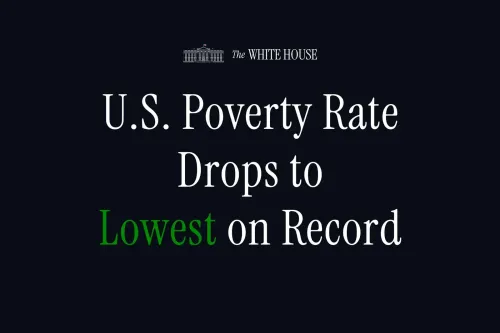
The White House claimed on November 20, 2026 that the US has hit an all-time record-low poverty rate and record-high employment, attributing both milestones directly to President Trump's economic stewardship.
Key Takeaways
The White House posted on November 20, 2026 claiming a record-low US poverty rate and record-high total employment.
The post credits President Trump directly for both economic milestones.
US poverty data is officially tracked by the Census Bureau ; employment figures by the Bureau of Labor Statistics .
The Tax Cuts and Jobs Act of 2017 was Trump's flagship first-term economic legislation, cited for boosting wages and labor participation.
American administrations routinely time such public messaging to coincide with fresh federal data releases.
The numbers, the White House says, speak for themselves. On Friday, November 20, 2026, the official communications account of the White House posted a pointed message on X claiming an 'all time record low poverty rate' and declaring that 'more Americans are working today than ever before' — capping it with a direct 'Thank you, President Trump.'
What the White House is claiming — and why it matters
The post makes two distinct claims: first, that the U.S. poverty rate has reached an all-time low; second, that total American employment has hit a historic peak. Both metrics are tracked by federal agencies — the U.S. Census Bureau publishes the official poverty rate annually, while the Bureau of Labor Statistics (BLS) releases monthly employment situation reports. When an administration invokes both in a single breath, it is typically timed to coincide with a fresh data release from one or both of those bodies.
Trump economic policy and the credit-claiming tradition
President Donald Trump, now serving a second term in the White House, built much of his first-term economic narrative around the Tax Cuts and Jobs Act of 2017, which slashed corporate and individual tax rates with the stated aim of lifting wages and expanding labor-force participation. U.S. administrations across party lines have long cited Census and BLS data in public messaging to claim ownership of prevailing economic conditions — the practice is as old as the modern statistical state. The White House post follows that well-worn playbook, with the added sharpness of a direct presidential shout-out.
Why these two numbers carry political weight
Poverty and employment are not abstract indicators. A record-low poverty rate, if confirmed by Census data, would mean that the share of Americans living below the federal poverty line is smaller than at any point in the history of the measurement — a threshold economists and policymakers treat as a generational benchmark. A record-high employment count, distinct from the unemployment rate, signals that the absolute number of people with jobs has never been larger, absorbing population growth in the process. Together, they form the most politically resonant pair of economic statistics an administration can wield.
Point of View
Linking these twin milestones to presidential stewardship reinforces the economic-nationalist brand that drove both of his electoral victories. The timing suggests a fresh Census or BLS data drop, and the unambiguous 'Thank you, President Trump' framing signals this is as much a political communication as a factual announcement. How durable these records prove — and whether independent data confirm the White House characterisation — will determine whether the moment becomes a lasting legacy talking point or a contested claim.
NationPress
20 Nov 2026
Frequently Asked Questions
What did the White House claim about US poverty in November 2026?
The White House posted on November 20, 2026 that the United States had reached an 'all time record low poverty rate,' attributing the milestone to President Trump.
Which agency officially measures the US poverty rate?
The U.S. Census Bureau publishes the official annual poverty rate. The Bureau of Labor Statistics tracks employment figures separately through its monthly jobs reports.
What is Trump's economic policy that is credited for these numbers?
The Tax Cuts and Jobs Act of 2017 , passed during Trump's first term, reduced corporate and individual tax rates with the goal of raising wages and expanding labor-force participation.
What does 'more Americans working than ever before' mean?
It refers to the absolute number of employed Americans reaching a historic peak — meaning more people hold jobs now than at any previously recorded point, accounting for population growth.
Why does the White House post economic data on social media?
US administrations routinely use social media to amplify favorable Census Bureau and BLS data releases, linking headline economic figures to presidential policy decisions for political messaging purposes.