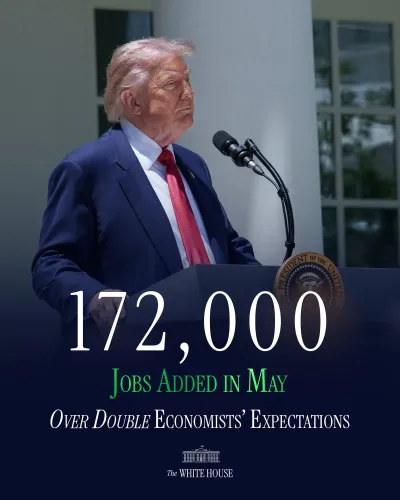
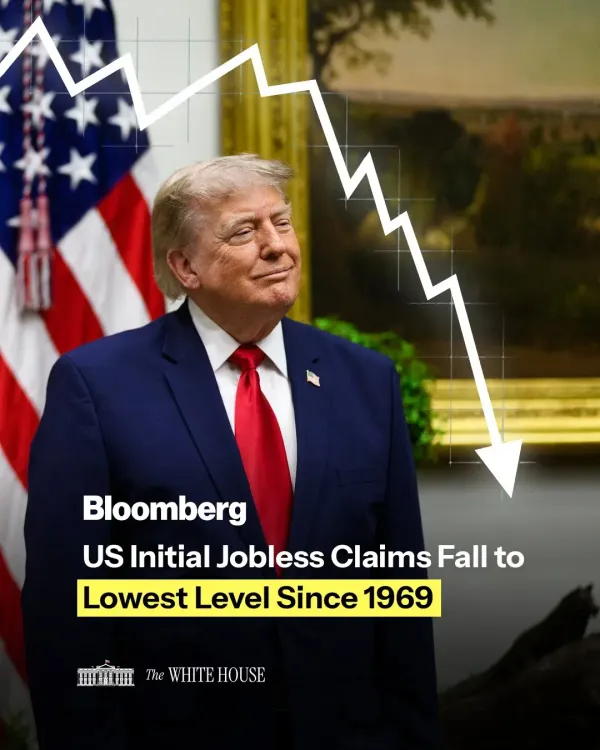
White House: US Jobless Claims Hit Lowest Since 1969
Synopsis
The White House announced on 23 July 2026 that US initial jobless claims have fallen to their lowest level since 1969, pointing to an exceptionally tight labour market. The weekly Department of Labor data is a high-frequency gauge closely watched by the Federal Reserve and financial markets alike.
Key Takeaways
The White House announced on 23 July 2026 that US initial jobless claims fell to their lowest level since 1969 .
Initial jobless claims measure first-time unemployment benefit filings and are released weekly by the US Department of Labor .
The last comparable low was recorded during the late 1960s ; the most recent pre-pandemic low came in 2019 .
The Federal Reserve closely monitors jobless claims when assessing labour market slack and setting monetary policy.
The next key data point will be the monthly Employment Situation report from the Bureau of Labor Statistics .
Analysts caution that a single week's reading can be volatile; sustained trends across multiple weeks carry more weight.
The White House announced on Thursday, 23 July 2026 that US initial jobless claims have fallen to their lowest level since 1969, marking a historic milestone in the country's labour market. The announcement was made via the official White House account on X, highlighting what the administration described as a record-setting week for first-time unemployment filings.
Context
Initial jobless claims measure the number of Americans filing for unemployment benefits for the first time in a given week. The data is compiled and released weekly by the US Department of Labor and serves as one of the most closely watched high-frequency indicators of labour market health. A fall to the lowest level since 1969 — more than five decades ago — signals an exceptionally tight labour market with limited layoffs.
The last time the United States recorded comparably low jobless claims was during the late 1960s, a period of strong economic expansion. More recently, claims had touched multi-decade lows in 2019 during the pre-pandemic growth cycle before spiking sharply in 2020 amid widespread economic disruption.
Policy Backdrop
Weekly jobless claims form a central pillar of the administration's economic messaging, offering near-real-time evidence of labour market momentum. When claims remain persistently low, it typically indicates that employers are holding on to workers and that hiring conditions remain favourable. The White House routinely amplifies such data releases as part of its broader economic communication strategy.
The Federal Reserve also monitors initial jobless claims closely when assessing the degree of slack in the labour market. Sustained low readings can influence the Fed's decisions on interest rates, as a tight labour market may keep wage pressures elevated. The latest reading is therefore likely to feature prominently in upcoming Fed deliberations.
Stakeholders and Impact
For American workers, a historic low in jobless claims reflects a labour market where layoffs remain rare and job security is relatively high. Labour economists view such readings as a positive signal for household income stability and consumer spending, both of which are key drivers of economic growth in the United States.
The data also carries implications for financial markets and fiscal planning. Investors and policymakers track jobless claims as a leading indicator, and a reading at a 57-year low could reinforce confidence in the durability of the current economic expansion. However, analysts caution that a single week's data can be volatile and that sustained trends matter more than any single print.
What's Next
Attention will now turn to the next monthly Employment Situation report from the Bureau of Labor Statistics, which will provide a fuller picture of hiring, unemployment rates, and wage growth. Any statements from Federal Reserve officials on labour market conditions in the coming weeks will also be closely scrutinised for signals on the monetary policy path.
If the low claims trend holds through subsequent weekly releases, it could strengthen the administration's economic narrative ahead of the next major policy cycle. Labour market resilience at this scale, if confirmed over multiple data points, would represent a significant structural story for the US economy in 2026.
Point of View
Concrete metric to anchor its economic messaging. For the Federal Reserve, however, such tightness complicates the calculus on rate policy, as persistently low layoffs can sustain wage pressures. The broader significance will depend on whether subsequent weekly prints and the monthly jobs report confirm this as a durable trend rather than a statistical outlier.
NationPress
22 Oct 2026
Frequently Asked Questions
What are US initial jobless claims?
US initial jobless claims measure the number of people filing for unemployment benefits for the first time in a given week. The data is released weekly by the US Department of Labor and is one of the most closely tracked high-frequency labour market indicators.
Why is the 1969 comparison significant?
1969 represents a period more than five decades ago when the US economy was in a strong expansion phase. Falling to that level in 2026 suggests the current labour market is among the tightest in modern American history.
How does this affect the Federal Reserve's decisions?
The Federal Reserve monitors jobless claims as part of its assessment of labour market slack. Persistently low claims can signal limited room for further tightening in the job market, which may influence decisions on interest rates.
What happens next after this jobless claims data?
The next major data point is the monthly Employment Situation report from the Bureau of Labor Statistics, which will provide broader details on hiring, the unemployment rate, and wage growth across the US economy.
Does one week of low jobless claims confirm a trend?
Not necessarily. Weekly jobless claims data can be volatile due to seasonal adjustments and one-off factors. Economists typically look for sustained low readings over several weeks before drawing firm conclusions about labour market direction.