White House Flags Foreign Access to US Voter Data, Voting Systems

Synopsis
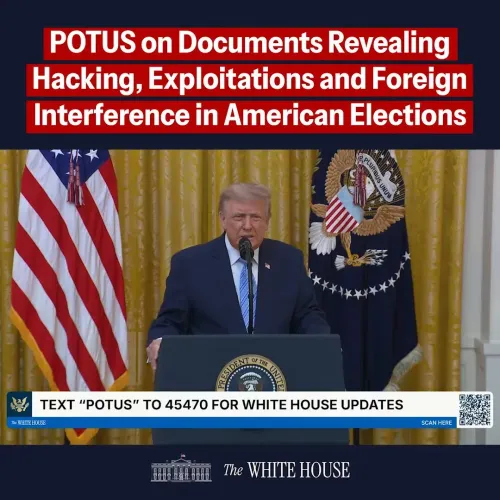
The White House on July 17, 2026, declared the US election system 'broken,' alleging hundreds of millions of voter files are in foreign government hands and that voting machines face hacking risks, naming China as an active adversary — the strongest such public statement from any administration in recent memory.
Key Takeaways
The White House posted on July 17, 2026 , declaring the US election system 'broken' in an official communication.
The post claims 'hundreds of millions of American voter files' are held by foreign governments.
Voting machines and ballot-counting systems are alleged to be exposed to hacking and manipulation.
China is specifically named as an adversary actively attempting to interfere.
The ODNI and CISA have documented foreign election threats annually since 2016, but this statement is notably more declarative than past assessments.
The claims are expected to intensify debate over federal election security standards ahead of the 2026 midterm elections .
The White House on Friday, July 17, 2026, posted a pointed public alert on X claiming that the United States election system is 'broken,' citing what it described as new disclosures involving foreign government access to voter files and vulnerabilities in voting infrastructure. The post, issued from the official communications account of the Executive Office of the President, marks one of the most direct public statements from the administration on the integrity of American electoral systems.
What the Post Claims
The White House post alleges that 'hundreds of millions of American voter files' are in the hands of foreign governments, and that voting machines and ballot-counting systems have been 'exposed to hacking and manipulation.' The post specifically names China and 'other adversaries' as actively attempting to interfere, though the post's linked content was truncated in the available text. The administration's use of the phrase 'disclosures' suggests the claims are grounded in intelligence or government findings rather than open-source reporting.
The post's framing — 'The U.S. Election System is Broken' — is notably stronger than the measured language typically used in official intelligence community assessments, which tend to describe threats as 'attempts' or 'probing activity' rather than confirmed systemic compromise.
Policy Backdrop
Warnings about foreign interference in U.S. elections have been a fixture of federal communications since the 2016 Intelligence Community Assessment, which concluded that Russia conducted influence operations targeting that year's presidential election. In 2017, the Department of Homeland Security designated election infrastructure as critical infrastructure, enabling direct federal assistance to state-level election administrators.
The Office of the Director of National Intelligence (ODNI) has published annual foreign threat assessments every cycle since, documenting attempts by China, Russia, and Iran to access voter rolls and probe voting systems. The Cybersecurity and Infrastructure Security Agency (CISA), established in 2018, has been the primary federal body coordinating with states on election security upgrades and issuing public guidance on cyber risks to election technology.
Successive administrations have paired these threat disclosures with funding allocations for state-level security improvements and partnerships with private-sector voting technology vendors. The July 2026 post continues this pattern of public disclosure but escalates the rhetoric significantly by declaring the system itself 'broken.'
Stakeholders and Impact
American voters and state election officials are the most directly affected constituencies. The United States conducts elections on a decentralised model — each of the 50 states administers its own voter registration databases and chooses its own voting equipment — which has historically made uniform federal security standards difficult to enforce. Any confirmed compromise of voter file databases at scale would represent a significant intelligence and administrative failure across multiple jurisdictions.
For Indian observers, the development carries relevance: India and the United States have deepened cooperation on cybersecurity under frameworks including the India-US Initiative on Critical and Emerging Technology (iCET), and threats to democratic election infrastructure in either country are increasingly viewed as part of a shared geopolitical challenge posed by China and aligned state actors.
What to Watch Next
The White House post is likely to accelerate calls for Congressional hearings on election cybersecurity funding and federal standards ahead of the 2026 midterm elections. Formal assessments from CISA or ODNI that substantiate or contextualise the administration's claims will be critical to evaluating the scale of the alleged exposure. State election officials and independent security researchers are expected to respond to the disclosure, and any proposed federal legislation mandating security standards for voting systems will face the perennial tension between federal authority and states' rights in election administration.
Point of View
Which framed foreign activity as attempts rather than accomplished compromises. By invoking 'hundreds of millions' of exposed voter files and naming China explicitly, the administration is staking a maximalist public position that will face immediate scrutiny from independent security researchers and congressional oversight bodies. The timing — ahead of the 2026 midterms — means the statement will inevitably be read through a partisan lens, complicating bipartisan cooperation on the very election security legislation it may be intended to spur. For allies like India, the disclosure underscores the shared vulnerability of democratic infrastructure to state-sponsored cyber operations, reinforcing the strategic logic of frameworks like iCET.
NationPress
17 Jul 2026
Frequently Asked Questions
What did the White House say about the US election system in July 2026?
The White House posted on July 17, 2026, claiming the US election system is 'broken,' alleging that hundreds of millions of voter files are in foreign government hands and that voting machines and ballot-counting systems are exposed to hacking and manipulation.
Which countries does the US accuse of interfering in its elections?
The White House post specifically names China and refers to 'other adversaries.' Past US intelligence assessments have also cited Russia and Iran as state actors attempting to access voter rolls and probe voting systems.
What is CISA and what role does it play in US election security?
The Cybersecurity and Infrastructure Security Agency (CISA) is the primary federal body responsible for coordinating election security with state officials, issuing guidance on cyber threats, and partnering with voting technology vendors to reduce vulnerabilities.
How are US voter files at risk from foreign governments?
US voter registration databases are maintained at the state level and have been identified in past intelligence assessments as targets for foreign cyber operations. The White House's July 2026 post claims the scale of foreign access has reached hundreds of millions of records, though independent verification of this specific figure is pending.
What happens next after the White House election security warning?
The statement is expected to prompt Congressional hearings on election cybersecurity funding and federal standards. CISA and ODNI assessments that substantiate the claims, and any new federal legislation on voting system security, will be key developments to watch ahead of the 2026 midterm elections.