White House Launches Fraud.Gov, Claims $229B in Waste Uncovered
Synopsis
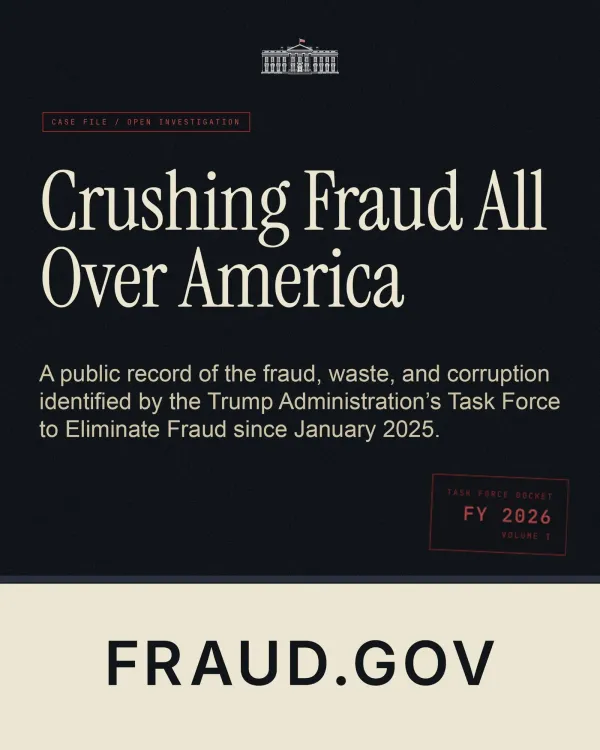
The White House launched Fraud.Gov on 6 August 2026, a live public tracker claiming the Trump administration's Task Force to Eliminate Fraud has identified over $229 billion in federal fraud, waste, and corruption since January 2025 — billed as the first consolidated record of its kind.
Key Takeaways
The White House announced the launch of Fraud.Gov on 6 August 2026 as a real-time public tracker of federal fraud findings.
The tracker claims more than $229 billion in fraud, waste, and corruption has been uncovered — with the total described as still growing.
The findings are attributed to the Task Force to Eliminate Fraud , launched at the start of President Trump's second term in January 2025 .
The administration calls it the first transparent, consolidated public record of its kind in U.S. history.
Key questions remain about the methodology: whether the figure represents funds identified or actually recovered , and how the data will be independently audited.
Congressional oversight hearings and inspector general reviews are expected to scrutinise the tracker's claims.
The United States government just put a number on the problem — and it is staggering. The White House announced on 6 August 2026 the launch of Fraud.Gov, a public-facing tracker that claims to document more than $229 billion in fraud, waste, and corruption uncovered by the Trump Administration's Task Force to Eliminate Fraud since January 2025. The administration is calling it the first transparent public record of its kind.
What Fraud.Gov Actually Is
The site is positioned as a live ledger — a single, consolidated destination where the public can track findings from the administration's anti-fraud task force in real time. The White House post described it as 'the first transparent public record tracking fraud, waste, and corruption' exposed since the task force's launch at the start of President Donald Trump's second term. The $229 billion figure is presented as a running total, with the phrase 'and counting' signalling that the number is expected to grow.
The Task Force Behind the Numbers
The Task Force to Eliminate Fraud was stood up in January 2025 as part of the Trump administration's broader push on government efficiency. U.S. administrations have historically used inspector general offices and inter-agency task forces to chase improper payments — a chronic problem across large federal programmes like Medicare, Medicaid, and defence contracting. What is new here is the public-facing, consolidated dashboard approach: rather than burying findings in inspector general reports or congressional testimony, the administration is surfacing the data directly to citizens.
Why a $229 Billion Figure Commands Attention
To put the scale in perspective, $229 billion exceeds the annual GDP of many mid-sized economies. If the figure is validated, it would represent one of the largest documented fraud-recovery or fraud-identification exercises in U.S. federal history. The critical distinction — one that will drive congressional scrutiny — is between funds identified as fraudulent and funds actually recovered. The tracker's methodology, audit trail, and the breakdown by agency or programme will be the next battleground for oversight committees and independent watchdogs.
The launch of Fraud.Gov hands the administration a potent political instrument heading into the budget cycle — a visible, updatable scoreboard that frames fiscal discipline as a measurable achievement. Whether the numbers hold up to independent audit will determine whether it becomes a lasting governance tool or a contested campaign prop.
Point of View
Rather than through the slow drip of inspector general reports. The $229 billion headline figure is designed to be viscerally large and shareable, but the administration's credibility on this initiative will hinge entirely on independent verification of the methodology. Historically, U.S. anti-fraud task forces have struggled to convert 'identified' fraud into actual recoveries, and that gap is where congressional opposition will focus its fire. If the numbers survive scrutiny, Fraud.Gov could become a genuine governance benchmark; if they don't, it hands critics a ready-made accountability target.
NationPress
6 Aug 2026
Frequently Asked Questions
What is Fraud.Gov and who launched it?
Fraud.Gov is a public online tracker launched by the White House on 6 August 2026. It is run by the Trump administration's Task Force to Eliminate Fraud and claims to document all federal fraud, waste, and corruption uncovered since January 2025 in one place.
How much fraud has the Trump administration claimed to uncover?
The White House claims more than $229 billion in fraud, waste, and corruption has been identified since January 2025, with the total described as ongoing and expected to rise.
What is the Task Force to Eliminate Fraud?
The Task Force to Eliminate Fraud is a Trump administration initiative launched in January 2025, at the start of President Donald Trump's second term, to identify and address improper payments, waste, and corruption across U.S. federal programmes.
Has the $229 billion fraud figure been independently verified?
As of the announcement, the figure comes from the administration's own task force. Independent verification by congressional oversight committees or inspector general offices has not yet been publicly confirmed, and the methodology behind the number is expected to face scrutiny.
What happens to the money identified as fraudulent by the US government?
Identifying fraud and recovering the funds are two separate steps. Federal task forces flag improper payments and refer cases for prosecution or clawback, but actual recovery rates have historically been lower than the amounts identified. Fraud.Gov's breakdown of recovered versus identified funds will be a key metric to watch.