White House Marks 236th Birthday of the US Coast Guard
Synopsis
The White House celebrated the United States Coast Guard's 236th birthday on August 5, 2026, honouring its personnel for protecting borders, saving lives, and intercepting deadly drug shipments — framing the service as a cornerstone of American homeland security.
Key Takeaways
The White House posted a birthday tribute to the US Coast Guard on August 5, 2026 , marking the service's 236th anniversary .
The tribute highlighted the USCG's roles in border protection , homeland defence , search-and-rescue , and counter-narcotics interdiction .
The Coast Guard was founded on August 4, 1790 , making it one of the oldest continuously operating armed services in the United States.
The USCG operates under the Department of Homeland Security during peacetime and conducts drug seizures across the Eastern Pacific and Caribbean .
The administration's language — border protection and drug interdiction — mirrors its broader homeland security and anti-narcotics policy priorities.
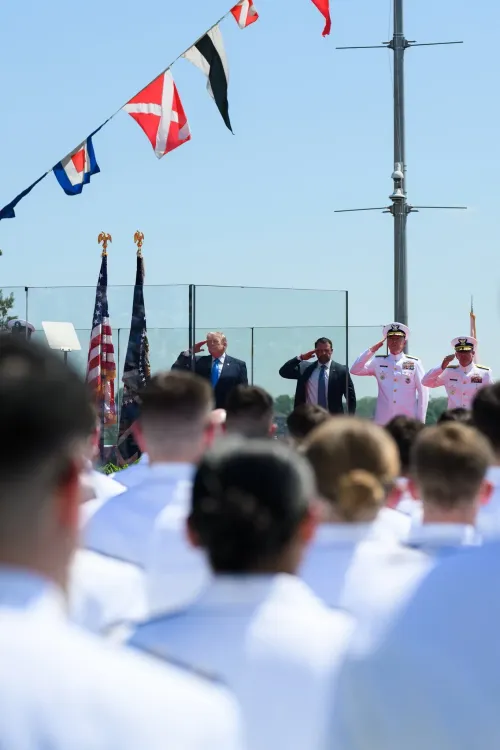
On a milestone that spans more than two centuries of American maritime history, The White House on Wednesday, August 5, 2026 saluted the United States Coast Guard as it turned 236 years old — honouring the service's dual role as both a lifesaving force at sea and a frontline defender against drug trafficking.
The official post quoted a tribute that read: 'Today we honor the incredible Men and Women of the United States Coast Guard, who protect our Borders, defend our Homeland, save countless American lives, and have done an AMAZING job taking deadly drugs off our streets before they can' — the message cut off mid-sentence by a link, but its thrust was unmistakable: the administration views the USCG not merely as a maritime safety agency but as a critical pillar of homeland security and counter-narcotics enforcement.
Two Centuries and Counting: What the Coast Guard Actually Does
The United States Coast Guard was established on August 4, 1790, making the service one of the oldest continuously operating armed forces in American history. Unlike the other military branches, the USCG operates under the Department of Homeland Security during peacetime, a distinction that places it at the intersection of law enforcement, search-and-rescue, and national defence.
The service's counter-narcotics mission has grown significantly in recent decades. Coast Guard cutters and aircraft intercept drug shipments — primarily cocaine and fentanyl precursors — in the Eastern Pacific and Caribbean transit zones, often in coordination with the Drug Enforcement Administration and partner nations. Annual seizures routinely run into hundreds of tonnes of narcotics, making the USCG one of the most consequential single actors in the US government's supply-side drug interdiction effort.
Why the White House Framing Matters
Birthday tributes from the executive office are ceremonial by nature, but the language chosen here — border protection, homeland defence, drug interdiction — mirrors the administration's broader security messaging. Elevating the Coast Guard's counter-narcotics role in a public salute signals continued political priority for maritime drug enforcement at a time when fentanyl trafficking remains a defining domestic crisis in the United States.
For the roughly 55,000 active-duty, reserve, and civilian personnel of the Coast Guard, the 236th birthday is a moment of institutional pride — and a reminder that their work spans everything from rescuing mariners in the Bering Sea to seizing narco-submarines off Central America.
Two hundred and thirty-six years in, the Coast Guard remains the United States' most versatile armed service — and, if the White House's framing is any guide, one of its most politically valued.
Point of View
Reinforcing institutional support for USCG funding and operational mandates. For a service that often sits in the shadow of the larger military branches, this public elevation carries real budgetary and political weight. The framing also reflects a broader pattern of treating counter-narcotics as a national security issue rather than a law-enforcement one.
NationPress
5 Aug 2026
Frequently Asked Questions
When was the US Coast Guard founded?
The United States Coast Guard was founded on August 4, 1790 , making 2026 its 236th anniversary . It is one of the oldest continuously operating armed services in American history.
What does the US Coast Guard do?
The US Coast Guard conducts search-and-rescue operations, enforces maritime law, protects US borders at sea, and intercepts drug shipments — primarily cocaine and fentanyl — in the Eastern Pacific and Caribbean transit zones.
Which department does the Coast Guard fall under?
During peacetime, the US Coast Guard operates under the Department of Homeland Security , distinguishing it from the other military branches which fall under the Department of Defense.
Why did the White House post about the Coast Guard birthday?
The White House posted a tribute on August 5, 2026 to mark the Coast Guard's 236th birthday , honouring personnel for their border protection, life-saving, and drug interdiction missions.
How many people serve in the US Coast Guard?
The US Coast Guard has approximately 55,000 active-duty, reserve, and civilian personnel who carry out missions ranging from maritime rescue to counter-narcotics operations.