White House Revives Reagan's 'Peace Through Strength' Doctrine
Synopsis
The White House invoked the Reagan-era deterrence slogan 'Peace through strength' on 19 November 2026, with no elaboration — a signal of the current administration's hard-power foreign-policy posture, relevant to allies and rivals watching Washington's strategic intent.
Key Takeaways
The White House posted 'Peace through strength' on 19 November 2026 , with no additional context.
The phrase was popularised by Ronald Reagan during the 1980s as the basis for his military buildup and Cold War deterrence strategy.
It has been invoked across multiple Republican administrations to frame military strength as essential to avoiding conflict.
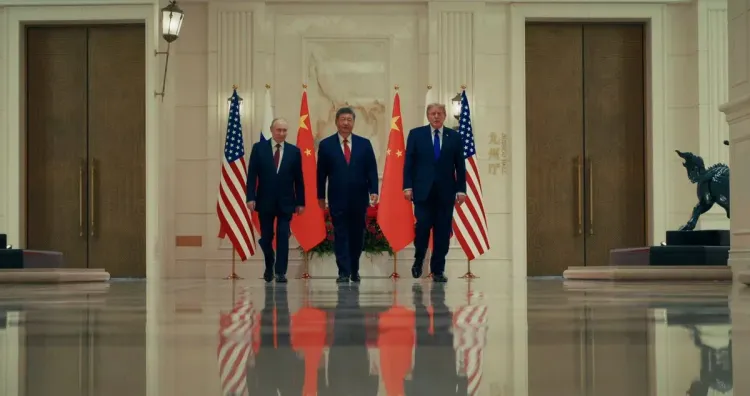
The post accompanied a video but carried no specific policy announcement or named trigger event.
The slogan typically precedes or accompanies defence budget discussions or responses to geopolitical tensions.
For US allies, including India , the phrase signals a Washington disposed toward hard-power partnerships over purely diplomatic frameworks.
A three-word post. No elaboration, no context — just a phrase that has shaped American foreign policy for over four decades. The White House posted 'Peace through strength' on 19 November 2026, invoking one of the most durable slogans in US strategic doctrine and signalling, with deliberate economy, where the current administration's posture stands.
Four Words With a Cold War Pedigree
The phrase belongs, above all, to Ronald Reagan, the 40th President of the United States, who made it the spine of his administration's defence strategy through the 1980s. Reagan's military buildup — dramatically increased Pentagon budgets, the Strategic Defense Initiative, and an unflinching rhetorical confrontation with the Soviet Union — was premised on a simple logic: a nation strong enough to deter attack would never have to fight one. The slogan outlived the Cold War. It has reappeared in Republican foreign-policy frameworks across successive administrations, each time signalling a preference for hard-power deterrence over diplomatic accommodation as the first guarantee of stability.Why Silence Can Be a Statement
The White House posted no accompanying explanation, no policy detail, no named adversary. That restraint is itself a choice. When an official government account distils an entire strategic philosophy into three words and pairs it with a video, the audience is not being informed — it is being reminded. Reminded of a lineage, a posture, and an implicit warning to any actor weighing the cost of confrontation. The post arrives at a moment when US defence appropriations, alliance commitments in Europe and the Indo-Pacific, and the broader question of American global engagement are all live debates in Washington DC.What the Doctrine Means for US Allies — and Rivals
For allies, 'peace through strength' has historically been reassuring shorthand: American military primacy as a security umbrella. For rivals, it is a deterrence signal — the message that military challenge will be met, not negotiated around. For countries like India, watching US strategic signalling closely as they navigate their own great-power equations, the phrase carries real weight. A Washington that frames strength as the precondition for peace is a Washington likely to prioritise defence partnerships, arms transfers, and alliance architecture over multilateral diplomatic processes. That is a posture New Delhi has, historically, found it can work with.Point of View
The current administration signals continuity with a hard-power foreign-policy tradition that prioritises military credibility as the foundation of diplomacy. For India, this matters: a US posture built on deterrence doctrine tends to favour robust defence partnerships and Indo-Pacific security architecture. The unanswered question is whether this is ambient posturing or the prelude to a specific policy move on defence appropriations or alliance commitments.
NationPress
19 Nov 2026
Frequently Asked Questions
What does 'peace through strength' mean in US foreign policy?
'Peace through strength' is a US foreign-policy doctrine, popularised by President Ronald Reagan in the 1980s, which holds that maintaining superior military capability deters adversaries and reduces the likelihood of conflict — essentially, that strength is the surest path to avoiding war.
Who first used the phrase 'peace through strength'?
While the concept is older, it was President Ronald Reagan who most famously institutionalised 'peace through strength' as a governing doctrine during the 1980s Cold War buildup against the Soviet Union. Reagan used it to justify large increases in US defence spending.
Why did the White House post 'peace through strength' in November 2026?
The White House offered no specific context for the 19 November 2026 post. Such invocations of the slogan typically accompany signals about defence posture, budget priorities, or responses to geopolitical tensions, but no specific trigger event has been confirmed.
What does the White House's post mean for India?
For India, a US administration signalling a 'peace through strength' posture typically means a Washington more inclined toward hard-power defence partnerships, arms cooperation, and Indo-Pacific security architecture — areas where India and the US have deepened ties in recent years.
Is 'peace through strength' a Republican or bipartisan doctrine?
While the phrase is most closely associated with Republican administrations — particularly Reagan's — the underlying principle of military deterrence as a foundation for stability is broadly shared across US strategic thinking, though the emphasis and application differ between administrations.