CM Rekha Gupta Launches Delhi's First Student Mental Health Policy
Synopsis
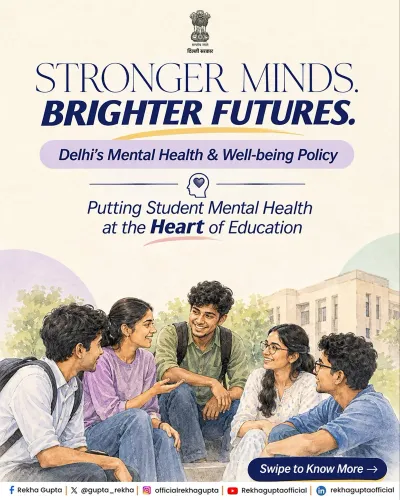
Delhi Chief Minister Rekha Gupta has announced the capital's first Mental Health & Well-being Policy, extending dedicated counselling and round-the-clock mental health support to over 45 lakh students — a landmark step in state-level operationalisation of India's national mental health framework.
Key Takeaways
Delhi's first dedicated Mental Health & Well-being Policy has been announced by Chief Minister Rekha Gupta .
The policy extends dedicated counselling and 24×7 mental health support to 45 lakh-plus students across Delhi schools.
The initiative builds on a national policy lineage: India's National Mental Health Policy (2014) , the Mental Healthcare Act (2017) , and the central Manodarpan scheme (2020) .
Delhi becomes one of several Indian states to institutionalise school-level mental health support, but the first in the capital to do so through a standalone policy.
Implementation details — counsellor hiring, helpline launch, school integration, and budget provisions — are yet to be publicly detailed.
Forty-five lakh students across Delhi just got a policy built around them. Delhi Chief Minister Rekha Gupta announced on Thursday, 19 November 2026 that the capital now has its first dedicated Mental Health & Well-being Policy — bringing structured counselling and round-the-clock mental health support to the city's school population.
What Delhi's first Mental Health Policy promises students
The policy commits to dedicated counselling services and 24×7 mental health support for 45 lakh-plus students enrolled in Delhi schools. Announcing the initiative on X, CM Gupta framed it in unambiguous terms: 'Mental health isn't an afterthought. It's a priority.' The #ViksitDelhi ('Developed Delhi') hashtag ties the initiative to a broader governance vision for the capital's growth.
The policy covers dedicated counsellor deployment and always-on helpline access — a significant operational step given the sheer scale of Delhi's school ecosystem. What the rollout timeline, hiring pipeline, and budget allocation look like in practice will be the real test of delivery.
From national frameworks to state-level action
Delhi's move sits within a clear national arc. India adopted its National Mental Health Policy in 2014, followed by the Mental Healthcare Act in 2017 — legislation that formally protected the rights of persons with mental illness and mandated expanded services. When the pandemic hit, the Ministry of Education launched Manodarpan in 2020, a central portal offering psychosocial support and counselling to students navigating COVID-19 disruption.
State governments have progressively built on that foundation. Several now integrate counselling directly into school systems rather than relying solely on central portals. Delhi's announcement is a state-level operationalisation of that same national priority — but as the first standalone policy dedicated to student mental health in the capital, it sets a new institutional marker for the city.
Why student mental health became a Delhi priority
India's student mental health crisis has been building for years, amplified sharply by the pandemic's disruption of school routines, peer interaction, and academic continuity. Post-COVID data across Indian cities documented a steep rise in adolescent anxiety, depression, and academic stress. Delhi, with one of the country's largest urban school populations, was squarely in that pressure zone.
Routing dedicated support through a formal state policy — rather than ad hoc school programmes — signals an intent to institutionalise care rather than treat it as an emergency measure. Whether the counsellor workforce, infrastructure, and helpline capacity can match the ambition of 45 lakh-plus beneficiaries will determine whether the policy translates into ground-level change.
Every conversation about a student's anxiety that now has somewhere to go is a small but concrete win. The harder question Delhi will have to answer: how fast, and how evenly, that net actually spreads.
Point of View
CM Rekha Gupta positions the BJP-led Delhi government within the mainstream of post-pandemic state governance. It also stakes out differentiated ground from prior Delhi administrations that leaned heavily on infrastructure and education metrics. The real political test will come at implementation: a 45-lakh coverage claim needs counsellors, budget lines, and a helpline that actually answers — the gap between announcement and delivery has historically been where such policies stall. If Delhi can demonstrate measurable rollout, the policy could become a replicable template for other state governments looking to operationalise national mental health commitments at scale.
NationPress
19 Nov 2026
Frequently Asked Questions
What is Delhi's Mental Health & Well-being Policy?
It is Delhi's first dedicated policy for student mental health, announced by Chief Minister Rekha Gupta, promising counselling services and 24×7 mental health support for over 45 lakh students in Delhi schools.
How many students will benefit from Delhi's new mental health policy?
The policy is targeted at over 45 lakh students across Delhi's school system.
What is the Manodarpan scheme and how is it related?
Manodarpan is a central government initiative launched by the Ministry of Education in 2020 to provide psychosocial support and counselling to students, primarily during the COVID-19 pandemic. Delhi's new state policy builds on this national framework but institutionalises support at the state level through a standalone policy.
When was India's National Mental Health Policy adopted?
India adopted its National Mental Health Policy in 2014 , followed by the Mental Healthcare Act in 2017 , which together form the national framework that state-level policies like Delhi's are built upon.
What are the next steps for Delhi's Mental Health & Well-being Policy?
Key implementation steps to watch include the launch of a dedicated helpline, the hiring and deployment of school counsellors, integration with existing school infrastructure, and budget allocations in upcoming Delhi assembly sessions.