White House Says Trump Is Reviving the American Dream
Synopsis
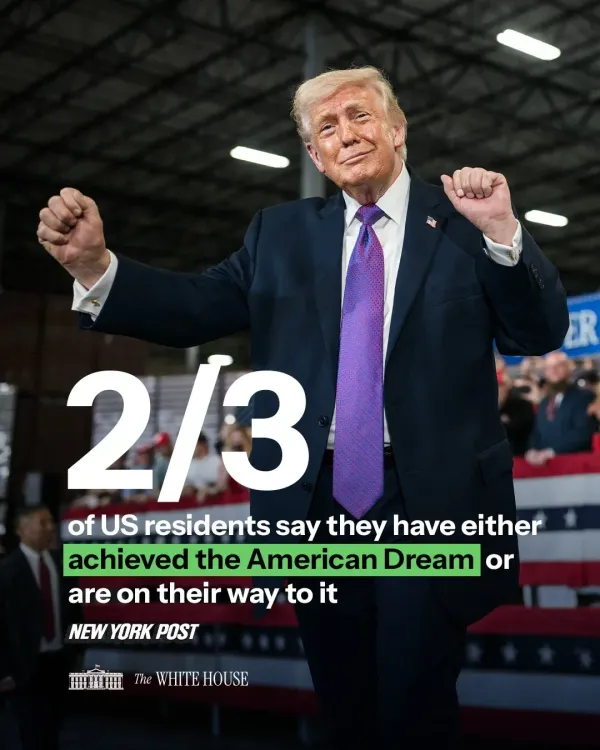
The White House declared on 1 July 2026 that President Donald J. Trump is reviving the American Dream. The post echoes the administration's long-running strategy of framing tax reform, deregulation, and trade policy as tools to restore economic mobility for working and middle-class Americans.
Key Takeaways
The White House posted on 1 July 2026 that President Donald J.
Trump is 'bringing back the AMERICAN DREAM.' The phrase has been a consistent rhetorical anchor for the Trump administration across both terms, linked to tax reform, deregulation, and trade protectionism.
Trump's first-term Tax Cuts and Jobs Act (2017) was the flagship legislative vehicle tied to this economic-mobility framing.
Key stakeholders identified by the administration are American middle-class families and working households .
Policy watchers expect follow-up action on housing affordability , energy production , and immigration enforcement under this banner.
The White House, the official communications account of the Executive Office of the President of the United States, posted on X on 1 July 2026 that President Donald J. Trump is 'bringing back the AMERICAN DREAM,' accompanied by the American flag emoji.
Context
The phrase 'American Dream' has long served as shorthand in United States political discourse for economic mobility, homeownership, and the promise that hard work yields prosperity. The White House's invocation of the term signals the administration's intent to frame its governing agenda around restoring that sense of opportunity for working and middle-class Americans.
Under Trump's first term as the 45th President (2017–2021), the administration repeatedly used the same framing to anchor major legislative and executive moves, from tax reform to trade policy.
Policy Backdrop
The most significant legislative milestone of Trump's first term tied to this rhetoric was the Tax Cuts and Jobs Act, signed in 2017, which reduced corporate tax rates and was presented by the administration as a mechanism to stimulate wage growth and domestic investment.
Beyond tax reform, the administration pursued deregulation, energy production expansion, and tighter immigration enforcement — each packaged, in White House communications, as tools to protect American workers and restore upward mobility. The current post continues that established pattern of messaging.
Stakeholders and Impact
American middle-class families and working households are the stated beneficiaries of the agenda the White House is signalling. For these groups, the 'American Dream' framing typically translates into policy debates around housing affordability, wage levels, job creation, and access to quality education.
The post, while brief, is consistent with a broader White House communications strategy of using high-visibility social media moments to reinforce the administration's core economic identity ahead of potential legislative or executive action.
What's Next
Analysts and policy watchers will look for follow-up executive actions or legislative proposals — particularly on housing affordability, domestic energy production, and immigration enforcement — that the administration may formally tie to its 'American Dream' restoration narrative.
Whether this post precedes a specific policy announcement or serves as broader brand reinforcement, it sets the rhetorical tone for the administration's public positioning as it moves through the second half of 2026.
Point of View
The administration retains maximum flexibility to attach the label to whatever legislative or executive move comes next. This mirrors the first-term playbook, where the same phrase was used to sell tax cuts, tariffs, and deregulation to overlapping but distinct voter coalitions. For observers in India and beyond, the signal matters because the policies that follow — on trade, energy, and immigration — carry direct implications for bilateral economic ties and global market sentiment.
NationPress
2 Jul 2026
Frequently Asked Questions
What did the White House say about the American Dream on 1 July 2026?
The White House posted on X that President Donald J. Trump is 'bringing back the AMERICAN DREAM,' accompanied by the American flag emoji, signalling the administration's economic-revival agenda.
What does 'American Dream' mean in the context of Trump's policies?
In Trump administration usage, the 'American Dream' refers to economic mobility, job creation, and national prosperity achieved through tax reform, deregulation, trade protectionism, and energy expansion — policies aimed primarily at working and middle-class Americans.
What was Trump's biggest economic policy tied to the American Dream?
The Tax Cuts and Jobs Act, signed in 2017 during Trump's first term, was the flagship measure — reducing corporate tax rates and framed as a way to boost wages and domestic investment.
What policies might follow the White House's American Dream post?
Analysts expect the administration to announce follow-up actions on housing affordability, domestic energy production, and immigration enforcement, each framed under the 'American Dream' restoration narrative.
Why does the White House's American Dream messaging matter for India?
Policies the Trump administration ties to this agenda — including trade tariffs, energy exports, and immigration rules — directly affect Indian businesses, the Indian-American community, and India-US bilateral economic relations.