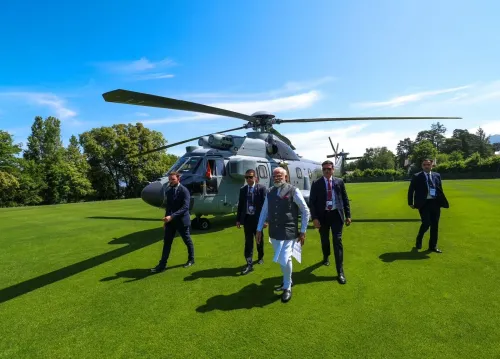
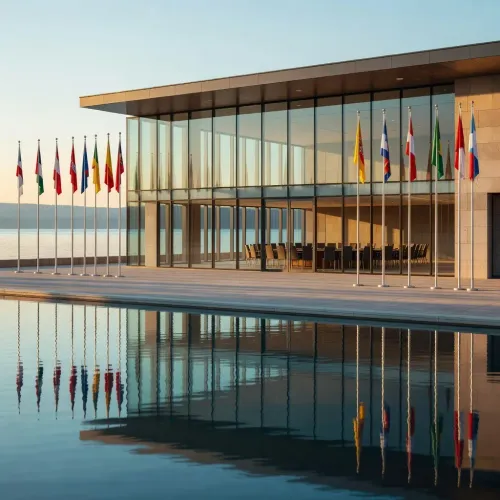
White House Hails G7 Summit in Evian as Return of American Strength

Synopsis
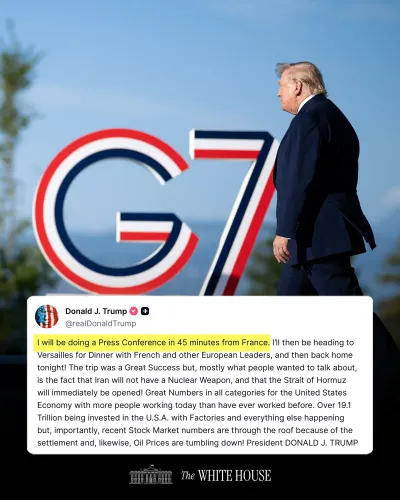
The White House on 18 June 2026 declared the G7 Summit in Evian, France a success, invoking 'the return of American strength' and promising real results from strong US leadership at the annual gathering of major advanced economies.
Key Takeaways
The White House declared the 2026 G7 Summit in Evian, France a success on 18 June 2026 .
The official statement used the phrase 'RETURN OF AMERICAN STRENGTH,' signalling an assertive US foreign-policy posture.
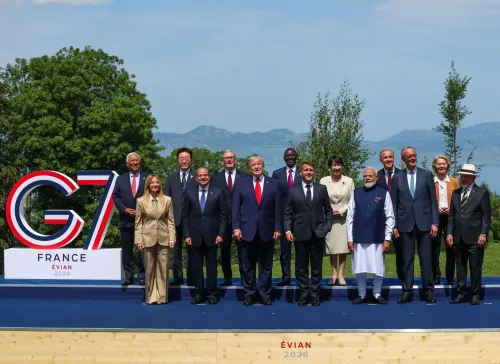
The G7 groups the United States, Canada, France, Germany, Italy, Japan and the United Kingdom for annual coordination on economic and security issues.
Evian previously hosted a major multilateral summit in 2003 , when the G8 addressed Iraq, non-proliferation and African development.
The official G7 communiqué and details of bilateral side meetings are expected to follow the summit's conclusion.
India's engagement with G7 nations across trade, technology and defence makes the summit's outcomes directly relevant to New Delhi.
The White House, the official communications account of the Executive Office of the President of the United States, declared the G7 Summit in Evian, France a success on Thursday, 18 June 2026, framing the gathering as a demonstration of renewed American global leadership.
Context
The post, shared by the White House on 18 June 2026, stated: 'A successful G7 Summit in Evian, France. Strong leadership. Real results. The RETURN OF AMERICAN STRENGTH.' The language was pointed and deliberate, invoking a narrative of resurgence that the current administration has consistently promoted in its foreign-policy messaging.
The G7 — comprising the United States, Canada, France, Germany, Italy, Japan and the United Kingdom — meets annually to coordinate on global economic governance, security and political challenges. France is a longstanding host nation; Evian, the lakeside resort in the Auvergne-Rhône-Alpes region, previously hosted a major summit in June 2003, when the G8 addressed Iraq reconstruction, nuclear non-proliferation and African development.
Policy Backdrop
US administrations have historically used G7 communiqués to signal alignment or divergence with European partners on trade, energy security and China policy. The current White House's framing of 'American strength' fits a broader pattern in which Washington portrays multilateral engagement not as consensus-building but as an arena for demonstrating national resolve.
The G7 process itself dates to the 1975 Rambouillet summit, convened by six nations to manage floating exchange rates and recession in the aftermath of the oil shock. Over five decades, the forum has evolved into the primary platform for advanced-economy leaders to coordinate responses to crises ranging from financial contagion to pandemic preparedness and climate finance.
Stakeholders and Impact
The communiqué and any bilateral side meetings held on the margins of the Evian summit will be closely watched by US foreign-policy officials, European governments and Asian allies alike. For India, which engages with G7 nations across trade, technology and defence corridors, the tone and substance of any joint statement will carry direct implications for ongoing negotiations on critical minerals, digital trade and the Global South agenda.
The White House's emphasis on 'real results' suggests the administration will point to concrete deliverables — whether on tariffs, defence burden-sharing or development finance — rather than procedural consensus. How European partners characterise those same outcomes will determine whether the summit is read as a genuine alignment or a managed divergence.
What's Next
The release of the official G7 communiqué will be the immediate test of the White House's claims. Analysts will scrutinise language on China trade policy, Ukraine support and climate finance to assess whether the summit produced the substantive alignment the administration is projecting. Any announced bilateral meetings between the US president and G7 counterparts on the sidelines will also signal the depth of Washington's re-engagement with the multilateral order.
For global markets and diplomatic observers, the Evian summit's legacy will ultimately be written not by a social-media post but by the policy follow-through in the weeks ahead.
Point of View
The language will be parsed carefully: 'real results' may imply Washington extracted concessions rather than built consensus. The communiqué's actual text will reveal whether this confidence is matched by substantive policy alignment.
NationPress
18 Sept 2026
Frequently Asked Questions
What happened at the G7 Summit in Evian in 2026?
The White House declared the G7 Summit in Evian, France a success on 18 June 2026, stating it produced 'strong leadership' and 'real results,' though the full communiqué details are awaited.
Where is Evian and why was the G7 held there?
Evian is a lakeside resort town in the Auvergne-Rhône-Alpes region of France. France, a G7 member, hosted the summit; Evian previously held a major multilateral summit in 2003.
What is the G7 and which countries are members?
The G7 is a group of major advanced economies — the United States, Canada, France, Germany, Italy, Japan and the United Kingdom — that meets annually to coordinate on global economic, security and political issues.
What does 'return of American strength' mean in the context of the G7?
The phrase is the White House's characterisation of the US role at the Evian summit, suggesting a more assertive American posture in multilateral diplomacy after a period the administration frames as retrenchment.
How does the G7 summit affect India?
India engages with all G7 nations across trade, technology and defence; outcomes on tariffs, critical minerals, digital trade and development finance at Evian carry direct implications for New Delhi's bilateral and multilateral negotiations.