White House Unveils Ratepayer Protection Pledge on Data Centers

Synopsis
The White House unveiled the Ratepayer Protection Pledge on July 25, 2026, committing that the surge in US data center construction driven by AI and cloud computing will reduce — not increase — electricity bills for American households, setting up a new federal framework for grid-cost allocation.
Key Takeaways
The White House announced the Ratepayer Protection Pledge on July 25, 2026 .
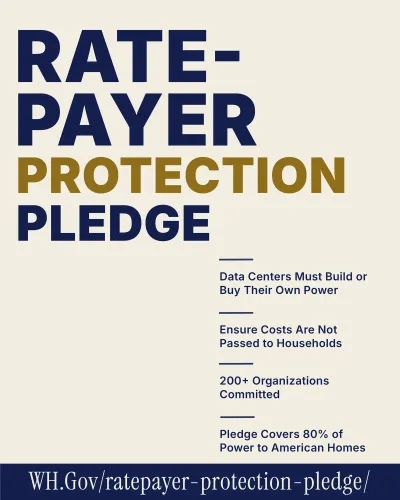
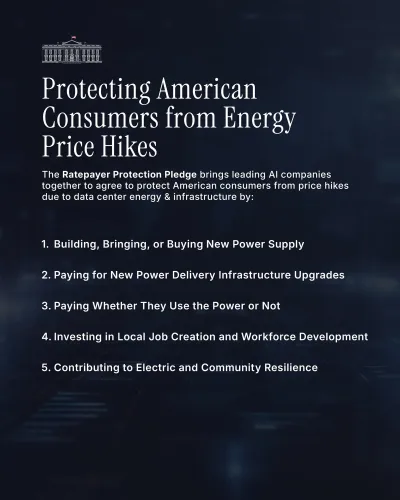
The pledge aims to ensure that new data center construction does not raise electricity bills for American families .
AI and cloud-computing expansion has sharply increased projected electricity demand across multiple US regions.
The Infrastructure Investment and Jobs Act of 2021 had earlier authorised grid modernisation funding, providing the legislative backdrop.
Key decisions on cost allocation will be made by state utility commissions in upcoming rate-design proceedings.
Specific provisions, enforcement mechanisms, and metrics of the pledge have not yet been publicly detailed.
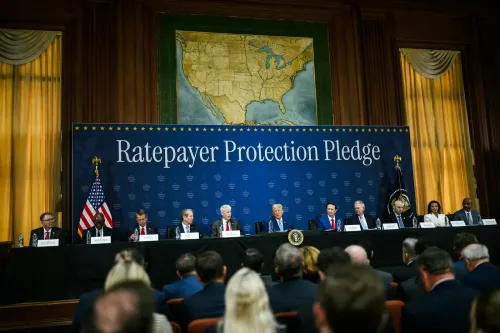
The White House announced the Ratepayer Protection Pledge on Saturday, July 25, 2026, positioning the initiative as a guarantee that the construction of new data centers across the United States will not drive up electricity bills for American households.
Context
The pledge arrives as the rapid expansion of hyperscale data centers — the vast server farms that power cloud computing and artificial intelligence workloads — has begun placing measurable new strain on regional power grids. The White House framed the initiative as 'a fair deal for everybody,' promising that as new data centers go up, 'electricity bills for American families come down.'
The statement signals a deliberate effort by the executive branch to put residential consumers at the centre of the energy-infrastructure debate, a space previously dominated by negotiations between utilities and large commercial users.
Policy Backdrop
The Infrastructure Investment and Jobs Act of 2021 had already authorised federal funding for electric grid modernisation, anticipating rising demand from multiple sectors. The Ratepayer Protection Pledge builds on that legislative foundation by addressing a more specific and politically sensitive question: who pays for the grid upgrades necessitated by data center growth.
AI-driven demand has sharply lifted electricity consumption forecasts in several US regions, prompting state utility commissions to revisit rate-design rules that traditionally spread infrastructure costs broadly across all customer classes. Without explicit protections, residential consumers risk absorbing a disproportionate share of costs generated by large commercial facilities.
The pledge is the executive branch's most direct response yet to that cost-allocation debate, though the specific provisions, enforcement mechanisms, and metrics attached to the initiative have not yet been detailed in public filings.
Stakeholders and Impact
Residential ratepayers stand to benefit most directly if the pledge is implemented effectively, shielding household electricity bills from infrastructure surcharges tied to commercial data center construction. Data center operators — including major cloud and AI companies — may face pressure to bear a larger share of grid-upgrade costs under any rules that flow from the pledge.
Electric utilities occupy a pivotal middle position: they must finance grid expansion while balancing the interests of regulators, large commercial customers, and millions of residential consumers. State public utility commissions will ultimately translate the pledge's principles into binding rate structures, making their upcoming proceedings a critical arena to watch.
What's Next
The practical impact of the Ratepayer Protection Pledge will hinge on follow-through at the state level, where utility commissions hold authority over rate design and cost allocation. Federal or congressional action on energy infrastructure financing could reinforce or complicate the initiative's goals.
Observers will be watching whether the pledge is accompanied by executive orders, regulatory guidance, or proposed legislation that gives it enforceable teeth — and how data center operators and utilities respond to any binding cost-allocation requirements that may follow.
Point of View
The White House is attempting to align a pro-technology agenda with working-family economics. The real test will come at state utility commissions, where the pledge's principles must be converted into binding rate structures — a process that data center operators and utilities will contest vigorously. If enforcement mechanisms prove weak, the pledge risks becoming symbolic rather than substantive, a distinction that regulators and consumer advocates will press hard on.
NationPress
26 Jul 2026
Frequently Asked Questions
What is the Ratepayer Protection Pledge?
The Ratepayer Protection Pledge is a White House policy initiative announced on July 25, 2026, designed to ensure that the construction of new data centers in the United States does not increase electricity bills for residential consumers.
Why are data centers affecting electricity bills in the US?
Hyperscale data centers that power AI and cloud computing consume large amounts of electricity, placing new strain on regional power grids and potentially triggering infrastructure upgrade costs that utilities could pass on to all customers, including households.
How will the Ratepayer Protection Pledge be enforced?
Enforcement will largely depend on state utility commissions, which have authority over rate design and cost allocation. Federal regulatory guidance or legislation may follow, but specific mechanisms have not yet been publicly detailed.
Who benefits from the Ratepayer Protection Pledge?
Residential electricity consumers are the primary intended beneficiaries. Data center operators may face pressure to shoulder a greater share of grid-upgrade costs rather than having those costs spread across all ratepayers.
What law provides the federal backdrop for US grid upgrades?
The Infrastructure Investment and Jobs Act of 2021 authorised federal funding for electric grid modernisation to meet rising demand, providing the legislative foundation on which initiatives like the Ratepayer Protection Pledge build.